

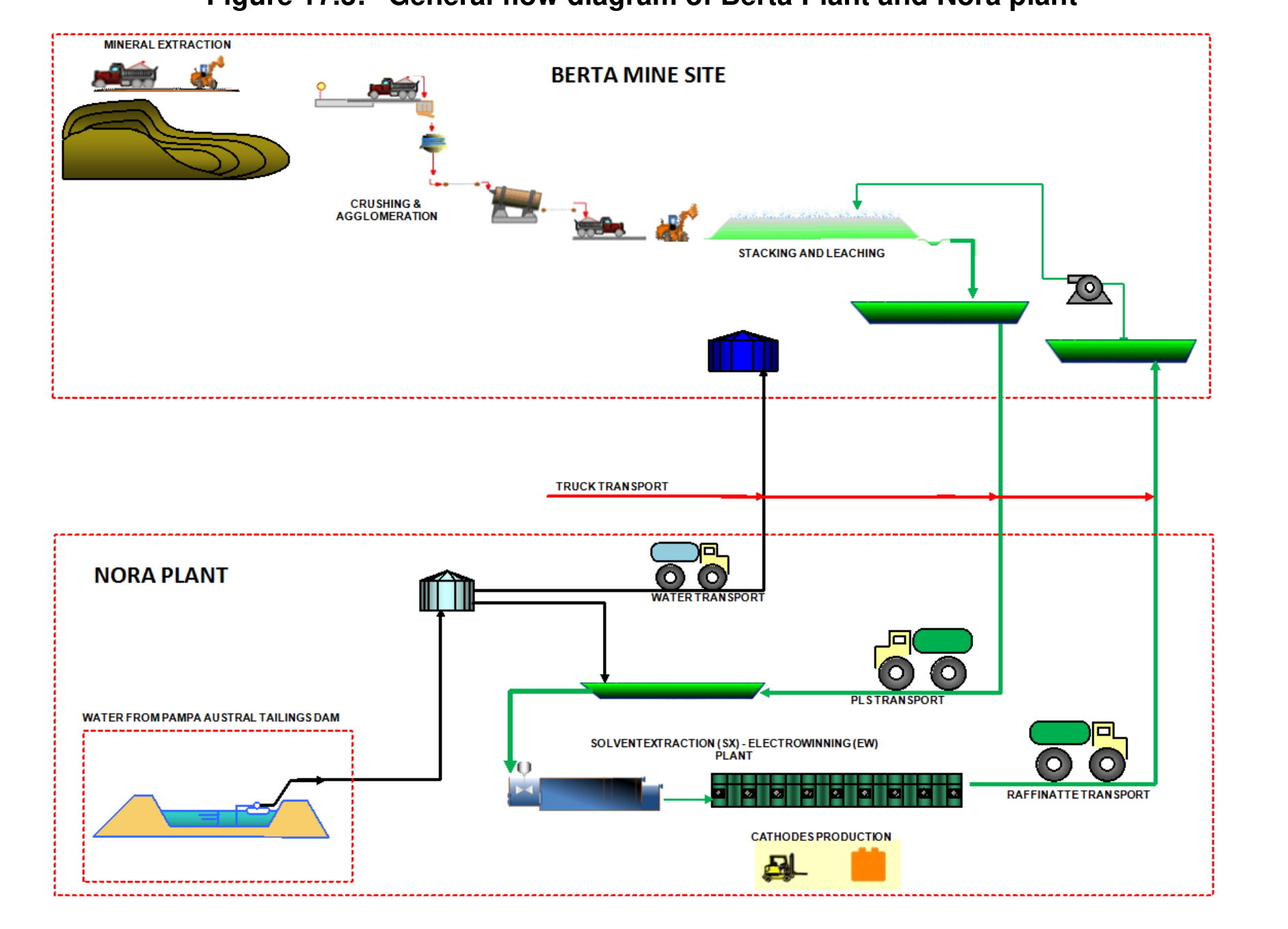
The 2014 preliminary economic assessment for Coro Mining's Berta copper oxide project near Inca de Oro describes 1.0 Mt/y of crushed and agglomerated heap leach ore, 1.2 Mt/y of ROM dump leach material, and 5,000 t/y of cathode from an expanded SX-EW plant 60 km away.
Berta is an open pit copper oxide project at the Inca de Oro area of Chile's III Region, with mine site facilities about 15 km west of the village of Inca de Oro at an elevation of 1,700 m. Coro Mining Corp. is the issuer of the report, a preliminary economic assessment (PEA) with an effective date of October 28, 2014, signed by Sergio Alvarado. The project is designed to produce 5,000 tonnes of copper a year as high-concentration pregnant leach solution (PLS). Trucks carry the PLS to the existing Nora plant, 60 km from the Berta site and 5 km from the town of Diego de Almagro, where solvent extraction and electrowinning (SX-EW) makes cathodes of 99.99% purity. Copper oxide ore is treated by heap leaching at a capacity of 1 million tonnes a year, and 1.2 million tonnes a year of run-of-mine (ROM) material goes directly to dump leach pads.
Critical Data
| Parameter | Value | Unit | Notes |
|---|---|---|---|
| Heap leach capacity | 1.0 | Mt/y | Crushing, agglomeration, permanent pads |
| ROM dump leach | 1.2 | Mt/y | Directly onto pads |
| Feed grade | 0.57 | % CuT | Average of open pit material |
| Heap/dump cut | 0.30 | % CuT | Above to heap, below to dump |
| Crushed product | Under 1/2 | in | Three stages in reverse closed circuit |
| Crushed ore stockpile | 1,025 | t | Capacity |
| Agglomeration drum | 250 | t/h | Acid and water |
| Heap leach recovery | 78 | % | Of total copper |
| Heap leach cycle | 60 | days | Four sub-cycles of 15 days |
| ROM leach recovery | 45 | % | Of total copper |
| ROM leach cycle | 40 | days | Two sub-cycles of 20 days |
| Leach pad area | 24 | ha | 600 m x 400 m |
| PLS grade | 18 | g/L Cu | 35 m3/h |
| Irrigation rate | 10 to 12 | L/h/m2 | Drippers preferred |
| SX-EW cathode capacity | 5,000 | t/y | Expanded from 3,000 t/y |
Overview
Berta's flowsheet is a leach-and-truck design. Oxide ore is crushed in three stages, agglomerated with sulphuric acid and water, stacked on lined pads and leached in a counter-current irrigation scheme. Lower grade material is leached as ROM stockpiles. The resulting PLS is carried by tanker trucks to the existing Nora plant for SX-EW, and an equal volume of raffinate is carried back to Berta.
Key Process Stages
Crushing
Open pit material averaging 0.57% total copper (CuT) is trucked to the crushing plant. It drops from a mine truck into a primary hopper with a grizzly vibrating screen that separates material over 3 inches for the primary jaw crusher. A double deck screen and standard cone crusher make the secondary stage, sending 1 inch oversize to the crusher and undersize on to the third stage. The tertiary stage has two double deck screens and two short head cone crushers in reverse closed circuit, and material over 1/2 inch is recirculated. The final product goes by conveyor to a 1,025 t stockpile. Dry haze type dust suppressants, chutes at transfers and covers on conveyors control emissions.
Agglomeration
A 250 t/h agglomeration drum mixes the oxide material with sulphuric acid and water. This starts leaching and makes fines stick to larger particles, which improves heap permeability. Transport and repose time before irrigation allow the fine and coarse particles to bind for mechanical strength during leaching.
Stacking and leaching
Oxide material above 0.30% CuT is heap leached and material below it goes directly to the dump leach area. The heaps cover 24 ha, 600 m by 400 m, on compacted ground lined with 300 g/m2 geotextile and covered with 1.5 mm HDPE. Agglomerated material is stacked in 3 m high truncated pyramids and is expected to recover 78% of the copper in a 60 day cycle. Irrigation is counter-current, with three intermediate leach solutions (ILS) producing a final PLS of 18 g/L copper. A new module is irrigated for 15 days each with ILS 3, ILS 2, ILS 1 and raffinate, and drainage is routed to the next pool, with the first drainage being PLS. ROM leaching uses 10 m high stockpiles on a 40 day cycle of two 20 day sub-cycles and is expected to recover 45%. Four passive wells downstream of the stockpile and solution pools detect leakage, and a fifth upstream well is the reference.
Nora SX-EW plant
The Nora plant would be expanded from its present 3,000 t/y to 5,000 t/y of cathode. It receives PLS in an existing pond, and five FRP mixer-decanter tanks in a 15 m by 48 m container can run in series or in parallel. In extraction, copper moves from the PLS into the organic phase and the acidic raffinate goes to the two existing raffinate ponds, each 20 m by 20 m by 3 m deep. Water trucks carry it back to Berta. In re-extraction, the loaded organic meets high-acid poor electrolyte returning from electrowinning, which reverses the reaction and makes loaded electrolyte for cathode production.
Additional Interesting Data and Summary
The plant design reports average feed of 0.57% CuT for the heap leach stage. The report presents the flow diagram of the Berta plant with its mass balances, followed by separate diagrams for crushing, agglomeration and the leach circuit, including the ILS, raffinate and emergency ponds, the solution transport system and the leaching pad.
The solution exchange between sites is part of the design: PLS of 35 m3/h at 18 g/L copper goes to Nora, and an equal volume of raffinate returns to be stored in the raffinate pond at Berta.
Key Processes
- Three-stage crushing in reverse closed circuit
- Acid agglomeration in a drum
- Lined heap leaching with counter-current irrigation
- Run-of-mine dump leaching
- Trucked transfer of pregnant leach solution and raffinate
- Solvent extraction in five mixer-decanters
- Copper electrowinning to 99.99% cathode
Source: Preliminary Economic Assessment for the Berta Project Inca de Oro, III Region, Chile, October 28, 2014.
