

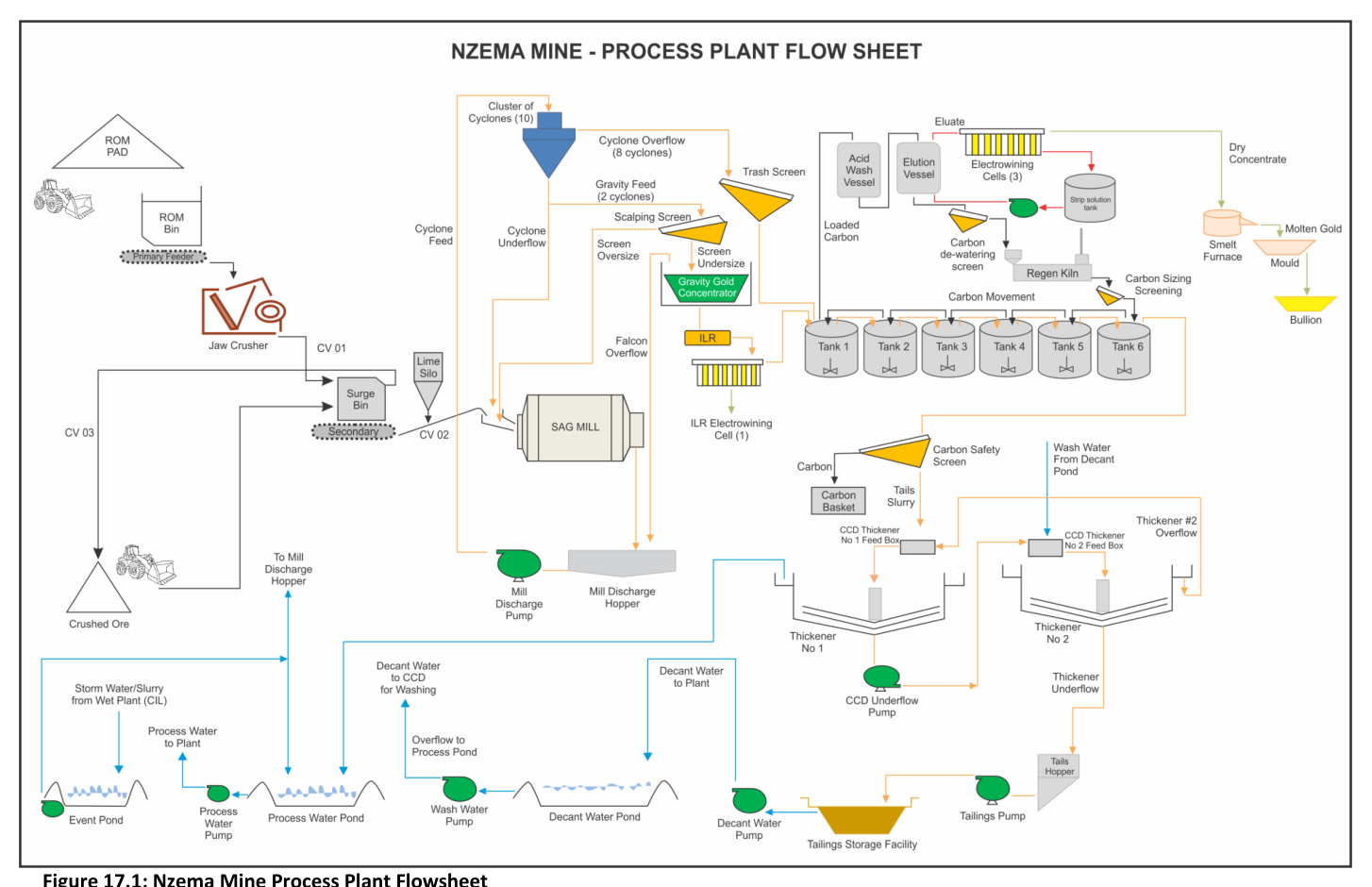
The April 2013 technical report on the Nzema gold mine describes a plant running since February 2011 at 2.1 Mtpa, with single stage jaw crushing, a SAG mill in closed circuit with ten cyclones, a Zadra elution circuit and two-stage CCD thickening of tails.
Nzema is a gold mine in Ghana, West Africa, reported by Endeavour Mining Corporation in its Technical Report and Mineral Resource and Reserve Update dated April 2, 2013. The processing plant is designed to treat oxide, transition and primary ores from the various pits. The design throughput depends on ore hardness, at 2.1 Mtpa of softer oxide ore and 1.6 Mtpa of the harder transition and fresh ore. The plant has operated since February 2011 and reached commercial production in April 2011. Between July 2011 and July 2012 the average monthly throughput was 175,859 dry tonnes, which meets the design 2.1 Mtpa. The mill treats an average 5,843 tpd, equal to 2.13 Mtpa, at a reconciled grade of 1.66 g/t, and plant availability was 92.1% in the same period.
Critical Data
| Parameter | Value | Unit | Notes |
|---|---|---|---|
| Design throughput, oxide | 2.1 | Mtpa | Softer ore |
| Design throughput, transition and fresh | 1.6 | Mtpa | Harder ore |
| Current average rate | 5,843 | tpd | 2.13 Mtpa at 1.66 g/t |
| Plant availability | 92.1 | % | July 2011 to July 2012 |
| Crusher product | 110 | mm P80 | Single toggle jaw crusher |
| Emergency stockpile | About 30,000 | t | Five days of crushed ore |
| SAG mill | 3.5 | MW | 5.5 m x 7.32 m EGL |
| Cyclones | 10 | Not applicable | Maximum eight in use |
| Mill feed rate | 290 | dry t/h | By a 320 m conveyor |
| Grind size | 106 | µm P80 | 80% to 86% passing |
| Gravity concentrator | Falcon 5200 | Not applicable | Plus Gekko in-line leach reactor |
| CIL tanks | 6 | x 2,000 m3 | Average live volume 1,890 m3 |
| Carbon concentration | 10 to 15 | g/L pulp | 0.8 mm retention screens |
| CIL efficiency | 85 to 87 | % | Year to date |
| Elution | 6 | t Zadra | About 7 strips a day |
| Cyanide consumption | 0.47 | kg/t | First year average |
Overview
The treatment plant flowsheet is based on single stage crushing, single stage SAG milling, gravity recovery of free gold from a portion of the cyclone underflow, and a six-stage carbon-in-leach (CIL) circuit that treats cyclone overflow. The circuit also includes a counter-current decantation (CCD) circuit for recovering cyanide from tails slurry. The stripping plant is a six tonne Zadra elution circuit with electrowinning, high-pressure spray removal of gold from the stainless cathodes, and smelting to doré bullion.
Key Process Stages
Crushing and stockpile
Ore is trucked from the Salman and Adamus pits to the ROM pad and reclaimed by front-end loader into the ROM bin, which has an 800 mm static grizzly, a fine chute, a primary feeder and a single toggle jaw crusher. The crusher makes a P80 of 110 mm, conveyed to the surge bin by a 400 t/h discharge conveyor. If the crusher breaks down, a front-end loader reclaims ore from a five-day emergency stockpile of about 30,000 tons of crushed ore.
Grinding and classification
A 3.5 MW SAG mill, 5.5 m in diameter with an effective grind length of 7.32 m, runs in closed circuit with a cluster of 10 hydrocyclones. A 320 m long conveyor feeds it at 290 dry tons per hour, and the mill is run to a P80 of 106 µm as feed for leaching. Plant records show grind passing 106 µm of 80% in the second half of 2011 and 85% in 2012.
Gravity concentration
The gravity circuit has a Falcon 5200 centrifugal concentrator, a Gekko in-line leach reactor and a dedicated electrowinning circuit. It is fed by underflow from two cyclones, about 10% to 20% of cyclone feed. Gravity recovery from Salman ore is currently 10% to 15%, and Adamus ore is expected to be 25% to 30% gravity recoverable gold.
Carbon in leach
Six tanks of 2,000 m3 capacity are fed by gravity from the cyclone overflow of at most eight hydrocyclones, with counter-current carbon advancement by air lifts. A trash screen removes wood chips, plastics and grit larger than about 0.63 mm. The mechanically agitated tanks each hold a batch of carbon at 10 to 15 grams per litre. Gold in the aqueous phase leaves the last tank at an average of 0.001 to 0.008 ppm. First-year averages were pH 10.2, dissolved oxygen 6.1, cyanide consumption 0.47 kg/t, lime 2.01 kg/t and a grind of 86% passing 106 µm. Overall plant recovery has generally declined but stayed above target, because of progressively more Salman Trend transitional ore. Mining the non-refractory Adamus ore is expected to help.
Elution and gold recovery
About 6.5 t of carbon a day is recovered from the CIL head tank, acid washed with dilute hydrochloric acid to remove carbonates, and stripped by the Zadra process with sodium hydroxide and sodium cyanide. The circuit has averaged seven strips a day at an average carbon loading of 1,500 ppm and barren carbon below 90 ppm, giving about 95% strip efficiency. Gold is electrowon, the cathode material is filter pressed and calcined, and the gold is smelted in a diesel-fired furnace to make doré. A horizontal kiln regenerates carbon, whose average activity is 88% of virgin carbon.
Cyanide recovery
Tailings from CIL tank 6 pass a vibrating carbon safety screen and go to a two-stage counter-current thickening circuit that recovers water and cyanide, with decant return dilution to bring free cyanide to tails below 50 ppm and ensure WAD cyanide compliance.
Additional Interesting Data and Summary
Monthly operating statistics from July 2011 to July 2012 show milled tonnes of 144,660 to 178,062 dry tonnes, milled rates of 221 to 263 dry t/h and reconciled grades of 1.61 to 1.92 g/t. Power outages affected plant availability, and an on-site power plant was being installed.
The report states that the ROM bin has a capacity of 80 t/h and that the apron feeder, designed for 346 wet tonnes, is achieving 400 wet tonnes per hour.
Key Processes
- Single toggle jaw crushing with a static grizzly
- Single stage SAG milling in closed circuit with cyclones
- Falcon gravity concentration with in-line leach reactor
- Six-stage carbon in leach with trash screening
- Acid washing, Zadra elution, electrowinning and smelting
- Two-stage CCD thickening for cyanide recovery
Source: Technical Report and Mineral Resource and Reserve Update for the Nzema Gold Mine, Ghana, West Africa, April 2, 2013.
