

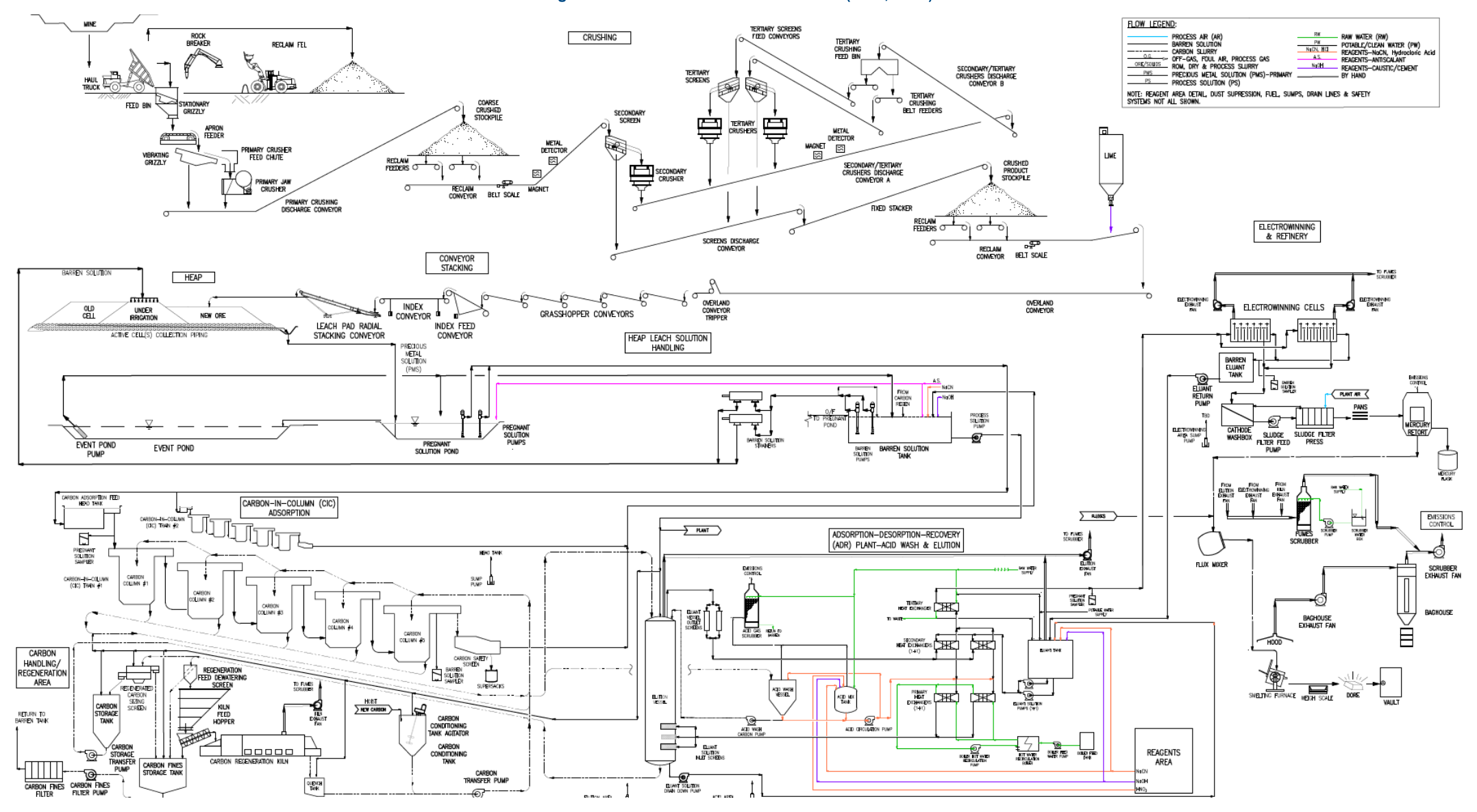
The March 2025 preliminary economic assessment for the Mercur gold project in Utah describes crushing to minus 1/2 inch, lime addition at 1.8 lb per ton, stacking in 33-foot lifts with grasshopper conveyors, carbon adsorption and 75% gold recovery.
Mercur is a gold project in Tooele and Utah Counties, Utah, USA, covered by an NI 43-101 Technical Report on the Mercur Gold Project, a preliminary economic assessment (PEA) prepared by Kappes, Cassiday & Associates and RESPEC for Revival Gold Inc. and dated March 2025. Test work results to date indicate that the minable mineral resource, which includes pits at Main Mercur and South Mercur, is amenable to cyanide leaching for gold recovery. The minable resource is 72.3 million tons, of which 62.6 million tons are at Main Mercur and 9.8 million tons at South Mercur. At the established processing rate of 20,000 tons per day, the project has an estimated life of 10 years.
Critical Data
| Parameter | Value | Unit | Notes |
|---|---|---|---|
| Minable resource | 72.3 | million tons | 62.6 Mt Main Mercur, 9.8 Mt South Mercur |
| Processing rate | 20,000 | tons/day | 18,144 tonnes/day; 7,300,000 tons per year |
| Project life | 10 | years | At the stated rate |
| Crushing rate | 1,111 | tons/h | 75% availability, 365 days/year |
| Crusher feed scalp | 4.0 | in | Vibrating grizzly |
| Primary jaw closed side setting | 6.9 | in | With rock breaker |
| Secondary cone closed side setting | 1 1/2 | in | Open circuit |
| Tertiary cone closed side setting | 1/2 | in | Closed circuit with two screens |
| Crushed product size | 100% minus 1/2 | in | 12.5 mm |
| Lime addition | 1.8 | lb/short ton | Belt weigh scale control |
| Lift height | 33 | ft | 10 m |
| Heap cell width | 260 | ft | Mobile conveyor stacking |
| Leach cycle | 80 | days | Dilute cyanide solution |
| Cyanide consumption | 0.36 | lb/short ton | Life of mine average |
| Gold recovery | 75 | % | Life of mine average |
| Stacking system availability | 80 | % | Design |
Overview
Mineralized material from Main Mercur and South Mercur is hauled to the central West Mercur processing site and crushed to 100% passing 1/2 inch (12.5 mm) at 20,000 tons per day using a three-stage closed crushing circuit. Lime is added for pH control before material is stacked in 33-foot (10 m) lifts and leached with dilute cyanide solution. Solution flows by gravity to a pregnant solution pond and is pumped to a carbon adsorption circuit. Gold loads onto activated carbon, is periodically stripped in a desorption circuit and recovered by electrowinning. The resulting sludge is treated in a retort to recover mercury before smelting to doré.
Key Process Stages
Crushing
The circuit is at West Mercur and is designed for 1,111 tons per hour. Haul trucks of 150 tons deliver ROM material directly to the crusher feed bin or to a ROM stockpile, from which a front-end loader feeds the bin. An apron feeder and vibrating grizzly scalp at 4.0 inches, sending oversize to a primary jaw crusher at a closed side setting of 6.9 inches, with a rock breaker. Undersize joins the jaw discharge conveyor and is stacked on a coarse crushed stockpile, reclaimed by two apron feeders. The reclaim conveyor has a cross-belt magnet and a metal detector that stops the conveyor and all upstream equipment if metal is sensed.
Secondary and tertiary crushing
The secondary circuit has a triple-deck screen with 3 inch, 2 inch and 1/2 inch decks and a standard cone crusher at 1 1/2 inch closed side setting in open circuit. Oversize above 1/2 inch goes to the cone crusher. The tertiary circuit has two triple-deck screens, with 3 inch, 1 inch and 1/2 inch decks, and short head cone crushers at a 1/2 inch setting in parallel and closed circuit. Screen undersize, minus 1/2 inch, is the final crushed product and is stockpiled. Conveyors are interlocked so that a trip stops all upstream equipment, and water sprays at transfer points limit dust.
Reclamation and stacking
Material is reclaimed from the crushed product stockpile by one of two belt feeders. Lime from a silo is metered onto the reclaim conveyor at an average of 1.8 lb per ton for pH control, and a cross-belt sampler takes a composite sample of the heap feed. The heap is built in 33-foot lifts in cells 260 feet wide using a mobile conveyor stacking system of ramp and standard grasshopper conveyors, an index feed conveyor, a horizontal index conveyor and a radial stacker. A maximum of 24 grasshopper and ramp conveyors is needed, depending on the area being stacked. Each has an onboard transformer and interlocked PLC, a strobe and horn alarm before start-up, pull-cords and emergency stops.
Leaching and gold recovery
Dilute cyanide solution leaches the heap over an 80 day cycle, with a life-of-mine average cyanide consumption of 0.36 lb per short ton. Pregnant solution reports to a pond and then the carbon adsorption circuit. Carbon is stripped periodically, gold is recovered by electrowinning, and the sludge is retorted to recover mercury before smelting.
Additional Interesting Data and Summary
Electric power will come from the grid, tied to the existing power line at the Main Mercur project site. An event pond manages contact solution from storm events and seasonal snow melt, and returns collected solution to the process as makeup as soon as practical.
The process design criteria call for crushing operation of 12 hours a shift, two shifts a day, seven days a week, 365 days a year, and a crusher availability of 75%.
Key Processes
- Primary jaw crushing with a grizzly and rock breaker
- Secondary cone crushing in open circuit
- Tertiary cone crushing in closed circuit with screens
- Lime addition on the reclaim conveyor
- Conveyor stacking of 33-foot heap lifts
- Dilute cyanide heap leaching
- Carbon adsorption, desorption and electrowinning
- Mercury retorting and doré smelting
Source: Preliminary Economic Assessment, NI 43-101 Technical Report on the Mercur Gold Project, Tooele & Utah Counties, Utah, USA, March 2025.
