

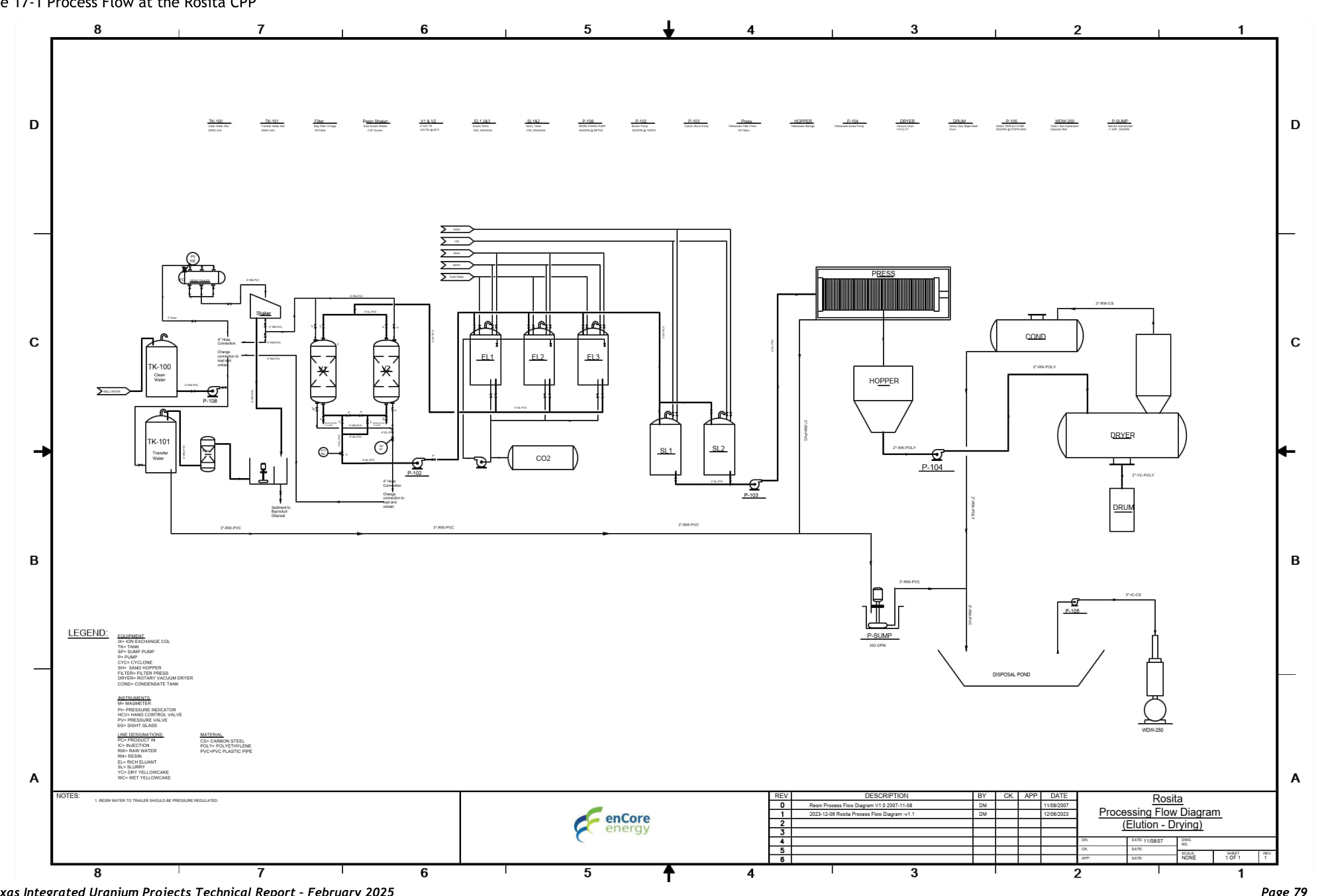
The February 2025 enCore Energy report on its South Texas integrated uranium projects describes a central processing plant for elution, precipitation, dewatering, drying and packaging, fed by resin trucked from satellite ion exchange facilities.
The Rosita Central Plant is part of enCore Energy Corp.'s South Texas integrated uranium projects in Texas, USA, described in a technical report dated February 2025. The design is for in situ recovery. A central processing plant (CPP) and satellite facilities collect and process uranium. The CPP is at the existing Rosita Central Plant property and handles elution, precipitation, dewatering, drying and packaging. Each satellite facility has an ion exchange (IX) circuit and a resin transfer system, so that loaded resin can be moved by truck from the satellite to the CPP. A preliminary design has been completed for the facilities and equipment.
Critical Data
| Parameter | Value | Unit | Notes |
|---|---|---|---|
| IX vessel resin batch | 300 | cubic feet | Anionic resin |
| Satellite module capacity | 800 | gpm nominal | Three tanks in series |
| Production flow per module | 800 to 1,000 | gpm | Water balance basis |
| Barren lixiviant uranium | Under 2 | ppm | Returned to the wellfield |
| Production bleed | 1 | % of flow | 8 to 10 gpm per module |
| Precipitation pH, first adjustment | 2 to 3 | pH | Hydrochloric acid |
| Precipitation pH, second adjustment | 4 to 5 | pH | Caustic soda |
| Precipitant | Hydrogen peroxide | Not applicable | Batch process, uranyl peroxide |
| Yellowcake dryer temperature | About 450 | °F | Thermal fluid in an external jacket |
| Drums | 55 | gallon steel | Shipped to a conversion facility |
| CPP fresh water | About 12 | gpm | Make-up and washdown |
| Restoration RO recovery | 75 | % | Two-stage, 25% concentrate to disposal |
| Fresh water demand | About 1.9 | gpm | From a well in a deeper aquifer |
Overview
Uranium is recovered from pregnant lixiviant by ion exchange at the satellites. Loaded resin is trucked to the CPP, where a sodium chloride and sodium carbonate brine strips the uranium. The uranium-rich eluant is precipitated as uranyl peroxide, filtered, washed, dried in an enclosed rotary vacuum dryer and packed in drums. Barren lixiviant goes back to the wellfield, where oxygen and carbon dioxide are added before reinjection.
Key Process Stages
Ion exchange
Uranium is taken from pregnant lixiviant in vessels that each hold a 300 cubic foot batch of anionic ion exchange resin. The satellite design uses modules with a nominal capacity of 800 gallons per minute, and more modules can be added to raise capacity. Each module has three tanks in series using pressurized down-flow loading. Piping and valving let flow be redirected to any of the three tanks and the order changed, to allow resin transfer and optimize loading. An interior stainless steel manifold distributes lixiviant evenly across the resin. The dissolved uranium bonds to the resin in exchange for a chloride ion, and the barren lixiviant leaving the vessels contains less than 2 ppm of uranium. Production and injection booster pumps sit upstream and downstream of the trains as needed.
Production bleed
A bleed is drawn from the injection stream before reinjection to maintain hydraulic control of the production zone. It goes through filters to storage tanks and then to an onsite non-hazardous Class I disposal well. Water in the storage tanks is also used for resin transfers and tank backwashes.
Elution
Loaded resin comes to the CPP by truck and trailer, where a brine of sodium chloride and sodium carbonate strips the uranium into a rich eluant, with the pH controlled by sodium hydroxide. The elution circuit has three eluant tanks and an elution tank, and the three tanks hold eluant with different uranium grades, depending on the stripping order. Tank one is pumped through the resin and then to a precipitation tank, tank two runs through the resin into tank one, and fresh eluant in tank three makes the last pass before being deposited in tank two. The eluted resin is rinsed and returned to the IX vessels.
Precipitation
Hydrochloric acid brings the eluant to pH 2 to 3, where the uranyl carbonate breaks down, liberating carbon dioxide. Caustic soda then raises the pH to 4 to 5, and hydrogen peroxide is added in a batch process to form insoluble uranyl peroxide. The slurry goes to a filter press, and the barren precipitation fluid goes to a settling pond, where it is neutralized and injected into a Class I disposal well.
Filtering, drying and packaging
The yellowcake in the filter press is washed with fresh water to remove excess chlorides and other soluble contaminants. The filter cake goes to a yellowcake storage bin for settling and decanting and then to a rotary vacuum dryer. This enclosed dryer is heated at about 450 °F by thermal fluid circulating through an external jacket. Off-gases, mostly water vapor, pass through a baghouse and are condensed. The report says this dryer will have no significant airborne particulate emissions, compared with conventional high temperature multi-hearth drying. Dried yellowcake is packed in 55-gallon drums for transport by a licensed trucking contractor to a conversion facility, and the drying and packaging stations are segregated in the plant for worker safety.
Additional Interesting Data and Summary
Class I non-hazardous disposal wells will be the sole method for liquid waste disposal. Liquid waste is injected and isolated from any underground source of drinking water. Radiologically contaminated solid waste that cannot be decontaminated is classified as 11e.(2) byproduct material, stored temporarily on site and shipped periodically to a licensed byproduct waste facility or mill tailings facility.
Electricity from the local grid runs the wellfield and processing pumps, and propane or natural gas fuels the dryer. Restoration activities include a two-stage reverse osmosis unit with 75% recovery to the wellfield.
Key Processes
- Ion exchange recovery of uranium from pregnant lixiviant
- Resin transfer by truck to the central plant
- Brine elution in a three-tank sequence
- Uranyl peroxide precipitation with hydrochloric acid, caustic and peroxide
- Filter press washing of yellowcake
- Rotary vacuum drying and drum packaging
- Class I deep well disposal of liquid waste
Source: Technical Report on the South Texas Integrated Uranium Projects, Texas, USA, February 2025.
