

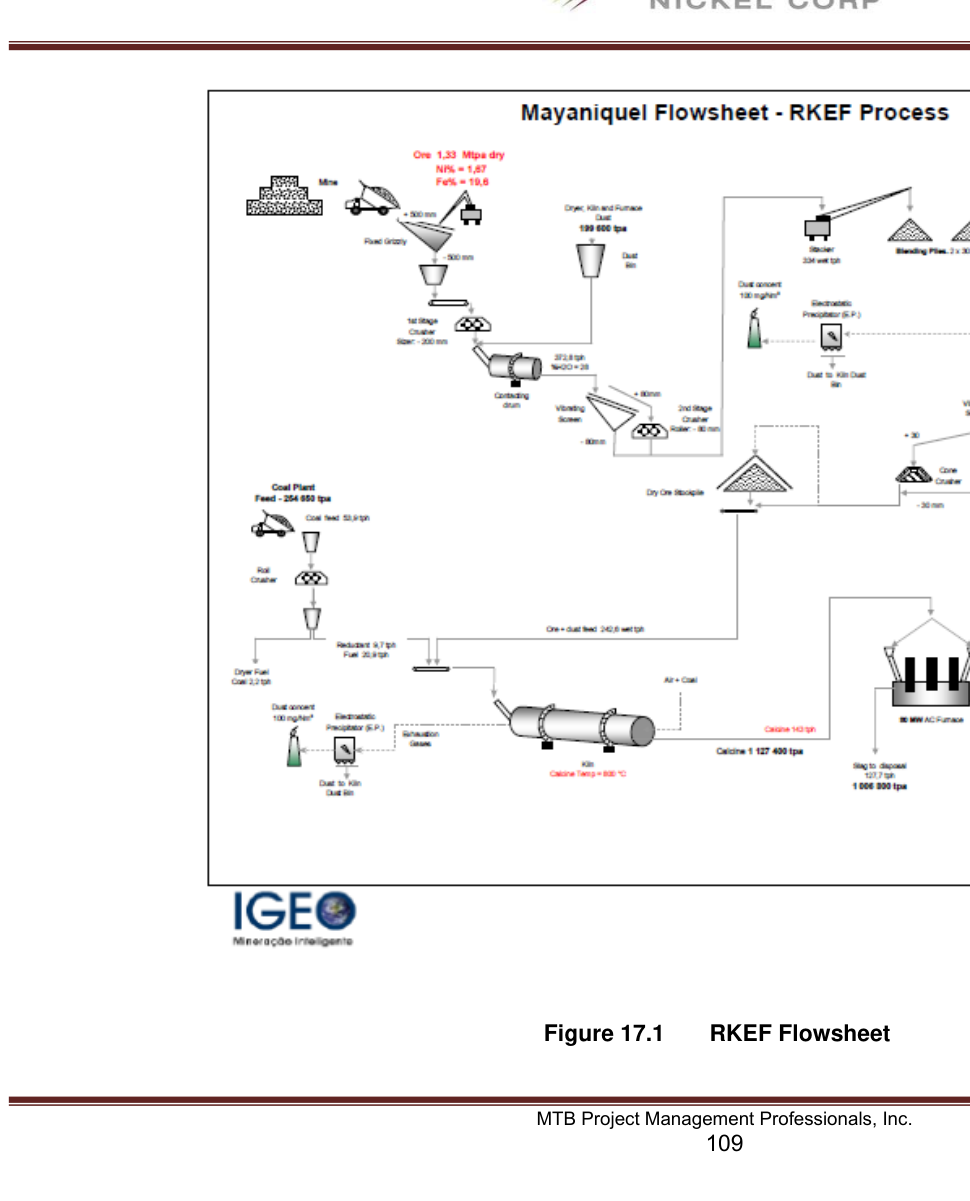
The July 2011 preliminary economic assessment for Anfield's Mayaniquel project describes a single rotary kiln electric furnace line fed 1.33 Mt/y of sorted and directly smelted ore, with an 80 MW furnace and ferronickel refining and granulation.
Mayaniquel is a nickel laterite project in Guatemala. The Canadian National Instrument 43-101 technical report is a preliminary economic assessment (PEA) with an effective date of April 12, 2011 and a report date of July 22, 2011, prepared by MTB Project Management Professionals with Robert Sim. The process design is based on the characteristics of saprolite, the dominant laterite component, as well as most of the higher grade transition and some of the higher grade limonite, drawing on pyrometallurgical smelting test work and modelling by Mintek. Tenova Pyromet and IGEO carried out the flowsheet design. The rotary kiln electric furnace (RKEF) process was chosen largely because it is proven technology, while the fluidized bed direct current (FBDC) process has not yet been operated on an industrial scale.
Critical Data
| Parameter | Value | Unit | Notes |
|---|---|---|---|
| Annual feed | 1.33 | million tonnes dry | Single process line |
| Average feed grade | 1.67 to 1.68 | % Ni | Blend design |
| Direct smelter feed grade | Over 1.7 | % Ni | Selectively mined |
| Process recovery | 90 | % | Design |
| Ferronickel alloy output | 88,900 | t/y | Design; 88,300 on schedule |
| Nickel output | 20,000 | t/y | Design; 19,900 on schedule |
| Plant stockpile | 60,000 | t | Blended upgraded ore, ahead of the dryer |
| Dryer product | 14 to 15 | % LOI | Rotary drier |
| Calciner LOI | Under 2 | % | After partial pre-reduction |
| Kiln heating | About 900 | °C | Coal burner |
| Fe2O3 reduced to FeO | About 30 | % | Partial pre-reduction |
| NiO reduced to Ni | Over 50 | % | Partial pre-reduction |
| Crude metal tap | About 1,500 | °C | 50 t ladle |
| Electric furnace load | 80 | MW | Total 110 MW |
| Make-up water | About 200 | m3/h | Whole plant |
Overview
The feed has two streams: a direct smelt fraction that is selectively mined, and a lower grade mined fraction upgraded by analytical sorting. Rejects are removed in two stages, first by nickel grade and then by higher iron content. The upgraded feed is blended with higher grade ore to give a head grade of approximately 1.67% nickel and the necessary smelting composition. The ore is batched and blended, crushed, mixed with recycled dusts from the drier, calcine and electric furnace, dried, calcined with partial pre-reduction, smelted in an electric furnace, refined and granulated.
Key Process Stages
Ore preparation and agglomeration
The upgrading plant needs the in situ variability preserved, so material handling before sorting is kept to a minimum. After sorting, the upgraded material is crushed, for example with a Bradford Breaker, and blended with the higher grade ore from the mine before the drier, and dusts are mixed in to agglomerate the fines for feeding into the drying and calcining stages. A plant stockpile of 60,000 t of blended, upgraded ore provides surge capacity ahead of the drier. These changes were made to the Tenova Pyromet RKEF flowsheet to include the upgrading plant.
Drying and calcining
The rotary drier dries the blended feed to a loss on ignition of 14% to 15%. It is then fed to the calcining kiln with coal as a reducing agent, which partially pre-reduces the iron and nickel oxides and cuts the loss on ignition to under 2%. Coal is also used in the kiln burner to heat the dried ore to around 900 °C. The calcined ore is hot-charged to the surface of the slag bath in the electric furnace, where partial pre-reduction and residual carbon in the calcine are controlled to reduce about 30% of Fe2O3 to FeO and over 50% of NiO to nickel metal.
Refining and granulation
The crude ferronickel tapped from the electric furnace at about 1,500 °C goes to a pre-heated ladle holding around 50 t of hot metal and contains some phosphorus and sulphur, under 0.1% carbon and limited silicon. Ferrosilicon is added for flow, and nitrogen is blown through a porous plug for agitation. During oxygen blowing, lime and fluorspar help remove phosphorus. At the heating station the oxidizing slag is skimmed, and the bath is de-oxidized with ferrosilicon and aluminum while a lime-rich slag is built for desulphurization. When the analyses meet specification, the alloy is granulated, dried and bagged in super bags.
Energy and water
The electric furnace is the largest load at 80 MW, with 30 MW elsewhere, for 110 MW in total. Coal and heavy fuel oil fire the dryer and kiln: estimated annual coal is 17,345 t for the dryer and 164,776 t for the kiln, and heavy fuel oil is 1,340 t and 12,536 t. Another 74,898 t of coal a year is used as reductant. Slag granulation uses about 62,400 m3/d of water flow, of which 2,900 m3/d evaporates, and metal granulation about 4,400 m3/d with 240 m3/d evaporating. Make-up water for evaporation is about 130 m3/h, and total plant make-up is about 200 m3/h, including entrained losses in slag, furnace cooling, potable and clarified water.
Additional Interesting Data and Summary
The report notes that Xstrata selected the FBDC process for its Koniambo Nickel Project in New Caledonia, designed to make 60,000 tonnes of nickel in ferronickel from a planned 2012 start-up, and that the option to reconsider FBDC would be reviewed at the prefeasibility stage. Evaporative losses might be reduced by cooling towers.
The blended feed design composition is 1.67% nickel, 28.54% Fe2O3, 31.94% SiO2, 3.74% Al2O3 and 19.95% MgO, with an Fe to Ni ratio of 11.71.
Key Processes
- Selective mining and analytical sorting of lower grade ore
- Primary crushing and dust agglomeration
- Rotary drying
- Rotary kiln calcining with partial pre-reduction
- Electric furnace smelting
- Ladle refining of ferronickel
- Alloy and slag granulation
Source: Canadian National Instrument 43-101 Technical Report, Preliminary Economic Assessment, Mayaniquel Project, Guatemala, July 22, 2011.
