

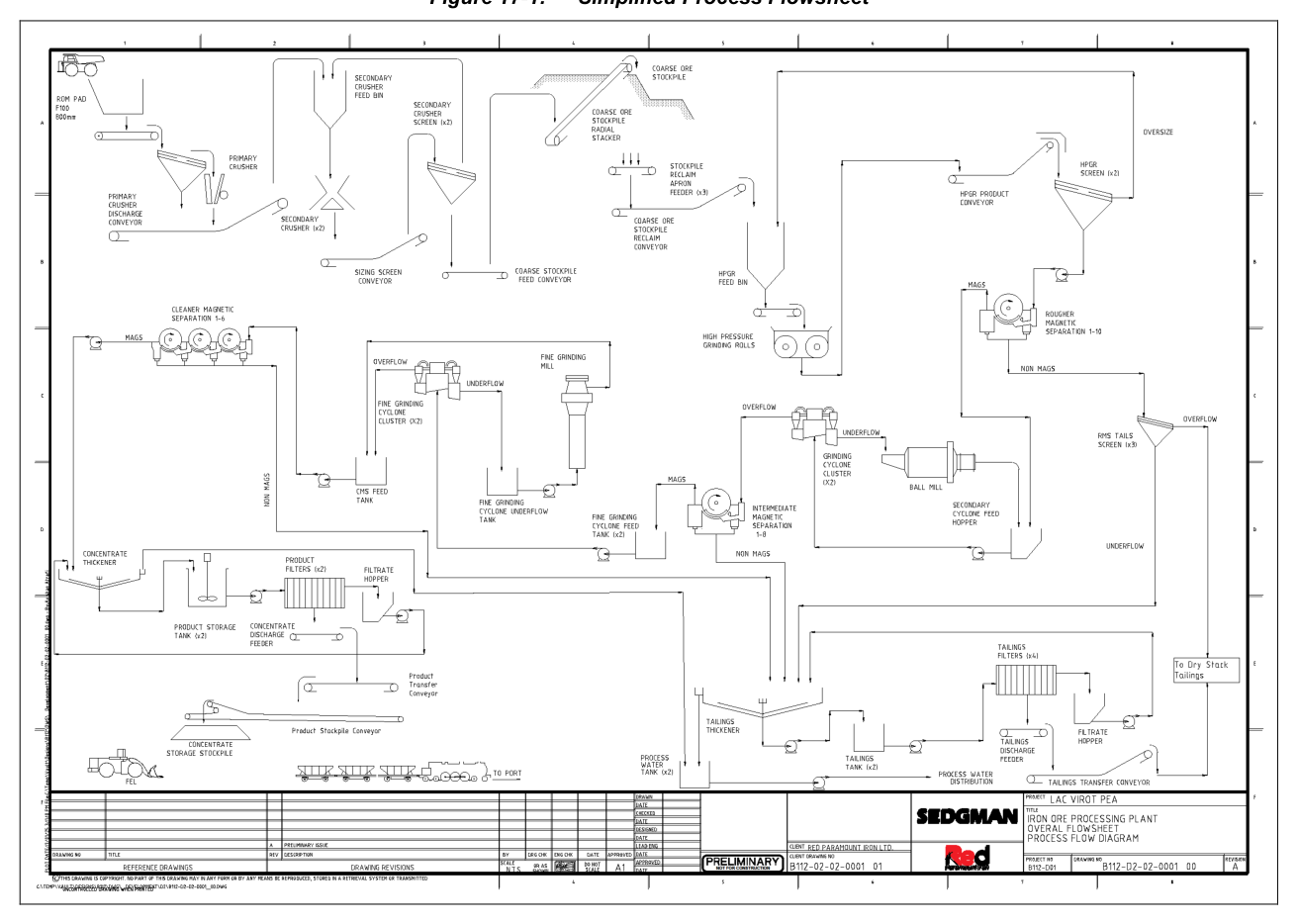
The February 2025 preliminary economic assessment for the Lac Virot iron ore project in Newfoundland and Labrador describes a 9.0 Mt/y plant with jaw, cone and HPGR crushing, ball milling to 150 µm, a 40 µm vertical mill regrind and filtered tailings.
Lac Virot is a direct reduction (DR) grade iron ore project in Newfoundland and Labrador, Canada. Red Paramount Iron Ltd. is the issuer of the NI 43-101 preliminary economic assessment (PEA), which has an effective date of February 16, 2025 and a report date of February 19, 2025, prepared by Sedgman Canada with Sedgman-Onyx, NewFields, Techser and SGS Canada as contributing firms. The process design rests on metallurgical test work and a plant designed to handle an annual feed of 9.0 Mt. The key strategy is to reject non-magnetic material at the coarsest possible size, which optimizes downstream processing. Initial tests indicate that 30% to 50% of the mass can be rejected in the first stage of magnetic separation, cutting energy use and operating costs. The overall objective is a DR-grade iron concentrate with high iron content and minimal impurities.
Critical Data
| Parameter | Value | Unit | Notes |
|---|---|---|---|
| Mill feed | 9.0 | Mt/y | 1,139 t/h |
| Operating schedule | 24 / 365 | h per day / days per year | Plant |
| Crusher utilization | 68.5 | % | About 6,000 h/y |
| Concentrator utilization | 90.3 | % | Design |
| Mill feed iron grade | 25.8 to 30.5 | % Fe | Life of mine average |
| Magnetic Fe in feed | 22.1 to 24.4 | % | Life of mine average |
| Crushing rate | 1,500 | t/h | Jaw, two cones, HPGR |
| Coarse stockpile | 12 | hours live | After secondary crushing |
| HPGR product | 3.4 | mm P80 | Closed circuit with wet screen |
| Rougher magnetic separation | 1,150 | Gauss | Rejects about 30%, grade about 40% Fe |
| Ball mill product | 150 | µm P80 | 5.8 m x 8.7 m EGL, 5.5 MW |
| Intermediate magnetic product | 50 to 60 | % Fe | 1,150 Gauss |
| Regrind | 40 | µm P80 | Vertical mill, 9.2 kWh/t |
| Cleaner magnetic separation | 850 | Gauss | Three stages |
| Concentrate | 2.5 | Mt/y | 417 t/h; 30% weight recovery |
| Concentrate iron grade and recovery | 67.5 / 78.6 | % Fe / % | Over 69% Fe in the PEA description |
| Concentrate silica | Under 3.7 | % SiO2 | Design |
| Concentrate moisture | 9 | % w/w | Filtered |
| Tailings moisture | 15 | % w/w | Dry stack |
Overview
The flowsheet is designed for staged recovery of magnetite at varying size distributions. ROM is crushed by a jaw crusher near the Mid Pit, carried by overland conveyor to the plant pad and crushed in cone crushers to a coarse stockpile. An HPGR in closed circuit with a wet screen makes a 3.4 mm product. A three-stage magnetic separation circuit with staged size reduction follows. Rejects are dewatered and deposited as filtered tailings.
Key Process Stages
Crushing
Run-of-mine material goes through a primary jaw crusher near the Mid Pit and by overland conveyor to a crushed feed bin at the process plant. Two secondary cone crushers work from the feed bin, and their product goes to a coarse stockpile with 12 hours of live capacity. Reclaimed material goes through an HPGR operating in closed circuit with a wet screen to give a P80 of 3.4 mm.
Magnetic separation and grinding
HPGR product goes to rougher magnetic separation with ten low intensity magnetic separators at 1,150 Gauss, which reject approximately 30% of non-magnetic material and raise the iron grade to about 40%. Rougher concentrate is ground in a ball mill of 5.8 m by 8.7 m EGL and 5.5 MW, in closed circuit with classifying cyclones, to a P80 of 150 µm. Intermediate magnetic separation follows with eight separators in two stages at 1,150 Gauss, upgrading to about 50% to 60% iron. The intermediate product is reground to P80 40 µm in a vertical roller mill to improve liberation. Cleaner magnetic separation uses six separators in three stages at 850 Gauss to make a final concentrate at over 69% Fe, with low silica, alumina and sulphur.
Concentrate dewatering
The final concentrate is thickened in a 23 m thickener to about 70% solids underflow and filtered to under 9% moisture before rail transport. Filter utilization is 83% at 0.477 t per square metre per hour.
Tailings
The rougher, intermediate and cleaner magnetic separation tailings are dewatered. The rougher tailings are coarse and go to a dewatering screen, with oversize conveyed to the filtered-tailings storage facility and undersize to the tailings thickener. Intermediate and cleaner tailings also go to the tailings thickener, a 40 m unit. The thickener product is filtered and conveyed to the filtered-tailings storage facility. The system is designed to make dry stack tailings with a moisture content of 15% w/w.
Flotation option
Reverse flotation and hydroseparation for reducing silica were assessed in the test work. The results showed potential for lowering silica with higher recovery rates, and the flotation conditions tested showed promising outcomes, but these processes have not been integrated into the current phase of project design.
Additional Interesting Data and Summary
The process design criteria are based on the test work, with values from Sedgman experience assumed where test results were not available. The Bond ball mill work index is 7.6 kWh/t. Total installed power for the processing facility is about 27 MW, received at a main substation at 46 kV and stepped down to 13.8 kV, 4160 V and 600 V. The plant will use reclaimed water from the filtered tailings and concentrate with make-up raw water.
Consumables include crusher liners, HPGR roll lines, ball mill and regrind mill media and liners, and flocculant.
Key Processes
- Jaw and cone crushing with a coarse stockpile
- HPGR crushing in closed circuit with a wet screen
- Rougher, intermediate and cleaner magnetic separation
- Ball milling and vertical mill regrinding
- Thickening and filtration of concentrate
- Dewatering and dry stacking of tailings
Source: Preliminary Economic Assessment, NI 43-101 Technical Report, Lac Virot DR-Grade Iron Ore Project, Newfoundland and Labrador, Canada, February 19, 2025.
