

The October 2025 preliminary economic assessment for Scottie Resources' Scottie Gold Mine project in northwestern British Columbia describes sorting coarse and fine fractions to make about 177,000 t/y of 11.5 g/t gold concentrate at 94.7% recovery.
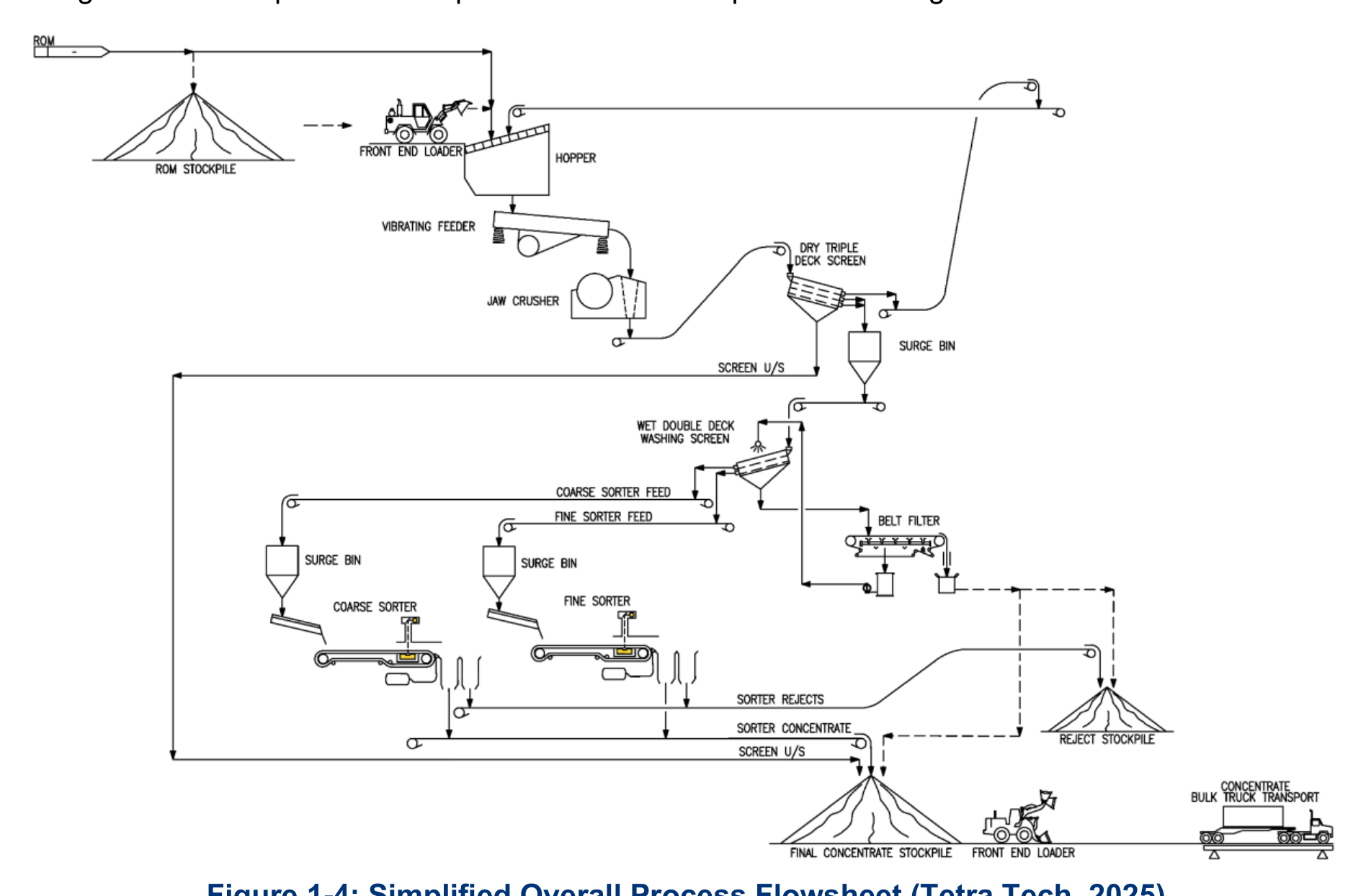
The Scottie Gold Mine project is in northwestern British Columbia, Canada. The Preliminary Economic Assessment (PEA) and NI 43-101 Technical Report was prepared for Scottie Resources Corp. and has an effective date of October 28, 2025. The feeds to the proposed pre-concentration plant come from three deposits: BBOP, BBUG and SGMUG. BBOP would be mined by a conventional truck-shovel open pit, and BBUG and SGMUG by longitudinal long-hole stoping underground. Run-of-mine plant feed is processed through single-stage crushing in closed circuit with a screen. The coarse and fine screen products are treated in separate coarse and fine ore sorters to make concentrates, which are blended with fines generated from screening the sorter feed and shipped off site as the final product.
Critical Data
| Parameter | Value | Unit | Notes |
|---|---|---|---|
| Nominal throughput | 1,000 | t/d | Life-of-mine average 900 t/d |
| Operating schedule | 1 shift of 12 hours | Not applicable | 365 days per year |
| Total plant feed | 2.19 | Mt | Life of mine |
| Plant feed grade | 6.86 | g/t Au | Life-of-mine average |
| Gold recovery | 94.7 | % | Including fines blended with sorter concentrate |
| Concentrate output | About 177,000 | t/y | Life-of-mine average |
| Concentrate grade | 11.5 | g/t Au | Life-of-mine average |
| Concentrate yield | 56.5 | % | Including fines |
| Crushing availability | 70 | % | 119 t/h feed rate |
| Fines cut size | 12.5 | mm | 21% of feed |
| Coarse sorter cut | Minus 100 plus 37.5 | mm | XRF sorter |
| Fine sorter cut | Minus 37.5 plus 12.5 | mm | XRF sorter |
| Sorter feed bins | 10 | t each | Coarse and fine |
| Reagents | Anti-scale chemical only | Not applicable | As needed |
Overview
The processing plant consists of a primary crusher operating in closed circuit with a triple-deck dry screen, a fine product stockpile, a double-deck wet screen to prepare the feeds for ore sorters, X-ray fluorescence (XRF) sorters for the coarse and fine fractions, a belt filter to recycle wash water from the wet screen and all associated utilities. The plant runs on a day-shift operating strategy. It makes a gold concentrate, which is trucked to the port at Stewart, BC, for overseas shipment to the smelter.
Key Process Stages
Sorter feed preparation
A jaw crusher operates in closed circuit with a dry triple-deck primary screen with apertures of 100 mm, 37.5 mm and 12.5 mm. Screen oversize recirculates to the crusher. The coarse fractions, minus 100 plus 37.5 mm and minus 37.5 plus 12.5 mm, go to a wet double-deck secondary screen with 37.5 mm and 12.5 mm apertures. The minus 12.5 mm undersize from the primary screen goes directly to the final product stockpile for blending.
Wet screening
The secondary screen washes the feed to remove surface contaminants, dust and dirt that could interfere with XRF analysis and lead to inaccurate sorting. Its coarse and fine products go to 10 t coarse and fine sorter feed bins that give a consistent feed to the sorters. Each size fraction is processed separately by a sorter calibrated for its feed size.
XRF sorting
Test results established that XRF sorting is better suited to this project. Sorter accepts are conveyed to the concentrate stockpile and rejects go to a reject stockpile. The sorter can also be designed to make a middling product if required.
Water and product handling
The wet screen undersize, mostly water and fine dirt, goes to a belt filter for solid-liquid separation. The filter cake goes to either the final product stockpile or the waste stockpile depending on its grade, and the filtrate is recycled to the wet screen as spray water. The sorter concentrate is blended with the minus 12.5 mm fines from the dry primary screen, loaded into bulk trucks and hauled to the port at Stewart. The sorter waste stockpile is ultimately returned to the pit as fill, as part of the reclamation strategy.
Test work behind the choice of XRF sorting
The sorting test program was commissioned from ABH Engineering in December 2024 and covered 210 individual quarter-core samples, 70 from each of the Blueberry Open Pit (BBOP), Blueberry Underground (BBUG) and Scottie Gold Mine Underground (SGMUG) zones. The samples were about 3 inches in size and chosen to cover a wide gold grade range. The program tested whether material could be separated into high-grade pieces, or concentrate, and low-grade pieces, or waste, using X-ray scanning. Results are given as operating parameters that show feed grade, mass pull to product, gold recovery, sorted product grade, rejected waste grade and upgrade ratio. ABH scanned every sample with a handheld XRF scanner, taking three readings from different sides and averaging them to represent the whole rock. The samples were also scanned by X-ray transmittance (XRT) at the Saskatchewan Research Council on a commercial-scale TOMRA XRT Tertiary sorter, and then assayed individually at SGS labs in Burnaby. The assays and scan data were used to estimate sorter performance.
Additional Interesting Data and Summary
An anti-scale chemical is added as needed to reduce scale build-up in the recycle water lines, supplied in liquid form and metered into the intake of the water pumps. No other reagents are required for the current flowsheet.
Major consumables include screen media and decks and jaw crusher liners, which need periodic replacement. Other consumables are belt filter cloths and laboratory supplies, and maintenance spares for crushing, screening, conveying and assaying equipment will also be held.
Key Processes
- Closed circuit jaw crushing with triple-deck dry screening
- Wet screening to prepare sorter feed
- X-ray fluorescence ore sorting of coarse and fine fractions
- Belt filtration of wet screen undersize with water recycle
- Blending of sorter concentrate with fines
- Return of sorter waste to the pit as fill
Source: Preliminary Economic Assessment, NI 43-101 Technical Report, for the Scottie Gold Mine Project in Northwestern British Columbia, Canada, October 28, 2025.
Project website: Scottie Gold Mine Project
