

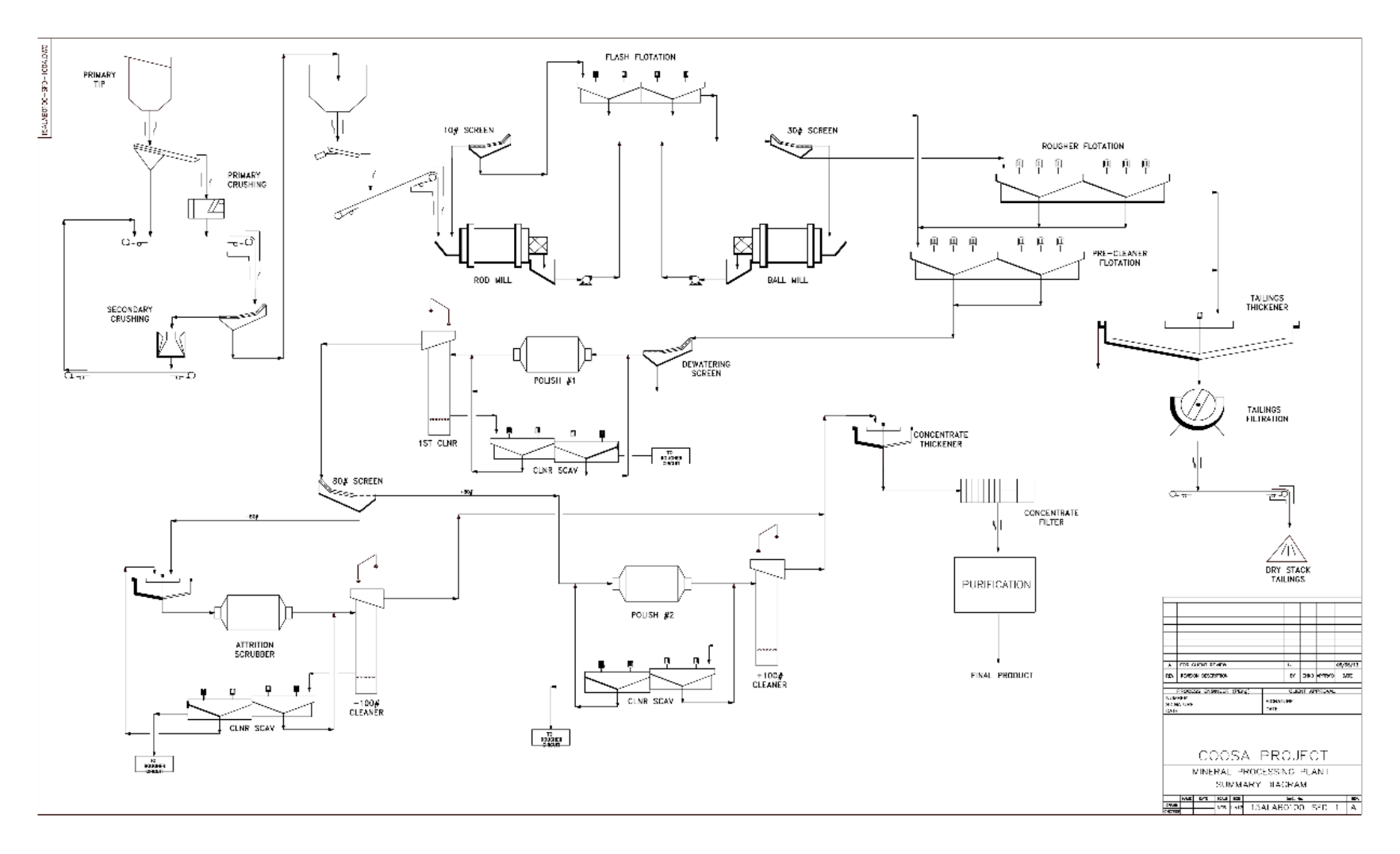
The November 2015 preliminary economic assessment for Alabama Graphite's Coosa project describes a 514 t/d concentrator with rod and ball milling, flash and trough flotation, three cleaner columns and a purification plant for micronization and spheronization.
Coosa is a flake graphite project near Montgomery, Alabama, USA. Alabama Graphite Corp. is the issuer of the Preliminary Economic Assessment (PEA) on the Coosa Graphite Project, dated November 27, 2015 and prepared by Metal Mining Consultants with AGP Mining Consultants. The proposed method of graphite recovery from the deposit consists of conventional crushing and milling followed by rougher and cleaner froth flotation. The cleaner flotation concentrate is then transported to a purification plant that includes micronization and spheronization before upgrading by thermal purification to make the final product. The section describes a concentrator and purification plant to make 5,500 tons per annum of purified product, and the capital cost covers an upgrade scenario to 16,000 tons per annum and a larger case used in the economic model.
Critical Data
| Parameter | Value | Unit | Notes |
|---|---|---|---|
| Graphite head grade | 3.0 | % Cg | Design |
| Plant throughput | 514 | tpd | 16,500 tons per month run of mine |
| Crushing circuit availability | 86 | % | Seven days per week |
| Grind and float availability | 92 | % | 24/7 |
| Rod mill feed | 14 | mm F80 | 6 ft x 10 ft overflow rod mill, 120 kW |
| Rod mill transfer size | 1.68 | mm T100 | Ten mesh |
| Ball mill | 5 ft x 8 ft | Not applicable | 60 kW, grind P80 450 µm |
| Rougher flotation time | 8 | min | Six DR30 trough cells, residence just over ten minutes |
| Mass recovery to rougher concentrate | 6.0 | % | Design |
| Pre-cleaner flotation time | 8 | min | Five DR18 cells, twelve minutes residence |
| Cleaner columns | 3 | x 3 ft x 20 ft | PLC level control and froth washing |
| Final flotation concentrate | 3.0 / 97.0 / 97.0 | % mass / % Cg recovery / % Cg grade | Design |
| Tailings moisture | 18 | % | Filtered |
| Fresh water | 7.0 | cu ft/t | Process plant |
| Power | 23.2 | kW/t | Process plant |
Overview
The flowsheet consists of two-stage crushing, rod and ball mill grinding, froth flotation, concentrate dewatering, thermal purification, spheronization and tailings thickening. AGP has taken a conservative approach to plant design, using commonly available technology and flowsheet configuration. The report cautions that the fundamental design criteria rest on limited test work and should be considered preliminary. Information from ongoing pilot work suggests the run-of-mine material will be extremely friable and contain a lot of fine material, but the study still includes a jaw crusher for oversize material.
Key Process Stages
Crushing
Twenty ton haul trucks, averaging two trucks an hour, tip into a rail-lined 30 ton surge bin. A vibrating grizzly feeder passes plus 60 mm oversize to a 15 inch by 24 inch jaw crusher with a 50 mm closed side setting, which accepts a top size of 400 mm. An overhead magnet removes tramp metal on the screen feed conveyor. A 4 ft by 8 ft inclined screen with 19 mm slots classifies the feed and closes the circuit around a secondary roll crusher set at 15 mm. Undersize goes to the fine feed bin conveyor, and a dust collection system covers the classification screen and secondary crusher area.
Grinding
A 150 ton fine feed bin gives about six hours of capacity, with an overflow stockpile of another six hours reclaimed by front-end loader. A 6 ft by 10 ft overflow rod mill with a trommel of 10 mm openings discharges to a 1.68 mm classification screen, whose undersize goes to flash flotation in two 100 cubic foot trough cells. The flash tails and a 5 ft by 8 ft overflow ball mill discharge go to a 595 µm screen, whose oversize returns to the ball mill and whose undersize feeds the rougher circuit.
Rougher and pre-cleaner flotation
Six DR30 rougher cells give just over ten minutes of residence, with air supplied by blowers and pulp level kept by dart valves. Rougher concentrate flows to five DR18 pre-cleaner cells with twelve minutes of residence, and the pre-cleaner concentrate goes to the cleaner circuit. Rougher and pre-cleaner tailings are the final flotation tailings.
Cleaner flotation
Pre-cleaner concentrate goes to a 230 mesh dewatering screen, and the solids go to a 4 ft by 13 ft tire-mounted polishing drum scrubber before the first cleaner column. Tails from that column pass four DR18 scavenger cells, whose first two concentrates return to the column feed and whose last two return to the dewatering screen. The first cleaner concentrate is screened at 80 mesh, 177 µm. The plus 80 mesh oversize goes to a second polishing scrubber and cleaning column. The minus 80 mesh fraction is thickened and attrition scrubbed before another cleaning column. Concentrates from the two circuits are combined and pumped to the concentrate thickener.
Dewatering and tailings
The concentrate thickener has rake lift, bed level detection and bed mass monitoring. A horizontal pressure filter with fifteen 1000 mm by 1000 mm plates and a filtration volume of 448 L dewaters it, and the cake goes to a storage shed before purification. Flotation tailings are thickened, filtered and trucked to the tailings management facility. Frother, collector and lime are pumped by peristaltic pumps from a central reagent area.
Additional Interesting Data and Summary
The coarse flake fraction of the final concentrate is monitored by the size distribution at the first cleaner stage, where the 80 mesh screen separates plus 177 µm material, about 45% of the first cleaner concentrate, from the finer fraction. The first cleaner mass recovery is 70%, and the first cleaner column flux is 2 t/h per square metre.
Spillage in each area is collected in sumps and pumped back into the circuit.
Key Processes
- Jaw and roll crushing with screening
- Rod and ball milling with flash flotation
- Rougher, pre-cleaner and scavenger flotation in trough cells
- Polishing and attrition scrubbing of flake concentrate
- Column flotation in three cleaner columns
- Thickening and filtration of tailings
- Thermal purification and spheronization of the concentrate
Source: Preliminary Economic Assessment (PEA) on the Coosa Graphite Project, Alabama, USA, November 27, 2015.
