

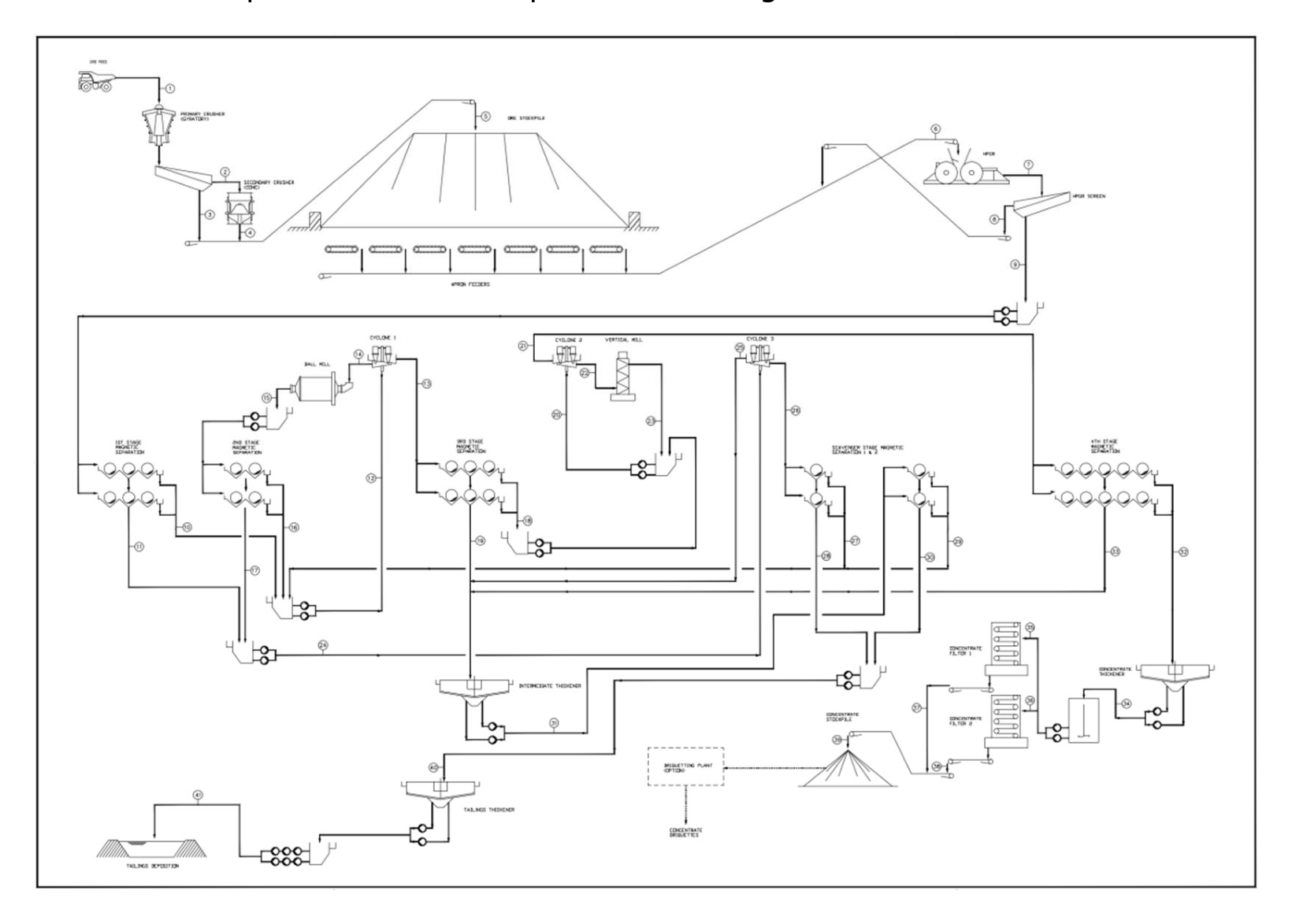
The May 2021 preliminary economic assessment for Strategic Resources' Mustavaara vanadium project describes a 3.25 Mtpa concentrator, direct smelting, selective oxidation, roast-leach to V2O5 and aluminothermic reduction to 4,577 tpa of FeV80.
Mustavaara is a vanadium project in north-central Finland, in the Municipality of Taivalkoski, with the mine site on the border between Taivalkoski and Posio. The NI 43-101 Preliminary Economic Assessment on the Mustavaara Vanadium Project, prepared for Strategic Resources Inc., has an effective date of May 4, 2021. The ferrovanadium production process consists of a concentrator plant at Mustavaara and smelter and hydrometallurgical plants in Raahe. The concentrator is based on two-stage crushing, three-stage grinding and multi-stage magnetic separation to make an iron and vanadium concentrate. Direct smelting and selective oxidation then bring vanadium to a form, vanadium slag, suitable as feed to a roast-leach process, with pig iron as a by-product. The roast-leach process makes vanadium pentoxide (V2O5), which is fed to aluminothermic reduction to make ferrovanadium (FeV80).
Critical Data
| Parameter | Value | Unit | Notes |
|---|---|---|---|
| Concentrator throughput | 3.25 | Mtpa ore | Design |
| Concentrate output | 505 | ktpa | 63.4% Fe and 0.92% V |
| Magnetite recovery to concentrate | 98 | % | Estimated |
| FeV80 output | 4,577 | tpa | Vanadium recovery 78.9% |
| Pig iron output | 329 | ktpa | By-product |
| Other by-products | 83 / 8 / 20 | ktpa TiO2 slag / Ca-Al slag / sodium sulphate | Possible |
| Plant availability | 90 | % | Crushing five days a week |
| Primary gyratory crusher | 375 | kW | Product about 150 mm P80 |
| Ore stockpile | 30,000 | t | Apron feeders |
| HPGR | 1,658 | kW | Product about 1 mm P80 |
| Secondary ball mill | 2,000 | kW | Product 200 µm P80 |
| Tertiary vertical mill | 2,250 | kW | Product 37 µm P80 |
| Magnetic separation stages | 5 | Not applicable | Four stages plus scavenger |
| Concentrate filter cake moisture | 8 | % | Two pressure filters |
| Thickened tailings | About 60 | % solids | Pumped to the tailings pond |
| Smelter furnace power | 85 to 90 | MW | Open slag bath AC furnace |
| Smelting energy | 1,550 | kWh/t feed | Mass and energy balance |
| Reduction temperature | About 1,600 | °C | Anthracite reductant |
Overview
The concentrator makes the iron-vanadium concentrate by magnetic separation, and the smelting and hydrometallurgical plants at Raahe turn it into vanadium products. Direct smelting reduces iron and vanadium in the concentrate to a liquid metallic phase. A converter then oxidizes the vanadium into a slag, while the hot metal is desulphurized to make saleable pig iron. A roast-leach process makes V2O5 from the vanadium slag.
Key Process Stages
Crushing and primary grinding
A 375 kW gyratory crusher takes ore trucked from the pit and targets about 150 mm P80. Crushed ore goes to a screen, oversize goes to a secondary cone crusher, and screen undersize and cone product are conveyed to a 30,000 t stockpile. Apron feeders feed an HPGR of 1,658 kW in closed circuit with a vibrating screen, with oversize returned and undersize going to the first magnetic separation stage.
Magnetic separation and grinding
The circuit has five magnetic separation stages with secondary and tertiary grinding. The first stage uses two parallel three-drum concurrent LIMS separators, with concentrate to the secondary grinding circuit and tailings to hydrocyclone classification. A 2,000 kW ball mill grinds first, second and scavenger stage concentrates to 200 µm P80. The second stage uses two parallel double-drum separators, and the third uses three parallel three-drum separators whose concentrate goes to the 2,250 kW vertical mill for 37 µm P80. The fourth stage, two parallel six-drum LIMS, makes the final concentrate. A scavenger stage of two single-drum separators returns concentrate to secondary grinding.
Concentrate and tailings handling
Fourth-stage concentrate is thickened and filtered on two pressure filters to about 8% moisture, then stockpiled and loaded by wheel loader. If concentrate is sold instead of smelted, the report recommends agglomeration by briquetting with a roller press and a curing kiln. An intermediate thickener takes third and fourth stage tailings and hydrocyclone overflow, and a tailings thickener takes scavenger tailings, giving about 60% solids pumped to the tailings pond. Lime and flocculant are the plant chemicals.
Smelting
Raw materials are concentrate, anthracite reductant, lime flux and iron ore pellets as oxidizer, dried in rotary dryers before dosing. An open slag bath AC furnace, one of the few types able to handle fine feed like the concentrate, smelts the charge at about 1,600 °C, with slag fluxed to a basicity of 1.2. The hot metal is about 93% iron with 1.30% vanadium, and the TiO2 slag is granulated and can be used as construction material. Off-gas is scrubbed, pressurized and used as fuel.
Selective oxidation and pig iron
A tilting converter oxidizes the vanadium into slag using iron oxide pellets and gaseous oxygen, controlling temperature with the pellets and oxygen. The V slag contains about 33% V2O3. The hot metal is then desulphurized in a ladle station by injecting magnesium and calcium powders to reach a typical pig iron sulphur content under 0.01%, after oxidation to reduce vanadium losses.
Roast-leach and V2O5 production
The V slag from selective oxidation is crushed, cooled and screened, then fed to a roasting furnace with sodium carbonate, which converts the vanadium to water-soluble sodium metavanadate and lowers the melting temperature. Roasting runs at about 1,200 °C, and the molten slag is granulated. The granules are leached in agitated hot water tanks at pH 11 to 13 and 70 to 80 °C, closed and at atmospheric pressure, with roasting heat covering part of the heating. Leach residue is thickened to about 40% solids, pressure filtered with cake washing and sent to hazardous waste disposal. Silica is precipitated from the pregnant solution with aluminium sulphate at about pH 8 and 50 to 70 °C, and ammonium metavanadate is then precipitated with ammonium sulphate, thickened to about 30% solids, filtered to a cake of about 25% moisture and dried in a flash dryer to under 0.1%. It is reduced to V2O5 in a rotary tube furnace and passed to aluminothermic reduction.
Additional Interesting Data and Summary
The report gives the analyses of furnace hot metal and TiO2 slag, with the slag at 37.14% TiO2 and 26.97% CaO, and of oxidation hot metal and V slag, with the slag at 44.55% FeO and 11.45% SiO2. Slag tapping is carried out about every two hours, and the electrodes are Söderberg type.
Key Processes
- Gyratory and cone crushing with a stockpile
- HPGR grinding in closed circuit
- Five-stage magnetic separation with ball and vertical mill regrinding
- Thickening and pressure filtration of concentrate
- Open slag bath furnace direct smelting
- Converter selective oxidation to vanadium slag
- Roast-leach production of V2O5 and aluminothermic reduction to FeV80
Source: NI 43-101 Technical Report, Preliminary Economic Assessment on the Mustavaara Vanadium Project, Finland, May 4, 2021.
