

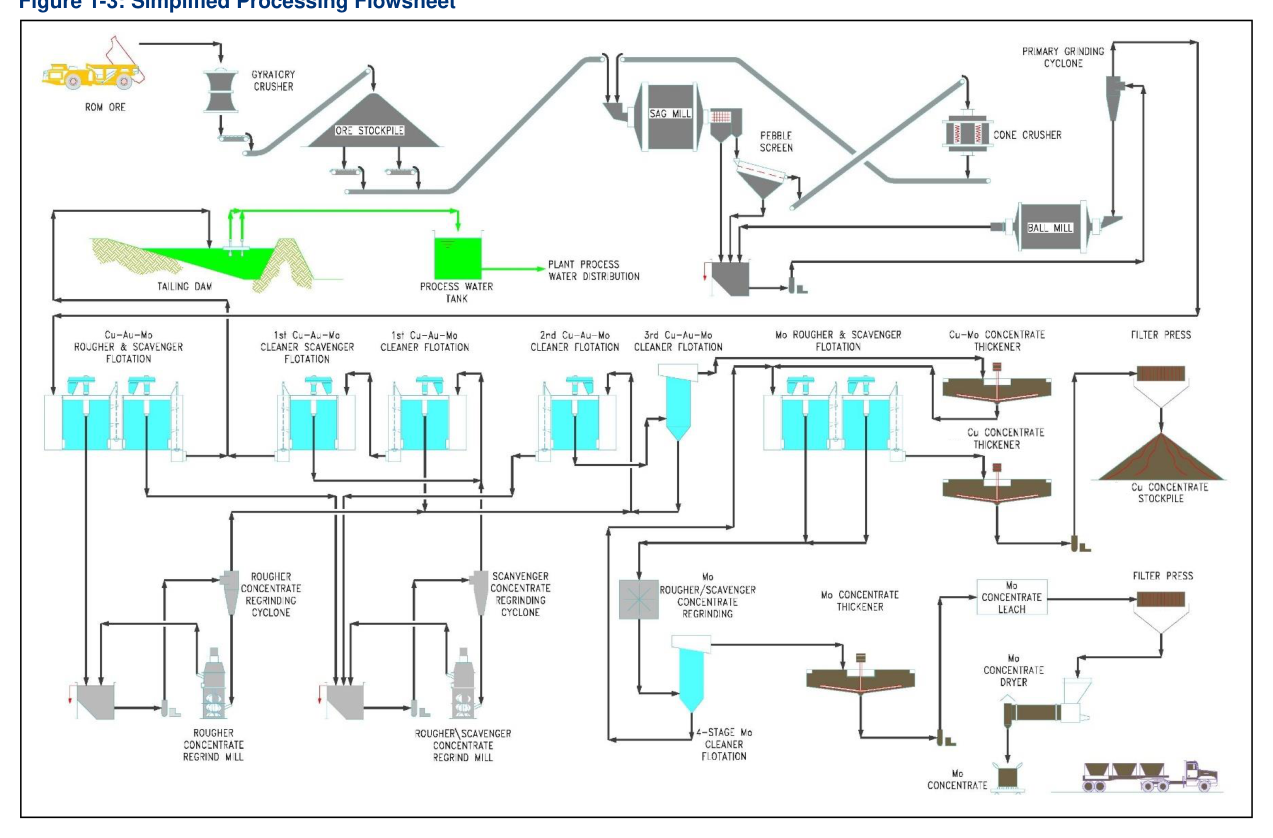
The September 2021 preliminary economic assessment for Copper Fox's Schaft Creek project in British Columbia describes two gyratory crushers, two SABC grinding lines, two bulk flotation trains and a copper-molybdenum separation circuit.
Schaft Creek is a calc-alkalic copper-molybdenum-gold-silver porphyry deposit in British Columbia, Canada. Tetra Tech prepared the Schaft Creek Preliminary Economic Assessment (PEA), an NI 43-101 technical report, for Copper Fox Metals Inc. with an effective date of September 10, 2021. The deposit has overlapping mineralized zones containing significant copper, molybdenum and gold, and would be mined by conventional truck-shovel open pit equipment. The mineralization would be processed in a conventional flotation plant that makes a copper concentrate containing gold and silver, and a molybdenum concentrate. The plant is designed to process a nominal 133,000 t/d. Life-of-mine average mill feed grades are 0.26% Cu, 0.16 g/t Au, 1.23 g/t Ag and 0.017% Mo.
Critical Data
| Parameter | Value | Unit | Notes |
|---|---|---|---|
| Nominal throughput | 133,000 | t/d | 92% availability |
| Crushing rate | 7,389 | t/h | Two gyratory crushers, 3,694 t/h each |
| Crusher product | 120 or finer | mm P80 | Stationary and semi-mobile crushers |
| Coarse mill feed stockpile | 120,000 | t live | Eight apron feeders at 1,004 t/h |
| SAG mills | 2 | 12.20 m x 7.01 m EGL | 22.5 MW gearless motors |
| Ball mills | 4 | 8.23 m x 13.72 m EGL | Two 10.0 MW motors each |
| Grind size | 150 | µm P80 | Primary transfer T80 2,900 µm |
| Rougher concentrate regrind | 35 to 40 | µm P80 | Rougher/scavenger concentrate 25 to 30 µm |
| Molybdenum concentrate regrind | 18 | µm P80 | Design |
| Copper recovery | 83.1 | % | LOM; 71.0% gold and 40.3% silver |
| Molybdenum recovery | 60.1 | % | In molybdenum concentrate |
| Copper concentrate | About 385,000 | t/a | 28% Cu, 14.1 g/t Au, 63.1 g/t Ag |
| Molybdenum concentrate | 9,780 | t/a | 50% Mo |
| Concentrate moisture | About 9 | % | Molybdenum dried to 4% to 5% |
| Bond ball mill work index | 22.4 | kWh/t | Volcanic type |
| Abrasion index | 0.23 | g | Average |
Overview
The processing plant includes primary crushing at the mine site, a crushed mill feed stockpile, and a main plant with two primary grinding circuits using two SABC circuits, two copper-molybdenum bulk flotation circuits, one copper and molybdenum separation circuit including molybdenum concentrate leaching to cut copper and lead, concentrate dewatering and tailings disposal. The final rougher and scavenger tailings, mostly non-sulphide gangue, are stored in the tailings storage facility (TSF).
Key Process Stages
Crushing and stockpile
A stationary facility south of the pit has a 1.52 m by 2.79 m gyratory crusher, a hydraulic rock breaker, a 2.13 m by 10.0 m apron feeder and a 326 m belt conveyor. A semi-mobile in-pit facility has a 1.52 m by 2.26 m gyratory crusher, a rock breaker, an in-pit apron feeder and conveyors of 261 m and 1.83 m width. Dust collectors serve both. Crushed feed goes to the 120,000 t live stockpile and is reclaimed by eight 1.52 m by 7.60 m apron feeders onto two 670 m SAG mill feed conveyors.
Grinding
Two SABC circuits each treat about 3,012 t/h. Each has one SAG mill with a vibrating screen, closed with pebble cone crushers. SAG mills have 76 mm pebble ports and trommel and screen undersize flows to a sump, with oversize going to a 1,500 t pebble surge bin, three retrievable belt feeders and three 750 kW cone crushers that crush pebbles to 80% passing 12.5 mm. Lime slurry is added to adjust flotation feed pH. Four ball mills, each in closed circuit with a cluster of ten 840 mm cyclones with seven operating, grind to 150 µm P80. The cyclone overflow at about 35% solids goes to bulk flotation, and collectors FO and SEX are added to the ball mill pump boxes.
Bulk flotation
Bulk copper, gold, silver and molybdenum flotation uses rougher, scavenger and cleaner stages. Rougher and scavenger flotation takes place in two banks, each with six 300 m3 tank cells for roughing and three for scavenging, making a high-grade rougher concentrate and a lower-grade rougher/scavenger concentrate. The two are reground separately, then upgraded in three stages of cleaner flotation to a copper-molybdenum bulk concentrate. Reagents are SEX, FO, MIBC and lime.
Copper-molybdenum separation and dewatering
The bulk concentrate is treated by further flotation, with sodium hydrosulphide (NaHS) to suppress copper minerals, making a copper concentrate of about 28% Cu and a molybdenum concentrate. The molybdenum concentrate is leached with the chloride leaching procedure to reduce copper and lead contents, reaching about 50% Mo. Final concentrates are thickened and pressure filtered to about 9% moisture, and the molybdenum concentrate is dried to 4% to 5%, bagged and trucked to Fairview Terminals in Prince Rupert. The copper concentrate is stockpiled and bulk trucked along Highway 37 to the Port of Stewart.
Additional Interesting Data and Summary
A 2015 simulation of a dual-line circuit with one 40 ft by 23 ft SAG mill and two 26 ft by 44.5 ft ball mills per line found a maximum throughput of about 118 kt/d on volcanic-type mineralization and about 153 kt/d on breccia-type. Ball mill capacity was the limit, so installed ball mill power was raised to 20 MW per mill and the sizing to 27 ft by 45 ft EGL. Estimated nominal grinding circuit throughput is over 150,000 tpd on breccia and intrusive, 149,000 on porphyry and 133,000 on volcanic mineralization.
The report notes that the grinding circuit might not reach 133 kt/d on volcanic feed at 92% availability, and recommends further circuit assessment together with the mine plan.
Key Processes
- Stationary and semi-mobile gyratory crushing
- Two SABC grinding lines with pebble crushing
- Four ball mills with cyclone classification
- Copper-molybdenum bulk rougher, scavenger and cleaner flotation
- Copper-molybdenum separation with NaHS
- Chloride leaching of molybdenum concentrate
- Pressure filtration, drying and bagging of concentrates
Source: Schaft Creek Preliminary Economic Assessment (PEA), NI 43-101 Technical Report, September 10, 2021.
Project website: Schaft Creek Project
