

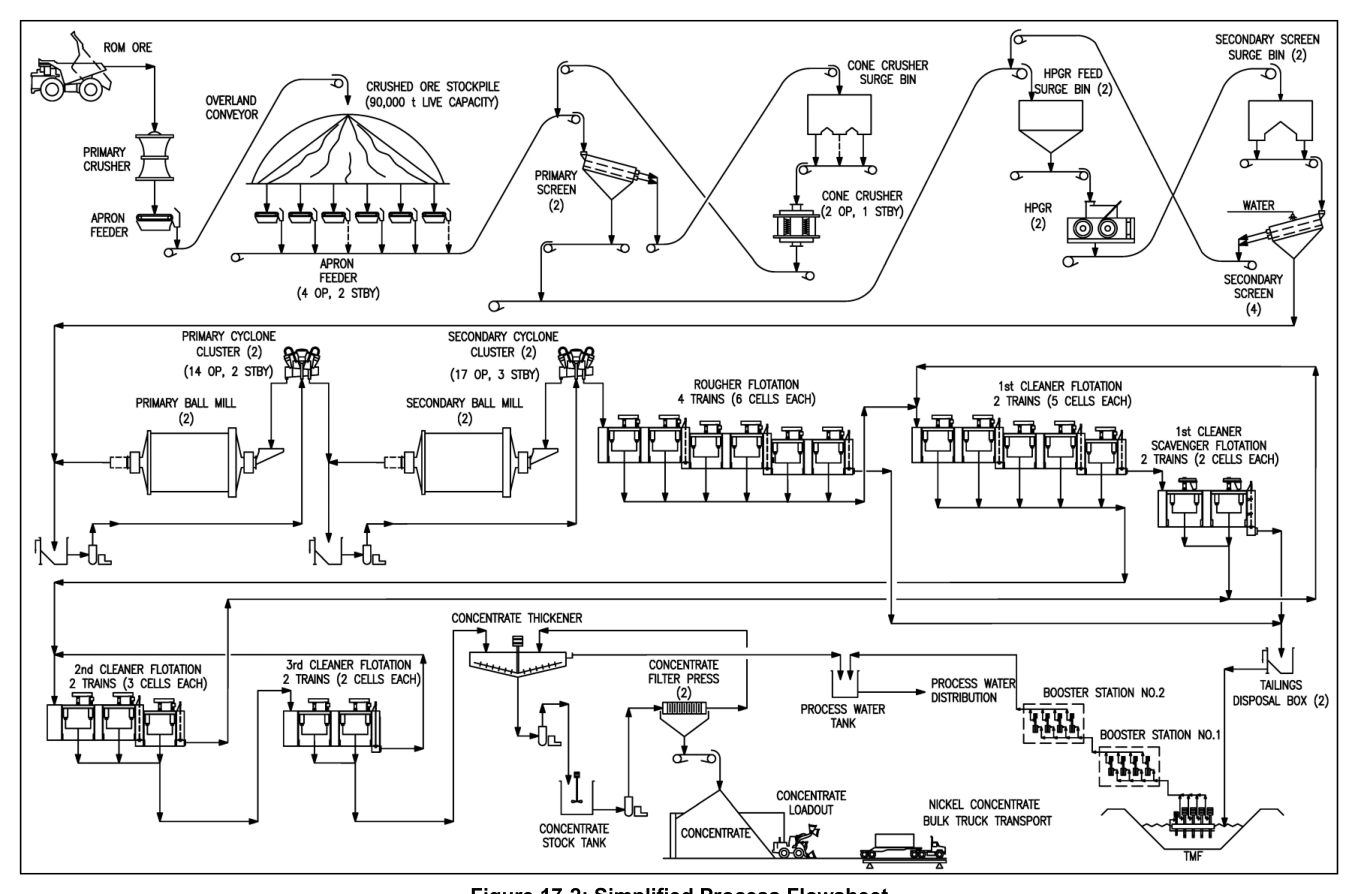
The September 2023 pre-feasibility study for Giga Metals' Turnagain project in British Columbia describes cone and HPGR crushing, primary and secondary ball milling to 80 µm, 24 rougher cells of 630 m3 and a 51.4% average nickel recovery.
Turnagain is a nickel and cobalt deposit in British Columbia, Canada. Tetra Tech prepared the Turnagain Nickel Project Pre-Feasibility Study, NI 43-101 Technical Report, for Giga Metals Corporation with an effective date of September 22, 2023. The main mineral resource is pentlandite, with minor nickel in pyrrhotite, and the rest of the nickel is in non-sulphide minerals such as olivine and serpentine. Cobalt, a valuable by-product, is associated closely with pentlandite and recoverable into the nickel sulphide concentrate. The deposit would be mined by conventional truck-shovel open pit methods and processed in a conventional flotation plant with HPGR and ball mill integrated grinding, making a nickel sulphide concentrate and tailings that would be impounded permanently in the tailings management facility (TMF). The plant is designed at a nominal 45,000 t/d for the first year, increasing to 90,000 t/d in year 2.
Critical Data
| Parameter | Value | Unit | Notes |
|---|---|---|---|
| Nominal throughput | 45,000 then 90,000 | t/d | 32.85 Mt/y at full capacity |
| Mill feed grade | 0.205 | % Ni | Life of mine average; 0.150% sulphide nickel |
| Cobalt feed grade | 0.013 | % Co | Life of mine average |
| Nickel recovery | 51.4 | % | Life of mine average |
| Cobalt recovery | 49.0 | % | Life of mine average |
| Concentrate grade | 18 / 1.1 | % Ni / % Co | MgO about 9.2% |
| Concentrate output | 182 / 196 / 237 | kt/y dry | Average / full operation years / peak |
| Primary crusher | 1.52 x 2.79 | m | Gyratory, 1,353 kW, P80 150 mm |
| Crushed ore stockpile | 90,000 | t live | Covered, two reclaim lines |
| Secondary cone crushers | 3 | x 933 kW | Two operating, one standby; P80 38 mm |
| HPGRs | 2 | 2.54 m x 2.31 m | Two 4,800 kW motors each; P80 3.5 mm |
| Primary ball mills | 2 | 8.53 m x 14.0 m EGL | Two 11 MW motors each; P80 250 µm |
| Secondary ball mills | 2 | 8.53 m x 14.0 m EGL | Two 11 MW motors each; P80 80 µm |
| Rougher flotation | 4 banks of 6 | x 630 m3 | Natural pH |
| Bond ball mill work index | 22.0 | kWh/t | 75th percentile |
| Concentrate moisture | 9 | % by weight | Pressure filters |
Overview
The processing plant includes a primary crushing and handling facility at the mine site, an overland conveying system to the plant site, a crushed ore stockpile, secondary crushing with cone crushers in closed circuit with dry screens, tertiary crushing with HPGRs in closed circuit with wet screens, primary and secondary ball mill grinding, rougher flotation and three stages of cleaner flotation, concentrate dewatering and handling, and tailings disposal to the TMF. Equipment for 45,000 t/d and the concentrate dewatering system would be installed before year 1, with the rest added in year 1 to reach 90,000 t/d in year 2.
Key Process Stages
Crushing and conveying
240 t haul trucks dump into a gyratory crusher pocket with a static grizzly of 1,000 mm aperture and a hydraulic rock breaker. The gyratory crusher makes a product of 80% passing 150 mm, and a sacrificial belt conveyor and an overland conveyor carry it to a crushed ore stockpile at the plant site. The stockpile is covered and reclaimed in two lines, each feeding a 45,000 t circuit with three apron feeders, two operating and one standby, at 1,019 t/h each.
Secondary and tertiary crushing
Two double deck vibrating screens with 85 mm and 53 mm apertures dry-screen at about 53 mm. Oversize goes to a cone crusher surge bin and three cone crushers, with product returned to the screen feed conveyor. Screen undersize, P80 38 mm, goes to HPGR feed surge bins of 2,500 t. Two HPGRs crush it, and four wet double deck screens with 16 mm and 6 mm apertures cut at about 6 mm, returning oversize to the HPGR feed and sending undersize at P80 3.5 mm to grinding.
Grinding
Two primary ball mills in reverse closed circuit with cyclone clusters of sixteen 840 mm cyclones, fourteen operating, grind to 80% passing 250 µm. Two secondary ball mills in reverse closed circuit with clusters of twenty 660 mm cyclones, seventeen operating, grind to 80% passing 80 µm. Sodium hexametaphosphate (Calgon) dispersant is added to each secondary cyclone feed pump box, and particle size analyzers monitor the cyclone overflow.
Flotation
Secondary cyclone overflow at about 30% solids goes to four rougher banks of six 630 m3 tank cells, using Calgon dispersant, SIPX collector and MIBC frother. Three stages of cleaning in conventional cells raise the grade to an average 18% Ni, using two first cleaner banks of five 300 m3 cells, two first cleaner scavenger banks of two 300 m3 cells, two second cleaner banks of three 100 m3 cells and two third cleaner banks of two 70 m3 cells. Cleaner scavenger concentrate returns to the first cleaner, and second and third cleaner tails recirculate upstream.
Concentrate dewatering and tailings
Third cleaner concentrate goes to a 12.0 m high-rate thickener with 5 g/t flocculant, thickens to 60% solids, and is pumped from a stock tank to two 82 m2 pressure filters, giving a cake of about 9% moisture. A concentrate stockpile holds seven days, and trucks haul concentrate to a port facility at Stewart for shipping to overseas smelters, or to a rail connection at Kitwanga. Rougher tailings and first cleaner scavenger tailings are pumped to tailings disposal tanks and flow by gravity to the TMF in two pipelines. Supernatant is reclaimed by a barge and returned to the process water tanks, with anti-scalant added.
Additional Interesting Data and Summary
The reagent consumption per tonne of mill feed is 78 g of SIPX, 115 g of Calgon, 40 g of MIBC, 5 g of Magnafloc 10 flocculant or equivalent and 4 g of anti-scalant. The report notes that the TMF will permanently impound the tailings and could absorb and sequester carbon dioxide over the long term.
The ore has a Bond crusher work index of 18.0 kWh/t at the 75th percentile and an average abrasion index of 0.23 g.
Key Processes
- Gyratory crushing and overland conveying
- Cone crushing with dry screens
- HPGR crushing with wet screens
- Primary and secondary ball milling
- Rougher and three-stage cleaner flotation with Calgon dispersant
- Thickening and pressure filtration of nickel sulphide concentrate
- Tailings impoundment in a TMF with reclaim water
Source: Turnagain Nickel Project Pre-Feasibility Study, NI 43-101 Technical Report, September 22, 2023.
Project website: Turnagain Nickel Project
