

The November 2018 preliminary economic assessment for the Mariana project at Salar de Llullaillaco, Argentina describes 767 ha of ponds, a liming step that removes magnesium and sulphate, and a plant that converts pond salts to potassium sulphate.
Mariana is a lithium brine project at the Salar de Llullaillaco in Salta Province, Argentina. The Preliminary Economic Assessment of the Mariana Lithium Brine Project, an NI 43-101 technical report dated 15 November 2018, was prepared by Advisian with Emerson Groundwater Consultants and Cordillera Development for the lithium company. The brine production wells, evaporation ponds and potassium sulphate (SOP) processing plant are designed to make 10,000 tonnes per year of lithium carbonate equivalent and 84,000 tonnes per year of SOP. To reach a concentrated brine with 4.70% lithium and solid products for SOP production, the process uses several stages of solar evaporation and an intermediate stage of precipitation of magnesium and sulphate.
Critical Data
| Parameter | Value | Unit | Notes |
|---|---|---|---|
| Lithium carbonate equivalent | 10,000 | tpy | Design |
| SOP production | 84,000 | tpy | Design |
| Product brine lithium | 4.70 | % | Pond 11 discharge |
| Evaporation ponds | 11 | ponds | Three halite, one schoenite/leonite, three kainite, four concentration |
| Total pond area | 767 | ha | 7,680,399 m2 at 90% availability |
| Halite ponds | 633 | ha | 83% of area |
| Lithium recovery to Pond 7 | 86.4 | % | Table of recovery by pond |
| Lithium recovery after liming | 70.97 | % | Includes liming losses |
| Lithium recovery to Pond 11 | 63.5 | % | Cumulative |
| Lime water use | 3 | m3/tonne | 85% CaO |
| Product brine storage | One week | Not applicable | Holding tank |
| SOP feed solids | 1,270 | t/day | Pond 4 to 7 salts plus 10% brine |
Overview
Brine from deep extraction wells in the salar is pumped by surface pipelines to solar evaporation ponds also in the salar. Halite ponds 1 and 2 precipitate halite and leave lithium concentrated in the brine. The brine then goes to kainite ponds 3 to 7, where schoenite, leonite and kainite precipitate, and the harvested salts go by truck to the SOP plant. The brine from pond 7 goes to a liming plant, and the product brine is further evaporated in ponds 8 to 11.
Key Process Stages
Liming plant
Slaked lime is added to the lithium-concentrated brine from the kainite ponds to remove magnesium and sulphate as magnesium hydroxide and gypsum. The slurry goes to a thickener, and solids settle and are removed as underflow, filtered on a belt filter, stored in a temporary pile and trucked to the tailings management areas. Brackish water from the reverse osmosis system can be used to slake the lime, and brine could also be used, subject to more test work. Thickener overflow goes to pond 8 for more evaporation and then to ponds 9 and 10.
Lithium recovery by pond
The report tabulates lithium losses pond by pond. Lithium recovery is 98.73% after pond 1, 94.24% after pond 2 and 86.39% after pond 7. After liming, recovery falls to 70.97%, with a 15.4% loss at that step, and after ponds 9 to 11 cumulative recovery reaches 63.51%. Final brine chemistry by weight is 4.70% lithium, 15.82% chloride, 0.81% potassium, 0.16% sulphate and 0.01% magnesium.
Product handling
Product brine at 4.7% lithium is pumped from pond 11 to a holding tank with a week of storage and is transported by tanker truck, rail and sea to Ganfeng's lithium carbonate processing plant in China.
SOP plant
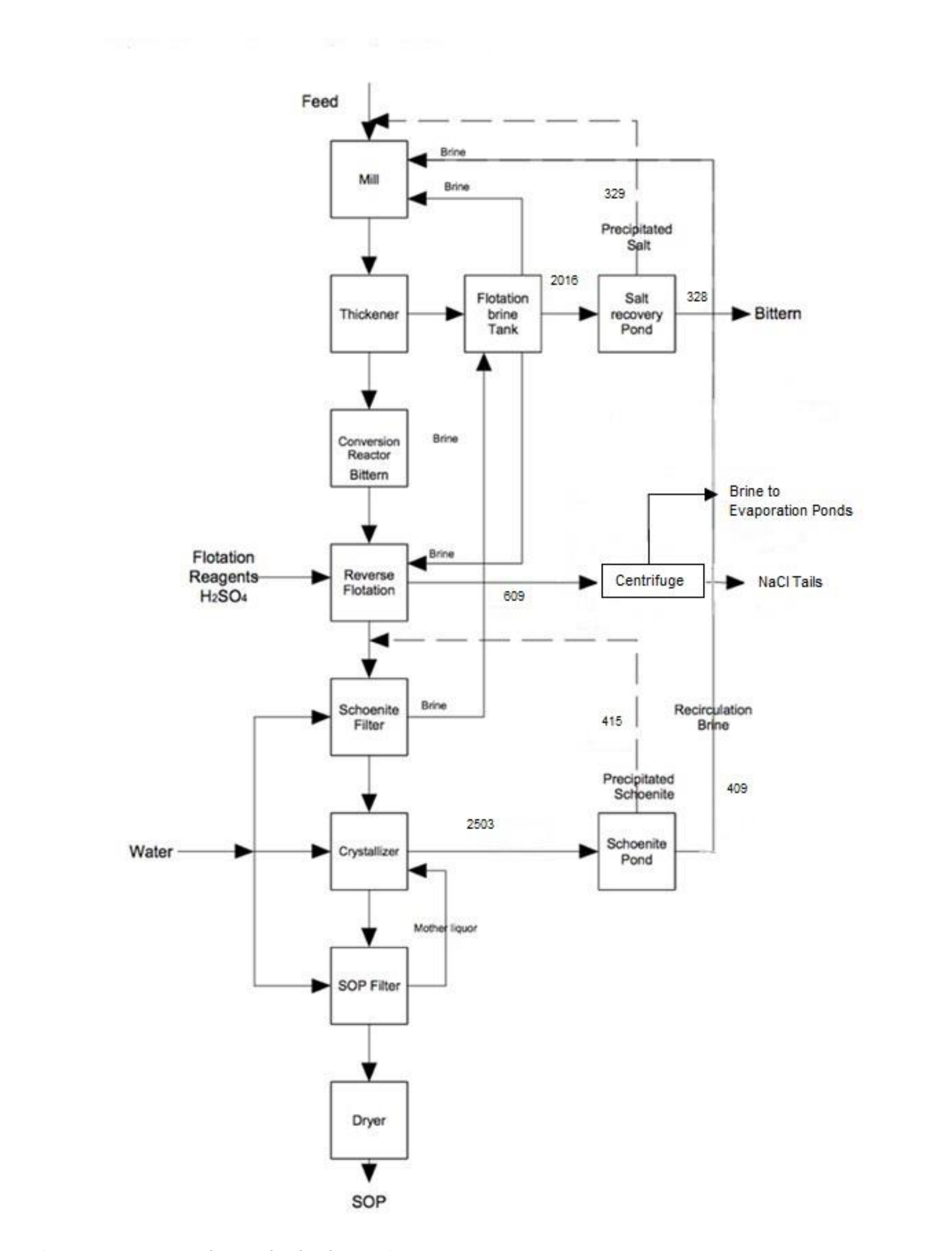
A mixture of solids harvested from evaporation ponds 4 to 7 forms the design basis. Feed is about 46.4% halite, 10.9% sylvite, 8.2% leonite, 7.7% schoenite, 23.9% kainite, 2.7% boric acid as borates and 0.2% polyhalite. Salts are harvested by front-end loader and held in three stockpiles, then blended and passed through a lump breaker. The material is pulped with recycle brine and ground in a rod mill. The discharge is screened, with oversize recycled to the rod mill and undersize sent to a conversion thickener, whose underflow goes to a conversion tank where it mixes with sulphate-rich brine and forms schoenite crystals.
SOP flotation, leaching and crystallization
The schoenite slurry is conditioned with hydrochloric acid for pH control and passes through two conditioning tanks and one mechanical flotation cell, where reagents float sodium chloride. The flotation concentrate, containing the salt, goes to the tailings pond, while the tailings, mostly schoenite with a little entrained salt, go to an agitated leach tank where fresh water removes the last traces of sodium chloride. A belt filter then separates the cake, which a screw conveyor takes to the crystallizer, and the filtrate returns to the brine flotation tank. In the crystallizer, process water, including heated filtered water at 55 °C from the power house, is combined with the schoenite cake. As the material cools, solid SOP precipitates, leaving a sulphate-rich brine. The SOP slurry is dewatered and washed on a belt filter to displace entrained brine.
SOP drying, loadout and salt disposal
A drag conveyor carries the filtered SOP to a product dryer. Exhaust gas passes a cyclone and baghouse before release through a stack, and cyclone underflow rejoins the dryer discharge. Dry SOP is conveyed to a covered storage building, screened and stockpiled, then loaded by front-end loader into a hopper that feeds a bagging system for shipment in one-tonne plastic totes. Sodium chloride tails from flotation go to a centrifuge for debrining. The centrate returns to pond 3, and the cake goes to a temporary stockpile and then to a wet salts storage pile. The report says recycling the brine to pond 3 will be investigated at the pre-feasibility stage, and that metallurgical testing is still needed for flotation retention time, reagent type and confirmation of single-stage flotation.
Additional Interesting Data and Summary
Pond areas are 2,602,299 m2 nominal for each of ponds 1 and 2, 487,931 m2 for ponds 3 and 4, 178,908 m2 for ponds 5, 8 and 9, 81,322 m2 for ponds 6 and 7 and 16,264 m2 for ponds 10 and 11. The ponds use standard civil engineering solutions that are common for salars.
The pond sequence is designed to give lithium a high concentration while sending potassium-bearing salts to the SOP plant, so the project plans two products from one brine, lithium and potash.
Key Processes
- Brine extraction from deep wells
- Solar evaporation in eleven ponds
- Liming to remove magnesium and sulphate
- Brine concentration to 4.7% lithium
- Salt harvesting for potassium sulphate production
- Rod milling and conversion of pond salts
Source: Preliminary Economic Assessment of the Mariana Lithium Brine Project, Salar de Llullaillaco, Salta Province, Argentina, NI 43-101 Technical Report, November 15, 2018.
