

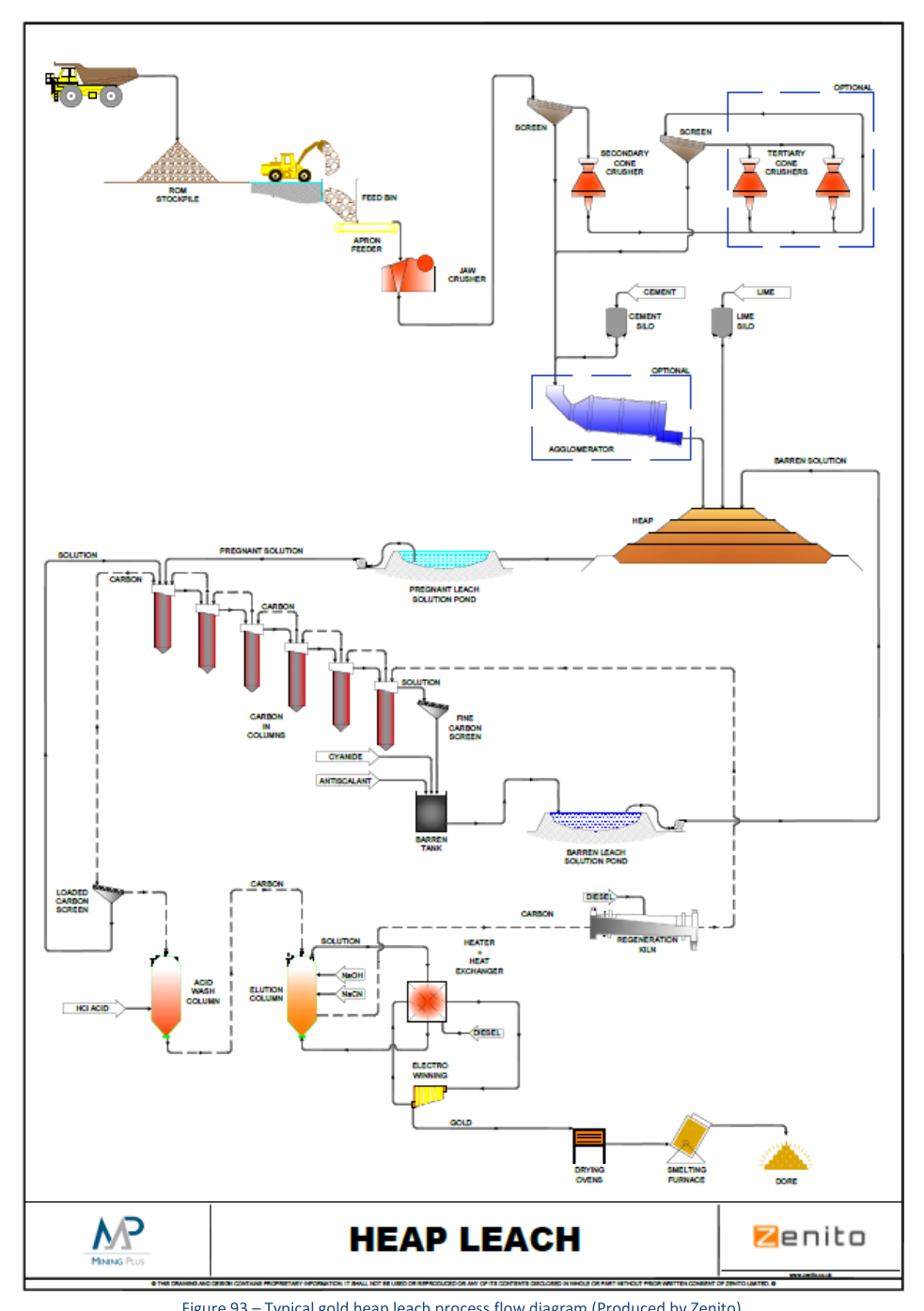
The August 2022 preliminary economic assessment for the Diba and Lakanfla project in the Kayes region describes two-stage crushing to 25 mm, optional cement agglomeration, 100-day drip leaching in 5 m lifts and gold recovery on carbon columns.
Diba and Lakanfla are oxide gold deposits in the Kayes region of Mali, about 450 km west-northwest of Bamako and 100 km south of Kayes. The Diba & Lakanfla Project Heap Leach Preliminary Economic Assessment (NI 43-101) was prepared for Altus Strategies Plc, with an effective and signing date of 1 August 2022. Limited metallurgical test work, commissioned by Etruscan in 2012 and conducted at Endeavour Mining's Tabakoto mine, and other operations in the region indicate that the oxide zone appears amenable to conventional cyanide leaching using agitated tank leach or heap leach. The PEA assumes heap leaching because of lower capital and operating costs and reduced project complexity with a shorter construction time. The report stresses that no detailed heap leach design has been completed, so the system is conceptual only.
Critical Data
| Parameter | Value | Unit | Notes |
|---|---|---|---|
| Oxide throughput | 2.0 | Mtpa | About 4,100 t/d |
| Operating schedule | 24 / 7 | hours per day / days per week | Leaching continuous year-round |
| Crushed product | Finer than 25 | mm | Jaw crusher, screen and cone crusher |
| Heap lift height | 5 | m | Three lifts for a 15 m average height |
| Heap footprint | About 250,000 | m2 | Conceptual |
| Solution application | 8 to 10 | L/h/m2 | Drip emitters |
| Leach cycle | 100 | days | Primary leach |
| Cyanide strength | 0.5 to 1.0 | g/L NaCN | Barren solution pond |
| Solution pH | 10.5 or higher | pH | Lime conditioning |
| Solution ponds | 4 | lined | PLS, BLS, event and polishing |
| Carbon regeneration | About 1,300 | °F | Kiln |
Overview
The proposed facilities are two-stage crushing, screening and agglomeration, heap stacking and leaching, and gold recovery by carbon-in-column (CIC) processing. The concept is a typical flowsheet to make gold doré at optimum recovery while minimizing initial capital and operating costs, and it is similar to operating heap leach mines treating similar material under comparable conditions.
Key Process Stages
Crushing and agglomeration
Haul trucks tip into a ROM bin, and a front-end loader reclaims stocked material. A belt conveyor takes ROM to a primary jaw crusher, whose product goes to a vibrating screen. Screen oversize goes to a surge bin ahead of a secondary cone crusher, whose discharge is planned to be finer than 25 mm. Further studies must test the crushing circuit. If it makes significant fines, an agglomerator would be added, with cement added to the conveyor feed and spray water to bind fines to coarser particles. Lime is added before placement to control heap alkalinity, and the agglomerated material cures on a stockpile.
Heap leaching
The pad is an engineered structure with a gravel or sand base under a clay liner and an impermeable synthetic geomembrane, with perimeter berms, sloping gently to a central PLS collection pond. A leak detection and recovery system with ground wells covers the pad and ponds. A front-end loader and haul truck move cured material to the pad, where it is stacked in 5 m lifts and spread by bulldozer. Barren leach solution is pumped to the top of the heap and dripped on at 8 to 10 L/h/m2 over a 100-day cycle. The report says the proposed heap height needs geotechnical verification and further metallurgical test work.
Solution ponds
Four lined ponds are planned: a PLS pond, a BLS pond for gold-depleted solution from the CIC facility, an event or overflow pond for excess process solution in the rainy season, and a polishing pond. Excess wet season solution would be treated with calcium hypochlorite and discharged to the polishing pond to reduce cyanide before discharge or reuse.
Carbon-in-column recovery and refining
PLS is pumped to a holding tank, a pressure clarifier and a vacuum de-aeration tower, then through a series of activated carbon columns. Loaded carbon is stripped with a heated sodium hydroxide and cyanide solution, and the gold is plated in electrowinning cells onto stainless steel cathodes, removed by high-pressure spray and melted into doré bars for an off-site refinery. Furnace slag is occasionally re-smelted. Stripped carbon is reactivated in a kiln at about 1,300 °F, cooled and screened to remove fines. BLS goes back to the BLS pond for conditioning with lime and cyanide before recycling.
Additional Interesting Data and Summary
The PEA treats the crushing circuit as untested, and notes that the undersize from the vibrating screen and the crushed material from the cone crusher feed a common conveyor to the agglomerator. The permeability gain from agglomeration is meant to improve gold extraction.
Event pond solution is recycled to the heap leach circuit when normal operation resumes, and the overflow pond also supplies make-up water by pumping to the BLS pond.
Water and air supply
Two separate systems supply freshwater and process water. Freshwater from the pits, a nearby river or wells goes to a fresh and fire water tank with a standpipe that keeps a two-hour supply of fire water, and serves fire water, slurry pumps and reagent make-up. Potable water comes separately from a nearby river and is treated and stored before delivery. Process water is needed for agglomeration and heap irrigation, and BLS from the CIC circuit is reused for irrigation, with freshwater from the pit, runoff catchment and wells added to offset water and evaporation losses, especially in the dry months. Air comes from a portable compressor for crushing, dedicated compressors for the CIC circuit, and a dried instrument air supply from the CIC compressors.
The project is isolated from public infrastructure apart from the dirt road between Kéniéba and Kayes, but lies near the Sadiola gold mine, where services such as food, accommodation, a hospital, communications, fuel, workshops and small commerce can be found.
Key Processes
- Two-stage crushing and screening to finer than 25 mm
- Optional cement and lime agglomeration
- Heap stacking in 5 m lifts
- Drip cyanide leaching over 100 days
- Carbon-in-column adsorption
- Stripping, electrowinning and doré smelting
- Calcium hypochlorite treatment of excess solution
Source: Diba & Lakanfla Project Heap Leach Preliminary Economic Assessment (NI43-101), Mali, August 1, 2022.
