

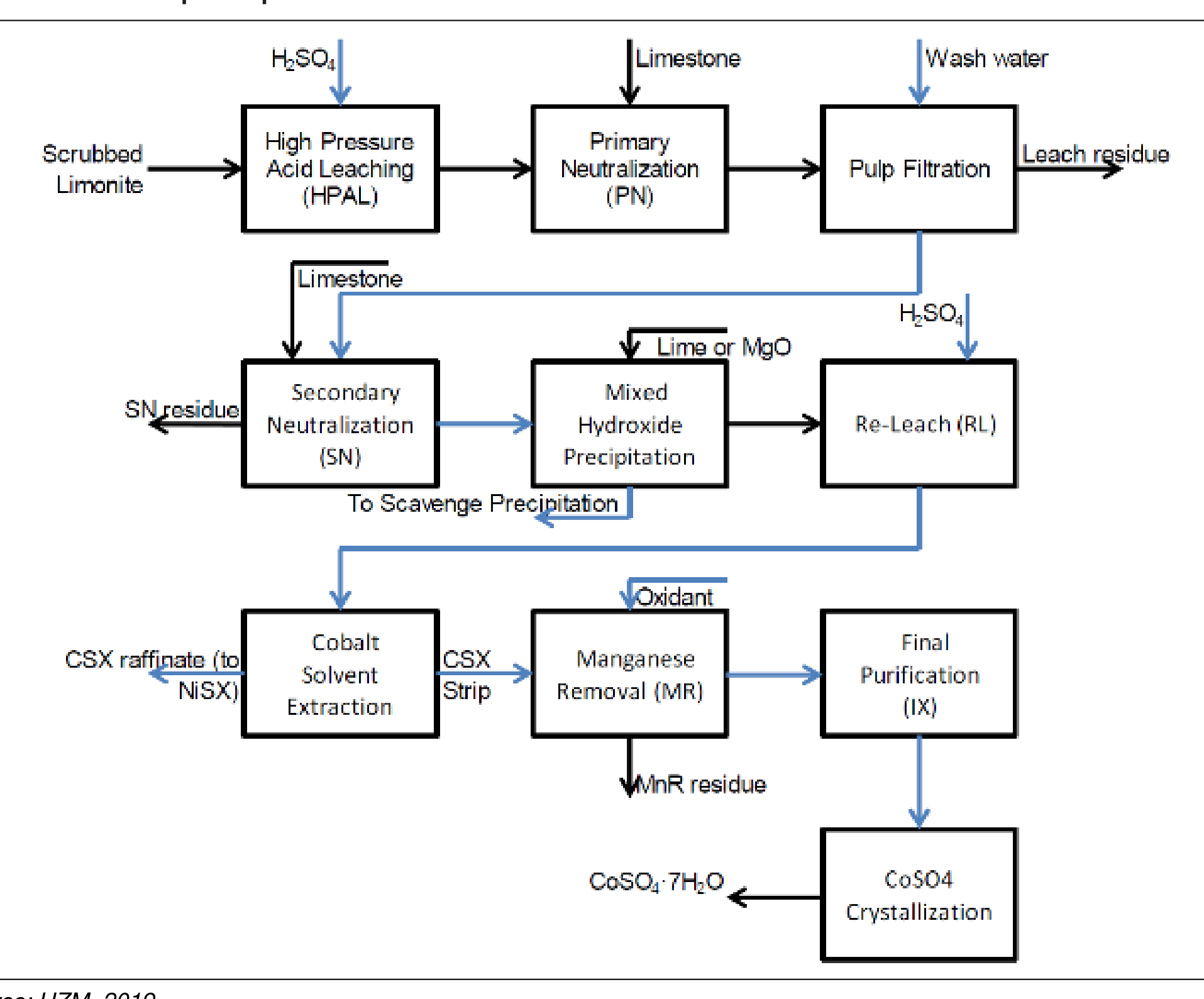
Horizonte Minerals' October 2019 pre-feasibility study for the Vermelho project in Pará State, Brazil rejects 2.34 Mt/y of silica, pressure leaches 2 Mt/y of concentrate, and refines a mixed sulphide into battery-grade nickel and cobalt sulphates.
The Vermelho Project is a nickel and cobalt laterite project in Pará State, Brazil, wholly owned by Horizonte Minerals Plc. The NI 43-101 Technical Report on the Prefeasibility Study is dated 31 October 2019. Simulus developed the engineering drawings, capital and operating cost estimates and implementation plan for the processing facility, based on metallurgical testwork and the mine schedule. The process selected is the production of separate high-purity nickel and cobalt sulphate products via high-pressure acid leaching (HPAL), mixed sulphide precipitation (MSP), pressure oxidation (POX) of the MSP, solvent extraction (SX) of the leached metals in the POX discharge, and crystallisation of the final nickel and cobalt sulphate products and a kieserite by-product. The plant is designed on 7,446 operating hours a year, or 85% overall uptime.
Critical Data
| Parameter | Value | Unit | Notes |
|---|---|---|---|
| ROM ore processed | 4.34 | Mt/y | Two trains of beneficiation |
| Coarse siliceous waste rejected | 2.34 | Mt/y | Plus 0.15 mm |
| HPAL concentrate feed | 2 | Mt/y | 1 Mt/y per stage |
| Crushing availability | 75 | % | Rest of plant 85% |
| ROM feed per train | 291 | dt/h | 20.6% moisture |
| Autoclave temperature | 250 | °C | 4,600 kPa absolute |
| Autoclave residence time | 60 | min | Six compartments |
| Acid consumption | 347 | kg/t | 40 g/L free acid at discharge |
| Nickel and cobalt extraction | 97 | % | Each |
| Neutralisation limestone | 225 | kg/t | pH 2.5 to 3.0 |
| Residue filtration stages | 3 | stages | 32% cake moisture |
| PLS nickel / cobalt | 7.24 / 0.38 | g/L | Magnesium 42.9 g/L |
| Stage 1 start / Stage 2 start | Year 1 / Year 4 | Not applicable | Each stage 1 Mt/y of concentrate |
Overview
The prior owner's earlier study chose a flowsheet that ended in nickel and cobalt cathode. The current project is a variation of another option from that study and replaces hydrogen reduction and briquetting with crystallisation, because a market for battery-grade nickel and cobalt sulphate has emerged since 2002 and those products earn a premium to metal prices. A kieserite crystallisation step removes magnesium from the process water and makes a potentially saleable by-product. The mixed sulphide intermediate carries higher nickel and cobalt grades than a mixed hydroxide, which lowers shipping costs and widens the customer list. The plant is built in two stages, so first-stage cash flow can fund the second stage. A single refinery treats mixed sulphide from both stages.
Key Process Stages
Beneficiation
Two trains upgrade ROM ore by rejecting free silica. Trucks tip onto a fixed 1 m grizzly with a hydraulic rock breaker, and primary and secondary toothed roll crushers reduce ore from 1,000 mm top size to a P80 of 120 mm, with tertiary crushing to 40 mm. A radial stacker builds a stockpile with seven days of capacity for blending and surge. A drum scrubber with three minutes of residence time and 55% solids liberates nickel-bearing fines, and a double-deck banana screen with 30 mm and 6.3 mm apertures separates coarse material. Undersize passes a 3.5 mm grit screen to primary hydrocyclones, then attrition cells for four minutes and secondary cyclones, with a stack of high-frequency screens at 150 µm. Coarse silica reports to a rejects stockpile after washing with kieserite condensate or raw water to remove soluble magnesium sulphate, and the fines go to a paste thickener before the autoclave.
High-pressure acid leach
Each of the two trains has a slurry feed tank, medium and high-pressure direct contact heaters, a six-compartment horizontal autoclave of titanium GR17 clad steel, three flash cooling stages and pumps. Feed at 43% solids is heated to 144 °C and 192 °C using flash steam, then pumped by a piston diaphragm pump into the autoclave at 134 dt/h. Concentrated sulphuric acid is sparged into the first two compartments through a tantalum-lined titanium lance, with high-pressure steam holding 250 °C. The 60-minute residence time optimizes nickel and cobalt extraction while minimizing net iron extraction. Ceramic choke valves reduce pressure through three flash vessels at 194, 146 and 103 °C.
Neutralisation and pre-reduction
Each train has four neutralisation tanks and two pre-reduction tanks. Limestone slurry neutralises residual free acid, precipitating gypsum and most of the iron, aluminium and chromium as hydroxides, with the pH controlled so that nickel and cobalt do not co-precipitate. A minor recycle of impurity removal filter cake re-leaches contained nickel and cobalt. Hydrogen sulphide gas then reduces iron (III) and chromium (VI) to iron (II) and chromium (III), partially precipitating copper, and removes toxic chromium (VI) to cut impurities in the MSP intermediate. Carbon dioxide vent gas is sent to a stack, and the pre-reduction vent returns to the MSP scrubber to recover hydrogen sulphide.
Leach residue filtration
Residue is filtered in three stages with counter-current re-pulp washing in recycled process water, specified because HPAL residues have low cake porosity, long wash cycles and poor wash recoveries. Each stage in each train has three filters, designed with a 1.2 factor, so throughput is limited to 80% with two of three filters online. Stage 3 cake goes by belt and conveyors to dry stacking, and stage 1 filtrate is pumped to a PLS pond and polished in pressure candle filters on the way to the MSP area.
Additional Interesting Data and Summary
The remaining plant areas are MSP precipitation, POX of the mixed sulphide, impurity removal, cobalt solvent extraction, nickel and cobalt sulphate crystallisation, acid liquor neutralisation, kieserite crystallisation, a sulphuric acid plant, and reagents and utilities. All slurry pumps have duty and standby units, but liquor pumps only have a duty pump.
The previous owner evaluated nine flowsheet options in its prior study, all built on HPAL, including mixed hydroxide production, ammonia re-leach routes, carbonate, oxide and sulphide products, and hydrogen reduction to briquettes. Option 4, nickel and cobalt cathode, was selected, and option 9 ranked second on NPV and IRR with marginally higher capital cost.
Key Processes
- Toothed roll crushing and scrubbing
- Hydrocyclone and attrition beneficiation to reject silica
- High-pressure acid leaching in titanium-clad autoclaves
- Limestone neutralisation and hydrogen sulphide pre-reduction
- Three-stage counter-current residue filtration
- Mixed sulphide precipitation and pressure oxidation
- Solvent extraction and sulphate crystallisation
- Kieserite crystallisation
Source: NI 43-101 Technical Report, Vermelho Project, Pará State, Brazil, October 31, 2019.
Project website: Vermelho Nickel-Cobalt Project
