

New Millennium Iron's July 2016 pre-feasibility study for the NuTac project in the Labrador Trough designs a semi-mobile crushing, HPGR and magnetic separation plant with optional flotation to make blast furnace or direct reduction grade pellet feed.
The NuTac Project is a taconite iron ore project in the Labrador Trough, on the Quebec and Labrador border region served by an existing railway to Sept-Îles. New Millennium Iron Corp. (NML) announced the NuTac initiative in September 2015 and commissioned this NI 43-101 Technical Report on the Pre-Feasibility Study, which has an issue date of July 21, 2016 and an effective date of June 9, 2016. The process plant would extract magnetite from the taconite reserves of the KéMag Deposit. The operation mills about 35 Mt/y of iron-bearing mineralisation to produce 8.7 Mt/y of magnetite concentrate. The plant includes multiple comminution stages combined with conventional magnetite recovery, and a flotation plant that further reduces silica to make a high-grade, low-SiO2 concentrate suitable for blast furnace (BF) and direct reduction (DR) pellets or for sale as pellet feed. The design life is 25 years.
Critical Data
| Parameter | Value | Unit | Notes |
|---|---|---|---|
| Run-of-mine feed | 34,448,300 | t/y | About 35 Mt/y, 2% moisture |
| Concentrate target | 8,708,700 | t/y | Dry |
| Weight recovery including flotation | 25.28 | % | Davis tube weight recovery of feed 27.3% |
| Feed grade | 31.4 | % Fe | 19.1% magnetic iron |
| Concentrate silica | 1.5 to 2.25 | % | After flotation |
| Operating days | 360 | days/y | 8,640 scheduled hours |
| Primary / secondary crushing availability | 70 / 85 | % | Not applicable |
| Grinding, concentration and flotation availability | 92 | % | Not applicable |
| Ore density | 3.41 | g/mL | Crushing work index 18.1 kWh/t |
| Ball mill work index | 13.7 | kWh/t | At 75 µm |
| Abrasion index | 0.81 | g | Not applicable |
| Primary crushing stations | 2 | semi-mobile | 3,500 t/h rated, 2,850 t/h nominal each |
| Dry stack tailings capacity | 25 | years | Not applicable |
Overview
The design philosophy is a robust system with the most effective means of concentrating the ore. Semi-mobile crushing units sit near the pit to cut haulage distances, and conventional secondary crushing and screening feed a primary stockpile that covers maintenance and weather delays. A two-pass high pressure grinding roll (HPGR) circuit with embedded wet cobber low intensity magnetic separators (LIMS) follows. Two steps of VertiMill regrinding with rougher LIMS, fine screening, desliming and finisher LIMS then produce the concentrate. Tailings are filtered and dry stacked, and concentrate is dewatered, with drying in winter for rail transport.
Key Process Stages
Crushing
The primary crushing circuit uses two semi-mobile in-pit crushing stations, each rated at 3,500 t/h and processing a nominal 2,850 t/h of ROM at 2% moisture, taking feed below 1.5 m to minus 250 mm. Double-deck screens cut the crushed ore at 50 mm. The fine fraction goes to the secondary ore stockpile ahead of the HPGR circuit, and oversize goes to an uncovered primary stockpile of 250,000 t, of which about 100,000 t is live, which buffers major crusher maintenance and winter storms. Bulldozers push dead-zone ore into the reclaim feeders. Reclaimed ore feeds three Metso MP 1250 cone crushers with 930 kW motors, with at least two running at any time. Cone crusher product goes to secondary screens, whose undersize joins the fines in a covered secondary stockpile of minus 50 mm ore, holding 60,000 t, with 16,000 t live, or four hours of live storage.
HPGR grinding and cobbing
A closed two-pass HPGR circuit with screening embeds wet cobber LIMS, and the flowsheet separates a coarse tails stream with a hydrosizer. The design uses HPGR followed by VertiMills for final grinding, a flowsheet that NML initiated in November 2011 and confirmed by pilot plant testwork between 2012 and 2015.
VertiMill regrinding and finishing
The magnetic separation plant has four steps: HPGR and cobber separation, secondary grinding and rougher separation, tertiary grinding and fine screening, and desliming and finisher separation. It uses a large amount of water, so the plant sits on the slope above the pit, with two parallel lines and a common central tailings launder that lets tailings flow by gravity to the tailings thickener. Deslimers and finisher LIMS then clean the product, and deslimer and finisher tails join the tailings stream.
Flotation
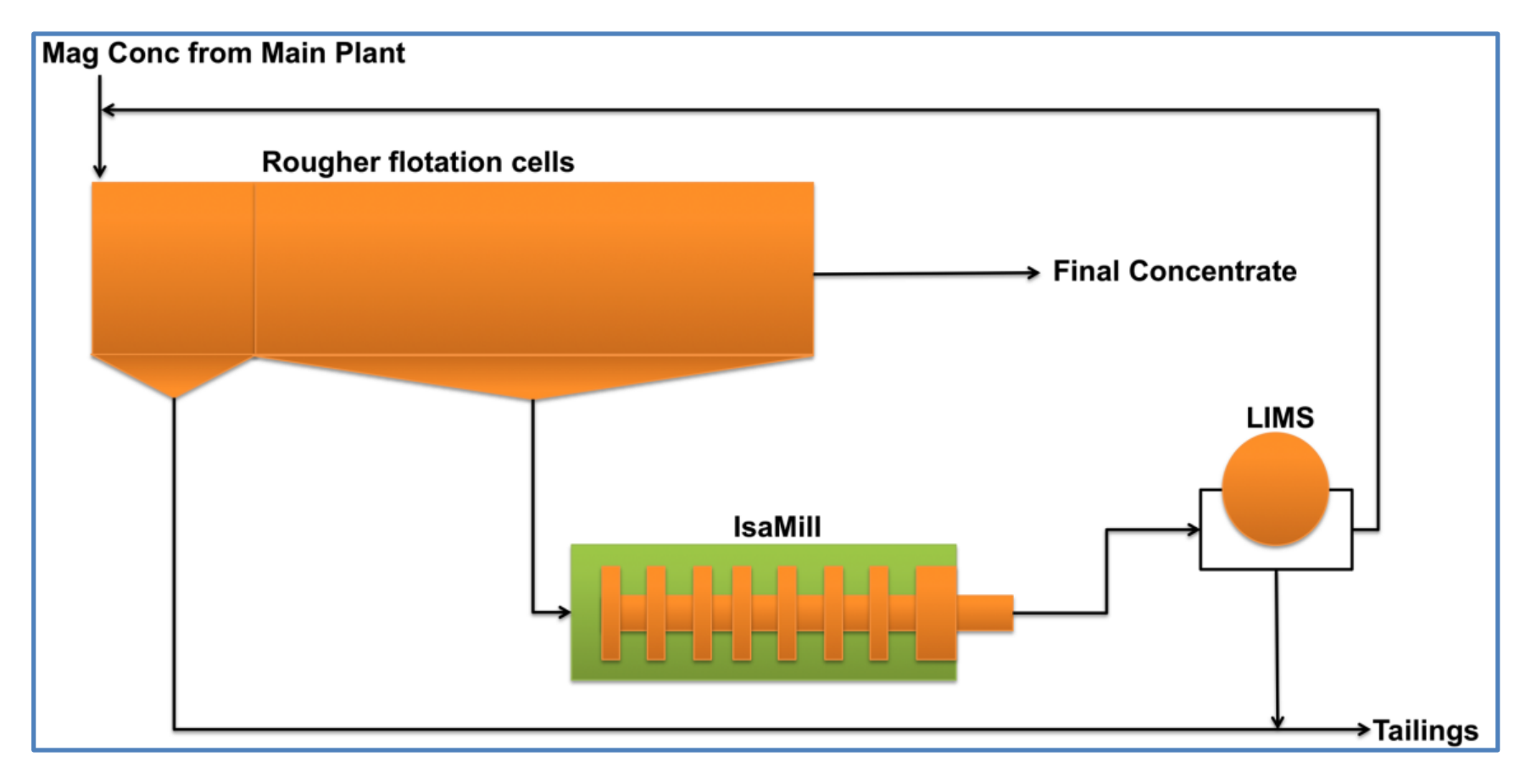
Depending on the silica level the pellet plant needs, part or all of the final concentrate goes to the flotation circuit, which runs with 92% availability. Reagents are added in the flotation plant, and flotation concentrate and tailings are separately thickened.
Dewatering and tailings
Final concentrate is thickened, filtered and partially dried if required for transport via the existing railway to pellet facilities at Sept-Îles. All tailings are dewatered and carried by conveyor to the dry stack tailings facility (DSTF). Water recovered in concentrate and tailings dewatering is recycled to the process plant.
Additional Interesting Data and Summary
The dominant iron mineral is magnetite, about 96% of the concentrate by mass. Hematite is non-magnetic and is not recovered unless it is associated with a magnetite particle, which is why magnetite weight recovery is critical. The design mineralogy is 27.4% magnetite as Davis tube weight recovery, 13% hematite and 60% quartz representing gangue.
The plant sits west of the pit on basement rock, on land sloping 10% or less to the east. Tailings are stacked north-west of the plant on the same watershed, with capacity for 25 years. A site water pond collects impacted water from the pit, tailings stack, plant site and waste dump for treatment and reuse as make-up. If needed, a fresh water intake would be installed on Lac Gillespie, and excess treated water would go to natural water bodies. The process design relies on testwork on representative samples from LabMag and KéMag, tested in pilot plants from 2005 to 2015.
Key Processes
- Semi-mobile primary crushing and conventional secondary crushing
- Two-pass HPGR grinding with cobber LIMS
- Two-step VertiMill regrinding with rougher and finisher LIMS
- Fine screening and desliming
- Flotation for silica reduction
- Concentrate thickening, filtration and winter drying
- Tailings filtration and dry stacking
Source: NI 43-101 Technical Report on the Pre-Feasibility Study on NuTac Project, July 21, 2016.
