

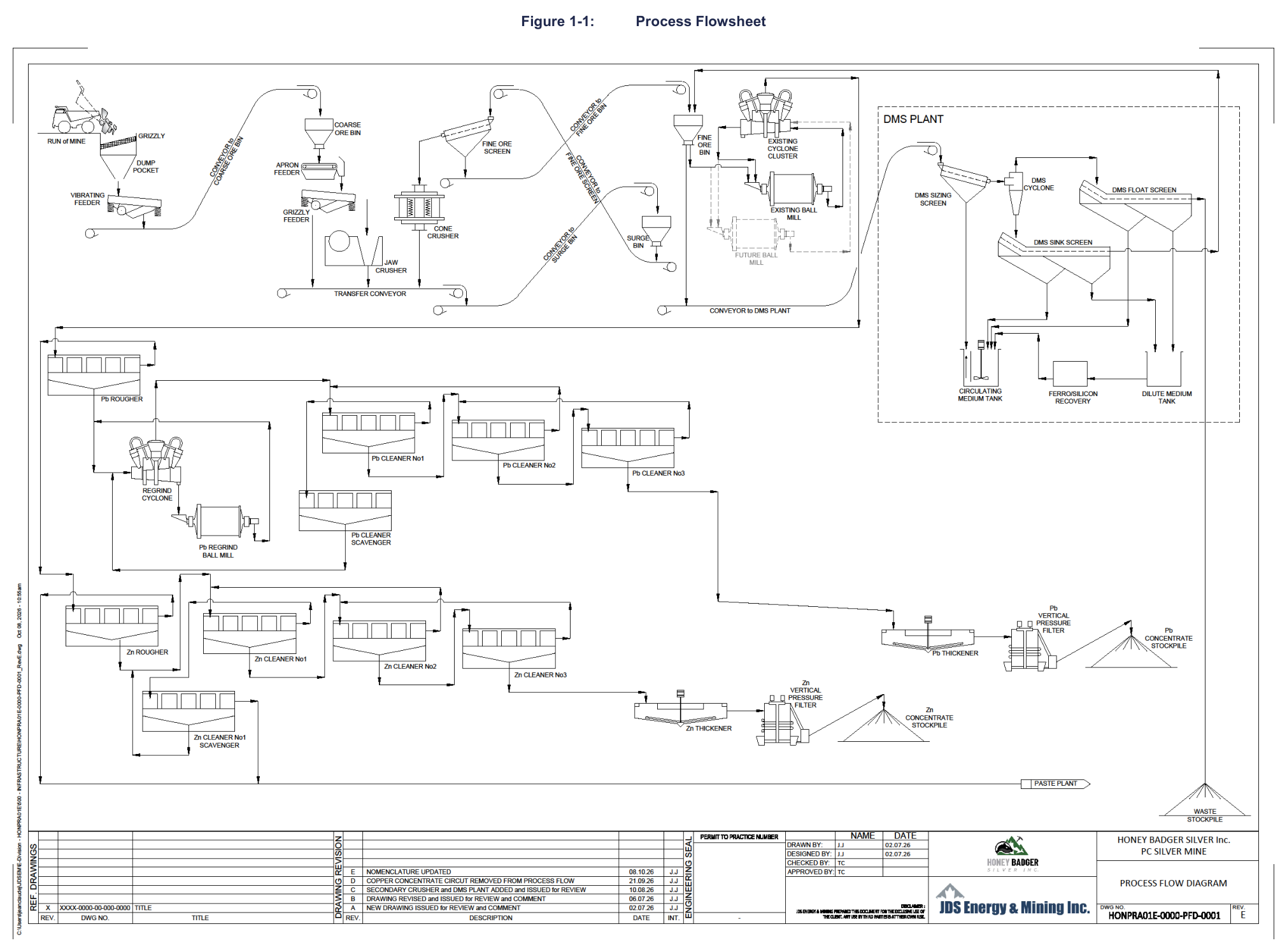
The PC Silver Mine processing plan reuses the mill equipment installed in the early 1980s and adds dense media separation, a second ball mill and new flotation cells.
Honey Badger Silver Inc. owns the PC Silver Mine in the Northwest Territories. The property sits north of the Nahanni National Park Reserve, and the October 15, 2026 Preliminary Economic Assessment describes it as a silver mine with lead, zinc and copper mineralisation. The study is a PEA. The current process design reuses equipment that was moved from another mine and installed at the site in 1981 and 1982. Throughput rises to 2,400 t/d. The crushing plant is the only area kept without modification. The dense media separation plant is new and receives feed by a new conveyor from the existing fine mill feed bin. A new ball mill joins the grinding circuit while the existing mill is refurbished. The flotation and dewatering circuits will be refurbished. Every pump and pump box will be bought new.
Critical Data
| Parameter | Value | Unit | Notes |
|---|---|---|---|
| Plant throughput | 2,400 | t/d | Design value |
| Annual plant throughput | 876,000 | t/a | Design value |
| Crusher availability | 70 | % | Design value |
| Crusher throughput | 143 | t/h | Estimated value |
| Crusher size | 24 x 36 | Not applicable | Design value; one crusher |
| Dense media separation feed rejected | 36.5 | % | Test result |
| Silver rejection by dense media separation | 97.40 | % | Test result |
| Lead rejection by dense media separation | 97.50 | % | Test result |
| Zinc rejection by dense media separation | 95.60 | % | Test result |
| Copper rejection by dense media separation | 97.20 | % | Test result |
| Iron rejection by dense media separation | 100.00 | % | Test result |
| Mill and flotation availability | 92 | % | Design value |
| Mill throughput | 69 | t/h | Estimated value |
| Bond work index | 13 | kWh/t | Test result |
| Primary grind size | 150 | µm | Test result, P80 |
| Lead concentrate regrind size | 40 | µm | Test result, P80 |
| Head grade, lead | 6.14 | % | Estimated value |
| Head grade, zinc | 8.52 | % | Estimated value |
| Head grade, copper | 0.25 | % | Estimated value |
| Head grade, silver | 112.5 | g/t | Estimated value |
| Flotation recovery, lead | 87.0 | % | Test result |
| Flotation recovery, zinc | 86.9 | % | Test result |
| Flotation recovery, copper | 95 | % | Test result |
| Flotation recovery, silver | 93.8 | % | Test result |
| Lead concentrate grade | 60 | % | Design value |
| Zinc concentrate grade | 58 | % | Design value |
| Lead concentrate filter cake moisture | 8 | % | Design value |
| Zinc concentrate filter cake moisture | 8 | % | Design value |
| Lead concentrate thickener diameter | 10.7 | m | Existing unit |
| Zinc concentrate thickener diameter | 10.7 | m | Existing unit |
| Thickened concentrate solids | 65 | % | Approximate value |
| Process plant personnel | 82 | Not applicable | Staff and hourly total |
Overview
Table 17-1 splits the process design criteria into design, estimated and test values, and the table above keeps that distinction. The plant flows from crushing through dense media separation to grinding, then lead and zinc sequential flotation, concentrate dewatering and tailings paste preparation.
The dense media separator rejects 36.5% of the feed mass in test work. The rejection stream carries very little of the valuable metal, at 97.40% silver, 97.50% lead, 95.60% zinc and 97.20% copper reporting to the sink. Iron reports entirely to the sink at 100.00%. Those figures come from test work and describe how the unit divides the rock. The design then sets flotation recovery at 87.0% lead, 86.9% zinc, 95% copper and 93.8% silver. The concentrate grades planned are 60% lead and 58% zinc.
Throughput is fixed at 2,400 t/d, or 876,000 t/a. Crusher availability is designed at 70% and crusher throughput estimated at 143 t/h. Mill and flotation availability is designed at 92%, with mill throughput estimated at 69 t/h. The Bond work index is 13 kWh/t.
Key Process Stages
Crushing. The existing crushing circuit is refurbished and comprises a primary unit and a secondary unit in closed circuit with a vibrating screen. Run-of-mine feed is reduced to 80% passing 12 mm. Major equipment includes a 40 t live capacity dump pocket with a fixed grizzly and vibrating feeder, a 136 t coarse feed surge bin with an apron feeder and grizzly bars, and a Kue-Ken 36 inch by 24 inch (914 mm by 610 mm) jaw crusher. A 45 t secondary feed surge bin with a belt feeder feeds a double deck screen with 25 mm and 15 mm apertures and a Symons Nordberg 5.5 ft (1.7 m) shorthead cone crusher. Conveyors carry a metal detector and magnetic separator, and a 1,800 t fine mill feed bin with a reversible belt feeder serves the circuit. Dust collection systems are included.
Dense media separation. This new plant rejects gangue to cut effective feed tonnage and lift grades going into grinding and flotation. Feed passes a desliming screen, which bypasses material too fine for the separator. Screen oversize enters the dense media separator for separation by rock density. The float fraction goes to an uncovered 200 t temporary stockpile and then by front-end loader and haul truck to the waste rock storage facility. The coarse sink fraction goes to the ball mills. The plant sits in a new heated building connected to the mill building and includes a Condor two-stage DM separator, Sepro HB 1.8 m by 4.8 m drain and rinse screens, a heavy media preparation system, circulating and dilute heavy media handling systems with a wet magnetic separator, plus tanks, pumps and conveyors.
Grinding. Two ball mills, one existing and one new, run in closed circuit with classifying hydro-cyclones inside the existing mill building. The existing mill is a refurbished 10 ft (3.05 m) diameter by 14 ft (4.27 m) long unit with a 700 horsepower (522 kW) motor. The new mill has the same dimensions or similar, with a 700 horsepower (522 kW) motor. The circuit adds a new hydro-cyclone pack, discharge pump box, hydro-cyclone feed pumps and feed conveyors for both mills, along with a steel ball storage bin and ball bucket. Primary grind is 150 µm P80.
Lead flotation. The lead circuit runs rougher, regrind and three cleaner stages. One existing rougher conditioning tank with a mechanical agitator and existing lead rougher cells lead the circuit. An existing regrind ball mill, 6.5 ft (2 m) diameter by 5 ft (1.5 m) long, works with cyclones. Refurbished cleaner conditioning tanks with mechanical agitators feed existing primary, scavenger, secondary and tertiary cleaner cells. Lead rougher concentrate is reground to 40 µm P80. On equipment, the report’s flotation introduction says all cells in both circuits and the regrind ball mill will be new, while its equipment lists name existing cells and an existing regrind mill, and its plant design overview says the flotation circuits will be refurbished.
Zinc flotation. The zinc circuit runs rougher flotation followed by three cleaner stages. Existing rougher conditioning tanks each have a mechanical agitator. Existing rougher cells and one existing cleaner conditioning tank with a mechanical agitator feed existing primary, scavenger, secondary and tertiary cleaner cells.
Reagents and air. Chemical reagents are added to the flotation circuits to aid lead, zinc and silver recovery. A solid reagent preparation unit includes a bulk handling system, a mixing tank for blending reagent with fresh water to the required strength, a holding tank and reagent pumps. Liquid reagents are diluted before reaching the flotation circuits or pumped directly without dilution. The existing reagent preparation area is refurbished and used, with level indicators and instrumentation on storage tanks to limit spills. Ventilation, fire and safety protection and Material Safety Data Sheet stations are provided, and every reagent line and addition point is labelled to Workplace Hazardous Materials Information Systems standards. Operators receive WHMIS training and additional training for safe reagent handling. Bulk reagents are stored inside the mill building. Two existing plant air compressors in duty and standby service are refurbished to supply high-pressure air for general plant use, pressure filters and instrumentation. Instrumentation air is dried and held in a new dedicated air receiver. The paste plant has its own air system. Two existing blowers are refurbished to supply all flotation cells.
Concentrate dewatering. Both concentrates are thickened and pressure filtered, then stored separately before shipment. Lead concentrate is thickened in the existing 10.7 m thickener, and underflow is pumped by a new pump to the existing lead surge tank at about 65% solids. The surge tank holds concentrate for roughly four hours to cover minor filter and load-out maintenance, and extra capacity comes from holding concentrate in the thickener. Thickener overflow returns as process water. The existing refurbished Larox pressure filter dewaters the concentrate to 8% moisture. Filtrate returns to the thickener and filter cake goes to the lead stockpile. The zinc circuit uses the existing 10.7 m thickener and works the same way, with a new pump, an existing surge tank holding about three hours of concentrate, and a new Larox or similar pressure filter delivering 8% moisture cake to a dedicated stockpile next to the lead stockpile. A new concentrate storage building holds both products in dedicated stockpiles and includes concrete foundations, a concrete slab, HVAC, a dust control system and a vacuum system for spill cleanup.
Tailings and water. Final tailings from zinc flotation go to the paste plant thickener and then to the backfill plant to make paste for backfilling underground stopes. The paste plant and delivery system are new. Fresh water comes from the water treatment plant and serves fire water and gland services for slurry pumps when contact water cannot be used. Process water comes from concentrate thickener overflows and from Cell A of the water storage pond, returning to the flotation circuits for reuse. Paste thickener overflow and excess paste plant water go to Cell A, where flotation reagents are allowed to degrade for about two months before reuse. No treatment of the process water is required. Cell A water also serves gland services and reagent make-up, and a ring main distributes process water through the plant.
Additional Interesting Data and Summary
The process plant workforce totals 82 people. Mill operations covers management, superintendents, an admin assistant, four shift foremen, control room, crusher, grinding, flotation, dense media separation and filter operators, and eight mill labourers. Mill maintenance covers two maintenance superintendents, two foremen, two planners, four electricians, four millwrights, two instrumentation staff and four apprentices. Mill technical staff include a chief metallurgist, two senior metallurgists, four metallurgists, a chief assayer, two senior assayers, four fire assay technicians and eight assay technicians.
The flowsheet recovers lead and zinc into separate concentrates while dense media separation removes a large share of the feed before grinding. Set against the design throughput of 2,400 t/d, the test work behind the rejection and recovery figures forms the basis for sizing each circuit.
Key Processes
- Two-stage crushing to 80% passing 12 mm
- Dense media separation with desliming and heavy media recovery
- Two-mill grinding circuit with hydro-cyclone classification
- Lead rougher, regrind and three cleaner stages
- Zinc rougher and three cleaner stages
- Thickening and pressure filtration of both concentrates to 8% moisture
- Paste plant for underground backfill
- Process water reuse from thickener overflows and the water storage pond
Source: Preliminary Economic Assessment for the PC Silver Mine, 2026-10-15. Project website: PC Silver Mine
