

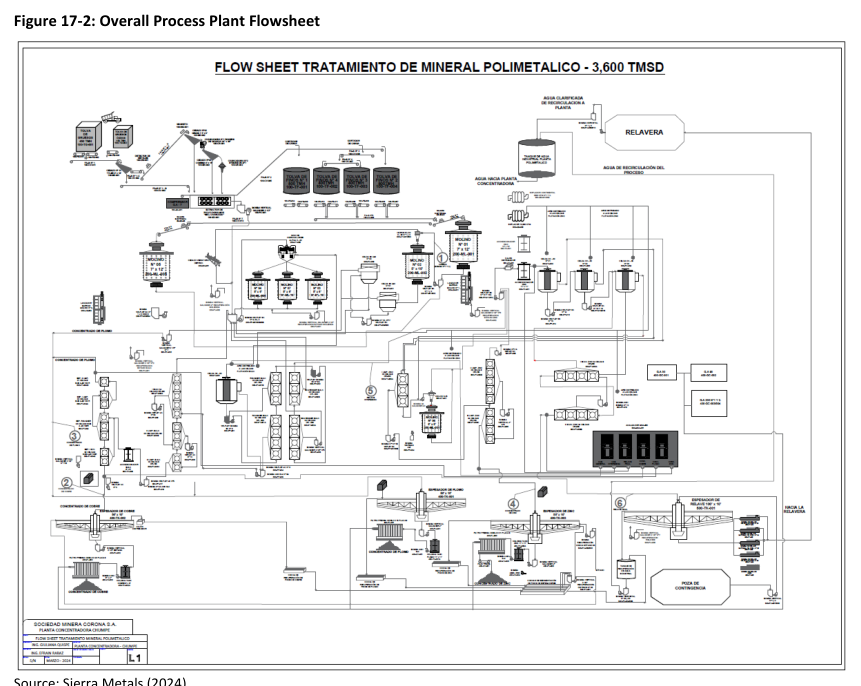
The 2023 technical report on Sierra Metals' Yauricocha mine in Yauyos, Peru, records 2,700 t/d of throughput in 2023, held back by permitting below the 1120 level, with recoveries of about 75% copper, 79% lead and 83% zinc.
The Technical Report on the Yauricocha Mine, Yauyos, Peru, was prepared by AGP Mining Consultants Inc. for Sierra Metals Inc. with an effective date of December 31, 2023 and a report date of June 14, 2024. The Yauricocha plant treats polymetallic sulphide ore by conventional crushing, rod and ball milling and flotation to produce separate copper, lead and zinc concentrates. Its nominal capacity is 3,600 t/d. Historically it handled 3,100 t/d of sulphide ore and 500 t/d of oxide ore, but no oxide material has been treated since 2018.
Critical Data
| Parameter | Value | Unit | Notes |
|---|---|---|---|
| Report effective date | December 31, 2023 | Not applicable | AGP Mining Consultants for Sierra Metals Inc. |
| Nominal capacity | 3,600 | t/d | Sulphide ore |
| Average throughput, 2023 | 2,700 | t/d | Limited by authorization below the 1120 level |
| Head grade, 2023 average | 0.87% Cu, 0.76% Pb, 2.42% Zn | Not applicable | Not applicable |
| Recovery, 2023 average | About 75 Cu, 79 Pb, 83 Zn | % | Not applicable |
| Grind | 80% passing 104 | µm | Two grinding lines |
| Crushing | Two stages, 24 x 36 inch jaw and cone crusher | Not applicable | Four crushed ore silos |
| Grinding mills | 7 x 12 ft rod mill; 8 x 10 ft and 8 x 6 ft ball mills | Not applicable | Table 17-1 |
| Tailings thickener | 100 ft diameter | Not applicable | Tailings to a conventional TSF |
| Power | Local grid via 69 kV line | Not applicable | Not applicable |
Overview
The report gives the 2023 average throughput as 2,700 t/d. This was because government authorization to mine ore below the 1120 level was slow, and it was expected in mid-2024. The plant itself is at full capacity to process 3,600 t/d. Over 2023 it treated ore averaging about 0.87% Cu, 0.76% Pb and 2.42% Zn and recovered about 75% of the copper, 79% of the lead and 83% of the zinc.
Recent upgrades to improve availability and reliability include a new primary screen in the crushing plant, upgraded grinding cyclones, a new motor and variable speed drive on mill No. 2, a high-rate rake mechanism in the zinc thickener, and more flotation blower capacity with better air control.
Key Process Stages
Crushing. Run-of-mine ore is tipped into the crusher feed bin or stockpiled nearby, and apron feeders feed a jaw crusher in open circuit. A double-deck vibrating screen sends oversize to a secondary cone crusher, whose product returns to the screen. Screen undersize goes to one of four crushed ore silos.
Grinding. Belt feeders reclaim ore from the silos to two grinding lines arranged in primary, secondary and tertiary stages, with a rod mill and ball mills, producing an average grind of 80% passing 104 µm. Balls are added manually in batches, and rods are replaced as needed.
Flotation. The circuit includes flash lead flotation, a bulk lead-copper rougher and cleaner circuit, lead-copper separation, a lead cleaner circuit, and zinc rougher, scavenger and three cleaner stages.
Dewatering. The copper, lead and zinc concentrates are each thickened and filtered in plate-and-frame pressure filters for sale. Concentrates travel by 30 t truck to customers in Peru.
Tailings and water. Final tails are pumped to the tailings storage facility, and process water is reclaimed from the tailings pond. Thickener overflows and reclaim water supply most of the plant's water. Fresh water is used for gland seals and reagent dilution.
Additional Interesting Data and Summary
The reagents are zinc sulphate, sodium cyanide, Z-14 and Z-11 xanthates, MIBC, Frother-70, lime, copper sulphate, sodium metabisulphite and zinc oxide. Low-pressure blowers supply flotation air. The mine site also uses water from the Klepetko and Yauricocha tunnels and recycled water from the mine water treatment plant. The report states that a planned tailings facility expansion with two more lift stages gives six years of additional capacity.
In summary, Yauricocha is an established sequential polymetallic flotation plant with spare capacity. It ran at 2,700 t/d in 2023 against a 3,600 t/d capacity while awaiting authorization for deeper ore.
Key Processes
- Jaw and cone crushing with screening
- Rod and ball milling to 80% passing 104 µm
- Flash lead flotation
- Bulk lead-copper flotation and lead-copper separation
- Zinc rougher, scavenger and three-stage cleaner flotation
- Concentrate thickening and pressure filtration
- Tailings storage with water reclaim
Source: Technical Report on the Yauricocha Mine, Yauyos, Peru, prepared by AGP Mining Consultants Inc. for Sierra Metals Inc., effective date December 31, 2023.
Consolidated report summaries
The following former standalone pages about this operation were consolidated here on October 25, 2026. They are retained for source traceability; dates and figures reflect each report’s own effective date and may be superseded by the current information above.
Yauricocha Technical Report PEA
This article summarizes the processing information contained in the February 2022 preliminary economic assessment technical report for the Yauricocha operation.
Report context
The Yauricocha Technical Report PEA, dated February 2022, documents a preliminary economic assessment of the Yauricocha property. The report includes a detailed description of the existing mineral processing facility, which is relevant for understanding the basis for the proposed project design. This article presents the processing-related information from that report.
Processing route
Plant Overview
The Yauricocha operation includes a conventional, multi-stage differential flotation plant with two parallel processing circuits: one for polymetallic mineralized material and one for oxide mineralized material. Each circuit consists of a crushing stage, grinding, sequential differential flotation, dewatering of concentrates, and thickening and disposal of flotation tails.
The original combined capacity of the two circuits is 3,600 tonnes per day. The polymetallic circuit historically operated at a nominal capacity of 3,000 tonnes per day and the oxide circuit at 600 tonnes per day, though ongoing improvements have been increasing daily throughput. No oxide mineralized material has been processed since 2018. Current plant production includes only three mineral concentrates: lead sulfide concentrate, copper sulfide concentrate, and zinc concentrate.
Recent Improvements
Reported recent improvements to the processing facilities include:
- Addition of one OK-50 flotation cell to add capacity to the Cu-Pb bulk flotation stage.
- Installation of an x-ray slurry analyzer for six streams: flotation feed, middling Zn feed, copper final concentrate, lead final concentrate, zinc final concentrate, and final tailings.
- Installation of a mechanical rod feeder for the primary rod mill.
- Installation of 5 DR-180 cells in the second Zn cleaning flotation stage and 4 DR-180 cells in the third Zn cleaning flotation stage.
- Installation of 10 DR-180 cells in the bulk cleaning flotation stage, arranged in three banks (first cleaning stage with 5 cells, second with 3 cells, third with 2 cells), increasing flotation retention time from 9 minutes to 17 minutes.
Grinding and Flotation
Both circuits have a flotation feed target of approximately P80 = 104 micrometers, which is monitored manually using a Marcy scale. The concentrator flowsheet is described as conventional. Mine haulage trucks deliver polymetallic and oxide mineralized material to dedicated coarse mineralized material bins. A single crushing plant batches material to dedicated bins for each processing line.
Concentrate Production and Quality
From January 2019 to March 2021, the polymetallic circuit produced lead, copper, and zinc concentrates. Reported average concentrate grades and production details for this period include:
For lead concentrate, quality reached consistent and commercial grade averaging 57.3% lead. Gold grade in lead concentrate averaged 2.2 grams per tonne, which may trigger credit payments. Silver grade in lead concentrate averaged 1,166 grams per tonne, likely triggering credit payments. Copper grade averaged 2.2%, likely triggering minor penalty charges. Zinc grade averaged 5.4%, likely triggering penalty charges. Arsenic grade averaged 0.12%, below the typical penalty threshold.
For copper concentrate, the mass pull averaged 2.6% over the period. Copper grade in concentrate averaged 1.8%. Gold grade in copper concentrate averaged 2.3 grams per tonne, ranging from 2.25 g/t up to 2.84 g/t. Silver grade averaged 612 grams per tonne. Lead grade in concentrate averaged 0.6%. Zinc grade averaged 6.9%, likely triggering penalty charges. Arsenic grade averaged 2.45%, above the typical threshold for penalty payments.
Global recovery to concentrates for the period January 2019 to March 2021 reached 24.8% gold, 80.2% silver, 95.7% lead, 92.8% copper, and 96.4% zinc. Total concentrate production for the period was 287,535 tonnes, representing an 11.4% mass pull. Zinc concentrate accounted for 6.5% of mass pull, copper concentrate 2.6%, and lead concentrate 2.3%.
Consumables
The 2020 consumables statistics for the polymetallic circuit, in kilograms per tonne of fresh feed, include: zinc sulfate (S04Zn) at 0.75, sodium cyanide (NaCN) at 0.333, Z-11 at 0.033, MIBC at 0.053, lime at 0.666, copper sulfate (CuSO4) at 0.566, sodium metabisulfite at 0.2, Z-14 at 0.033, and zinc oxide at 0.166. Grinding media consumption included steel balls 1.5 inch diameter at 0.333 kg/t, steel balls 2 inch diameter at 0.466 kg/t, and steel rods 3 inch diameter at 0.4 kg/t.
Key reported parameters
| Parameter | Value |
|---|---|
| Plant configuration | Two parallel circuits (polymetallic and oxide) |
| Original combined plant capacity | 3,600 tonnes per day |
| Polymetallic circuit nominal capacity | 3,000 tonnes per day |
| Oxide circuit nominal capacity | 600 tonnes per day |
| Flotation feed target P80 | 104 micrometers |
| Lead concentrate grade (avg, Jan 2019-Mar 2021) | 57.3% Pb |
| Copper concentrate grade (avg, data period) | 1.8% Cu |
| Average daily throughput Q1 2021 | 3,534 tonnes per day |
| Mill feed (2021 Jan-Mar) | 322,483 tonnes |
| Global recovery, gold (Jan 2019-Mar 2021) | 24.8% |
| Global recovery, silver (Jan 2019-Mar 2021) | 80.2% |
| Global recovery, lead (Jan 2019-Mar 2021) | 95.7% |
| Global recovery, copper (Jan 2019-Mar 2021) | 92.8% |
| Global recovery, zinc (Jan 2019-Mar 2021) | 96.4% |
| Total concentrate production (Jan 2019-Mar 2021) | 287,535 tonnes |
| Concentrate mass pull (Jan 2019-Mar 2021) | 11.4% |
Project website: https://miningdataonline.com/property/1492/Yauricocha-Mine.aspx
Technical qualifications
The report notes that copper concentrate production showed a sustained drop starting June 2021. For 2020, the polymetallic circuit operated at an average of 3,040 tonnes per day of fresh feed, based on 365 days per year. Production in certain months of 2020 was affected by the Covid-19 pandemic, and other months were affected by a strike at the mine. No arsenic grade data was available for lead concentrate for 2021.
Source: Yauricocha Technical Report PEA, February 2022, Section 17: Recovery Methods.
Yauricocha Property NI 43-101 Technical Report
The Chumpe Mill treats complex polymetallic, copper, and lead oxide ores from the Yauricocha Mine using crushing, grinding, and flotation to produce multiple concentrates.
Report context
This technical report on the Yauricocha Property, dated October 19, 2012, describes the recovery methods employed at the Chumpe Mill for Dia Bras Exploration. The mill treats ore from the Yauricocha Mine, processing three ore types: polymetallic (PM), copper, and lead oxide (PbOx) ores, which contain silver, lead, copper, zinc, and gold values.
Processing route
Crushing and Screening
All ore from the mine passes through a common crushing-screening circuit. PM and copper ores are received in a 450 tonne bin, while PbOx ore uses a separate 150 tonne bin. The two ore types are crushed separately in campaigns. The crushing circuit incorporates a 24-inch by 36-inch jaw crusher, a 48-inch standard cone crusher, and three screens. Fine PM and copper ores are stored in three fine ore bins, with fine PbOx ore stored in a single dedicated bin.
Polymetallic Circuit
When treating PM ore, the polymetallic circuit produces three final concentrates: copper, lead, and zinc. A bulk copper-lead concentrate is produced initially and then separated into lead and copper fractions. When treating copper ore, the circuit produces only a copper concentrate, with no lead or zinc concentrates produced.
Grinding
Ore from the fine ore bins is fed to a 7-foot by 12-foot rod mill operating in open circuit. Rod mill discharge enters a cyclone sump, with cyclone underflow ground in an 8-foot by 10-foot ball mill. Ball mill discharge passes through three unit flotation cells producing copper-lead bulk concentrate, with tails returned to the cyclone sump. Cyclone overflow is treated in three circular flotation cells also producing copper-lead bulk concentrate. Tailings from these cells feed the cyclone sump of a fine grinding circuit comprising two 8-foot by 6-foot ball mills in closed circuit. This sump also receives scavenger concentrates and cleaner tails from downstream copper-lead operations.
Copper-Lead Flotation and Separation
Cyclone overflow from the fine grinding circuit undergoes bulk copper-lead rougher-scavenger flotation followed by four stages of cleaning. The final cleaner concentrate, along with copper-lead bulk concentrates from the earlier flotation cells, is sent to a copper-lead separation circuit. Scavenger tails report to the zinc circuit.
In the separation circuit, lead minerals are depressed while copper minerals are floated in a rougher-scavenger configuration. Scavenger tails (lead concentrate) go to the lead concentrate thickener. Copper rougher concentrate passes through three stages of cleaning, then to a recleaner stage comprising four recleaner cells where copper is depressed and remnant lead is floated. The recleaner tails form the final copper concentrate and report to the copper concentrate thickener; the recleaner lead concentrate reports to the lead thickener.
Zinc Flotation
Scavenger tails from the copper-lead bulk circuit form the zinc circuit feed. The feed is conditioned and floated using pre-roughers, roughers, cleaners, rougher-scavengers, and cleaner-scavengers. A final zinc concentrate is produced and sent to the zinc thickener. Final zinc scavenger tails are sent to the PM tailings thickener.
Lead Oxide Circuit
The lead oxide circuit produces a sulphide concentrate (sent to the lead thickener and combined with polymetallic circuit lead concentrate) and a separate lead oxide concentrate. Crushed PbOx ore is fed directly to a 7-foot by 12-foot rod mill. Discharge is sent to a cyclone, with underflow to a 5-foot by 6-foot ball mill in closed circuit. Cyclone overflow feeds the lead oxide sulphide circuit.
Sulphide Flotation
The sulphide circuit consists of six rougher cells, with the first two serving as conditioners. The available flowsheet indicates a sulphide cleaner circuit is contemplated but not yet installed. Concentrate from the final four cells is sent to the lead concentrate thickener, where it is mixed with lead concentrate from the polymetallic circuit. Sulphide circuit tails become the feed for the lead oxide circuit.
Oxide Flotation
The lead oxide circuit uses two rougher stages, three rougher-scavenger stages, two cleaner stages, and one cleaner-scavenger stage. Conditioners are employed before the first rougher, first rougher-scavenger, and first cleaner. Third rougher-scavenger tails are sent to the tailings thickener, where they are mixed with polymetallic circuit tailings before being pumped to disposal. Second cleaner concentrate is pumped to the lead oxide concentrate thickener.
Thickening and Filtration
Four concentrates (lead sulphide, copper, zinc, and lead oxide) and final tailings are sent to separate thickeners. Underflows from the concentrate thickeners are filtered using drum filters and filter presses. Tailings thickener underflow is sent through two tailings lines, each with a dedicated pump, to the tails dam. A third standby pump can serve either line.
Reagents and Consumables
The two milling circuits share some reagents and grinding media, though most are used in only one circuit. The polymetallic circuit treats both PM and copper ores with somewhat different reagent schemes, but separate consumptions are not available. Annual reagent usage for 2011 is reported, with notable consumptions including: zinc sulphate (366,800 kg), copper sulphate (110,300 kg), sodium cyanide (83,600 kg), and sodium sulphide (850,000 kg for the lead oxide circuit). Grinding media consumption includes various ball sizes and 3-inch rods.
Key reported parameters
| Parameter | Value | Unit | Basis |
|---|---|---|---|
| Mill throughput (2011) | 816,289 | tonnes | Historical operating data |
| Mill throughput (2010) | 837,048 | tonnes | Historical operating data |
| PM ore head grade – Pb (2011) | 2.19 | % | Historical operating data |
| PM ore head grade – Cu (2011) | 0.65 | % | Historical operating data |
| PM ore head grade – Zn (2011) | 4.6 | % | Historical operating data |
| Copper ore head grade – Cu (2011) | 2.35 | % | Historical operating data |
| PbOx ore head grade – Pb (2011) | 6.75 | % | Historical operating data |
| PM circuit Cu recovery (2011) | 58.1 | % | Historical operating data |
| PM circuit Pb recovery (2011) | 78.8 | % | Historical operating data |
| PM circuit Zn recovery (2011) | 88.6 | % | Historical operating data |
| Copper ore Cu recovery (2011) | 90.06 | % | Historical operating data |
| PbOx circuit Pb recovery – oxide (2011) | 50.73 | % | Historical operating data |
| Total power usage (2011) | 22,817,152 | kWh | Historical operating data |
| Mill operating cost (2011) | 9.48 | $/t | Historical operating data |
| Mill operating cost (2010) | 8.36 | $/t | Historical operating data |
Project website: https://www.mining.com/sierra-metals-yauricocha-mine-in-peru-hits-full-production/
Technical qualifications
Specific limitations from the report include: gold assays for 2011 and 2012 are not presented due to unit conversion errors and mathematical inconsistencies in the supplied data; silver assays for 2011 and 2012 are not reported due to these same issues; impurity elements such as arsenic and antimony are not routinely monitored in the mill; gold has not been tracked in the mill until recently; PM and copper ore reagent consumptions are not available separately; and the feed-recovery estimation equation for copper from copper ore exhibits nonstandard behavior where recovery decreases as feed grade increases, suggesting possible circuit overloading.
Source: Yauricocha Property NI 43-101 Technical Report, October 19, 2012, Sections 17.1–17.3, 17.5.
