

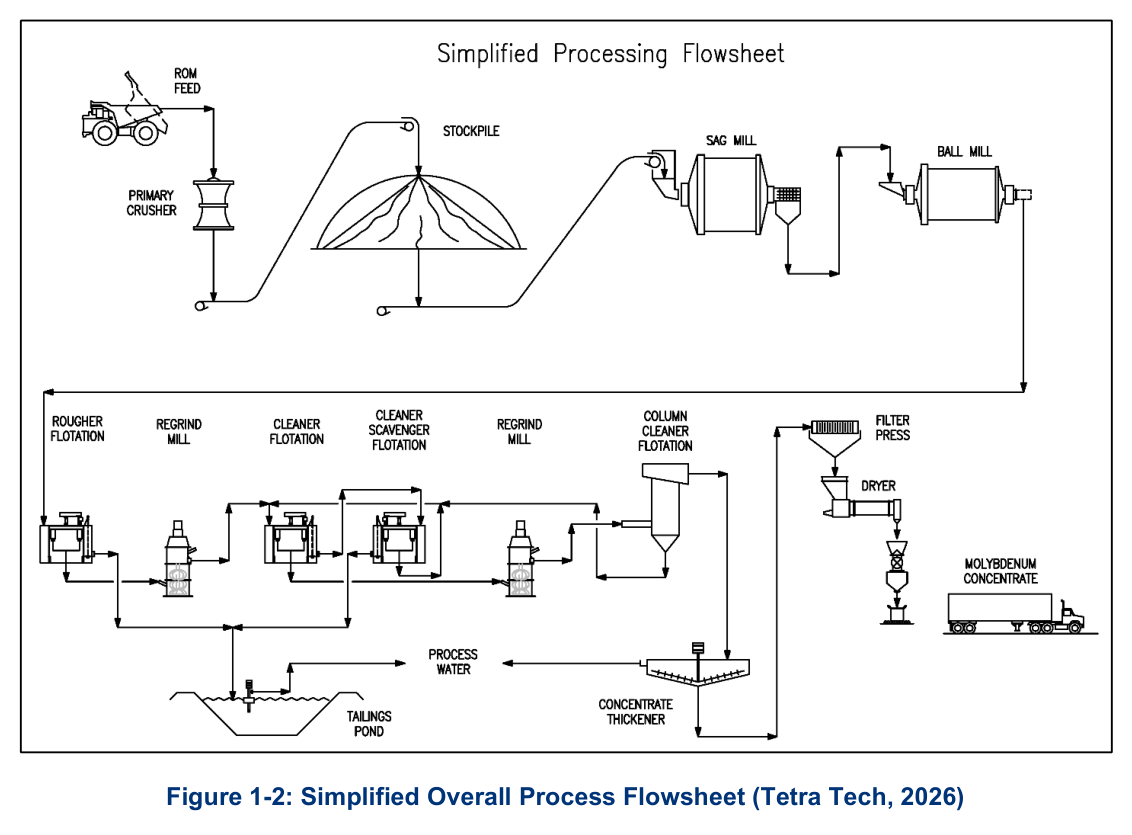
The Adanac Molybdenum Project, located in northwestern British Columbia, Canada, is a development-stage project owned by EraNova Metals Inc. The property hosts molybdenite as its principal economic mineral. The Preliminary Economic Assessment, with an effective date of August 6, 2026, outlines a conventional open-pit mining operation feeding a flotation concentrator. Construction timing is not stated in the recovery methods section.
Critical Data
| Parameter | Value | Unit | Notes |
|---|---|---|---|
| Nominal plant throughput | 30,000 | t/d | Design value |
| Annual nominal throughput | 10.95 | million t/a | Calculation |
| LOM average head grade | 0.054 | % Mo | Mine plan |
| LOM average recovery | 90.2 | % | Calculation |
| LOM average annual concentrate production | 9,550 | t/a | Calculation, at 54% Mo |
| Annual molybdenum production | 11,400 | klbs/a | Calculation |
| Concentrate grade | 54 | % Mo | Test work |
| Bond Ball Mill Work Index | 12.8 | kWh/t | Test work, average |
| Abrasion Index | 0.58 | g | Test work, average |
| Specific gravity | 2.6 | Test work | |
| Bulk density | 1.6 | t/m³ | Industry experience |
| ROM feed size, P100 | 1,000 | mm | Industry experience |
| Primary crush product, P80 | 137 | mm | Calculation |
| Grinding circuit product, P80 | 180 | µm | Test work |
| Rougher concentrate regrind, P80 | 50 | µm | Test work |
| 1st cleaner concentrate regrind, P80 | 40 | µm | Test work |
| Milling and flotation availability | 92 | % | Process design |
| Primary crushing availability | 70 | % | Industry experience |
| Concentrate moisture | 3 | % (by wt.) | Industry experience |
| Process make-up water at full capacity | 2,285 | m³/h | Design estimate |
| Fresh water at full capacity | 83 | m³/h | Design estimate |
| Plant staffing | 93 | personnel | Includes cross shifts |
Overview
The Adanac deposit contains molybdenite (MoS₂) found as coarse, platy rosettes or scales distributed in quartz-filled fractures. The veins locally contain traces of scheelite, orthoclase, fluorite, biotite, sericite, and carbonate. Metallurgical test work and the mine plan form the basis for selecting recovery methods.
The processing plant is designed to handle 30,000 t/d of feed. The plant will produce a high-grade molybdenum concentrate through conventional flotation. The LOM average head grade from the mine plan is 0.054% Mo. Anticipated LOM average recovery sits at 90.2%. LOM average annual concentrate production is approximately 9,550 t/a at 54% Mo, yielding about 11,400 klbs of molybdenum per year.
Crushing and grinding circuit sizing is based on comminution test work results. Flotation cell sizing uses optimum residence time from lab test work, scale-up factors, and slurry volumetric flow rates. The dewatering circuit is sized using industry experience for thickener unit area and filtration rates at similar operations.
Key Process Stages
The plant uses a Semi-Autogenous and Ball Mill grinding circuit. A rougher flotation circuit includes rougher and rougher-scavenger cells. Rougher concentrate passes through a regrind circuit. Cleaner flotation uses first-stage cleaner and cleaner-scavenger cells. First-stage cleaner concentrate goes through another regrind circuit. Four stages of column cleaner flotation follow. Concentrate dewatering uses three stages: thickening, filtration, and drying. Tailings go to the tailings management facility.
ROM mill feed arrives at the primary gyratory crusher station in 186-t capacity haul trucks. A static grizzly screen with a 1,000 mm aperture catches oversize material, which gets broken with a hydraulic rock breaker. The gyratory crusher reduces grizzly undersize to about 80% passing 130 to 140 mm. A conveyor moves crushed feed from the mine site to a stockpile at the plant.
The crushed mill feed stockpile has a live capacity of about 30,000 t. Two reclaim apron feeders operate at 679 t/h each, with one on standby. Feed goes into the SAG mill. SAG mill discharge passes through a trommel and a vibrating screen with a 12.5 mm aperture. Undersize goes to a pump box for the ball mill circuits. Oversize returns to the SAG mill feed conveyor.
The ball mill works in reverse closed circuit with a hydrocyclone cluster. Grinding reduces feed to 80% passing 180 µm. Hydrocyclone underflow returns to the ball mill by gravity. Overflow goes to rougher flotation at about 35% solids by weight. A particle size analyzer monitors hydrocyclone overflow.
Steel balls get added to the SAG mill and ball mills at controlled rates. Kerosene acts as a collector, and lime acts as a pH modifier. Both are added in the grinding circuit for rougher and scavenger flotation preconditioning.
Hydrocyclone overflow flows by gravity to four rougher and three rougher-scavenger flotation cells. Each cell has an effective volume of 300 m³. Rougher concentrate goes to a regrind circuit. Rougher-scavenger tailings get pumped to the tailings management facility. Rougher and rougher-scavenger flotation runs at pH 11.3. Pine oil serves as the frother.
The rougher and rougher-scavenger concentrate regrind circuit uses one tower mill in reverse closed circuit with one hydrocyclone cluster. The circuit grinds concentrate to 80% passing 50 µm.
Reground rougher concentrate enters a first-stage cleaner bank with three 15 m³ cleaner cells and three 15 m³ cleaner-scavenger cells. Cleaner-scavenger tailings join rougher-scavenger tailings for the TMF. Cleaner-scavenger concentrate returns to the first cleaner cell.
First cleaner concentrate gets reground in an open-circuit tower mill with a hydrocyclone cluster. This step reduces particle size to 80% passing 40 µm. Tower mill discharge and hydrocyclone overflow feed the column flotation circuit at about 25% solids by weight.
Four stages of column cleaner flotation upgrade the reground concentrate to about 54% Mo. Sodium hydrosulphide (NaHS) acts as a depressant in the columns. Pine oil maintains the froth bed. A ventilation system handles hydrogen sulphide (H₂S) gas that may form during cleaner flotation.
Final concentrate goes through three dewatering stages: thickening, filtration, and drying. Flocculant added to the thickener feed helps fine particles settle. Thickener overflow recycles to the process water tank. Underflow at 50% solids gets pumped to a pressure filter through a slurry stock tank.
Pressure filter cake is expected to have about 13% to 15% moisture by weight. Filtrate recycles to the concentrate thickener. Filtered cake goes to a rotary dryer, reducing moisture to about 3%. Dried concentrate discharges into a storage bin. An automated bagging system packages the product into 2-t tote bags. Bags get weighed and sampled before shipping in sea containers.
Flotation tailings go to a tailings sand preparation facility near the dam construction area. A hydrocyclone classification system separates tailings into fine and coarse fractions. Fines report to the tailings pond. Coarse material goes to the tailings embankment for dam construction. The hydrocyclone sand preparation runs during warm seasons only, on an as-needed basis.
Additional Interesting Data and Summary
The assay laboratory sits inside the processing plant building. It handles all routine assays for the mine, plant, and environmental and geological departments. Main instruments include an Atomic Absorption Spectrophotometer, a Leco furnace, and an Inductively Coupled Plasma Mass Spectrophotometer.
The metallurgical laboratory monitors performance and works to improve process flowsheet and efficiency. Equipment includes jaw crushers, rod and ball mills, a Ro-Tap sieve shaker, ring and puck pulverizer, moisture determination equipment, a Denver D12 flotation machine, lab cleaner flotation cells, filtering units, laser particle size analyzer, pH meters, oven, weighing devices, fume hoods, dust collection system, bulk sample preparation equipment, and lab glassware and reagents. An automatic sampling system collects samples for analysis and testing. Major process streams get sampled regularly for reconciliation, optimization, and regulatory purposes.
Reagent consumption estimates for the 30,000 t/d throughput include kerosene at 1,650 t/a, pine oil at 1,650 t/a, lime at 9,300 t/a, sodium hydrosulphide at 2,200 t/a, flocculant at 5.5 t/a, antiscalant at 45 t/a, 125 mm grinding media at 2,750 t/a, 75 mm grinding media at 6,050 t/a, and regrinding ceramic media at 275 t/a. All values are rounded preliminary estimates.
Kerosene arrives as liquid in bulk tankers or drums. It gets pumped to a holding tank and added to flotation without dilution. Pine oil follows the same procedure. Lime comes as quick lime powder in bulk tankers, stored in a silo, slaked and mixed to 20% solids density, and distributed through a pressurized loop. Sodium hydrosulphide comes as powder in 25 kg bags, mixed to 20% storing strength. Flocculant comes as powder in 1 t bags, mixed to 0.5% storing strength and diluted to 0.05% strength before addition. Antiscalant arrives as liquid in barrels and gets pumped to the process water and fresh/fire water tank without dilution.
Process water comes from concentrate thickener overflow, reclaim water from the TMF, and fresh make-up water. It goes to a 15 m diameter by 15 m high surge tank. Pipelines outside heated buildings get buried below frost level or receive insulation and heat tracing.
Freshwater comes from wells near the mine and plant site. It goes to a 14 m diameter by 14 m high storage tank kept full for emergency firewater supply. Uses include firewater, reagent preparation, mill cooling, dust suppression, and potable water. Potable water gets treated with chlorination and ultraviolet lamps and stored in a 3 m by 4 m tank.
Compressed air comes from dedicated plant air compressors, two operating and one standby, for maintenance and filter operation. Three air blowers, two operating and one standby, provide low-pressure air for flotation. Dried and oil-free instrument air comes from plant compressors and gets stored in a dedicated receiver.
The plant control system uses a distributed control system integrated with PC-based operator control stations in the plant control room. The DCS manages equipment and process interlocks, control functions, alarms, trending, event logging, and report generation. I/O cabinets sit in electrical rooms connected through a plant-wide fiber-optic network. PLCs and third-party control systems interface with the DCS via Ethernet.
Plant staffing requirements are organized into two 12-hour shifts per day on a two-week in/out rotation. The breakdown includes 11 management personnel, 38 operations staff, 10 for the metallurgical and assay laboratory, and 34 for process plant maintenance, for a total of 93 personnel including cross shifts.
Key Processes
- Primary gyratory crushing with static grizzly screening and hydraulic rock breaking.
- SAG and ball mill grinding in an SAB configuration with reverse closed-circuit hydrocycloning.
- Rougher and rougher-scavenger flotation at pH 11.3 using kerosene collector, lime pH modifier, and pine oil frother.
- Rougher concentrate regrind using a tower mill in reverse closed circuit with a hydrocyclone cluster to 80% passing 50 µm.
- First-stage cleaner and cleaner-scavenger flotation in 15 m³ cells.
- First cleaner concentrate regrind using a tower mill in open circuit with a hydrocyclone cluster to 80% passing 40 µm.
- Four stages of column cleaner flotation using NaHS depressant and pine oil frother.
- Three-stage concentrate dewatering: high-rate thickening with flocculant, pressure filtration, and rotary drying to 3% moisture.
- Automated bagging of dried concentrate into 2-t tote bags for sea container shipment.
- Tailings classification by hydrocyclone into fine fraction for the pond and coarse fraction for dam embankment construction.
Source: Preliminary Economic Assessment, NI 43-101 Technical Report, for the Adanac Molybdenum Project in Northwestern British Columbia, Canada, August 6, 2026. Project website: Adanac Molybdenum Project
