

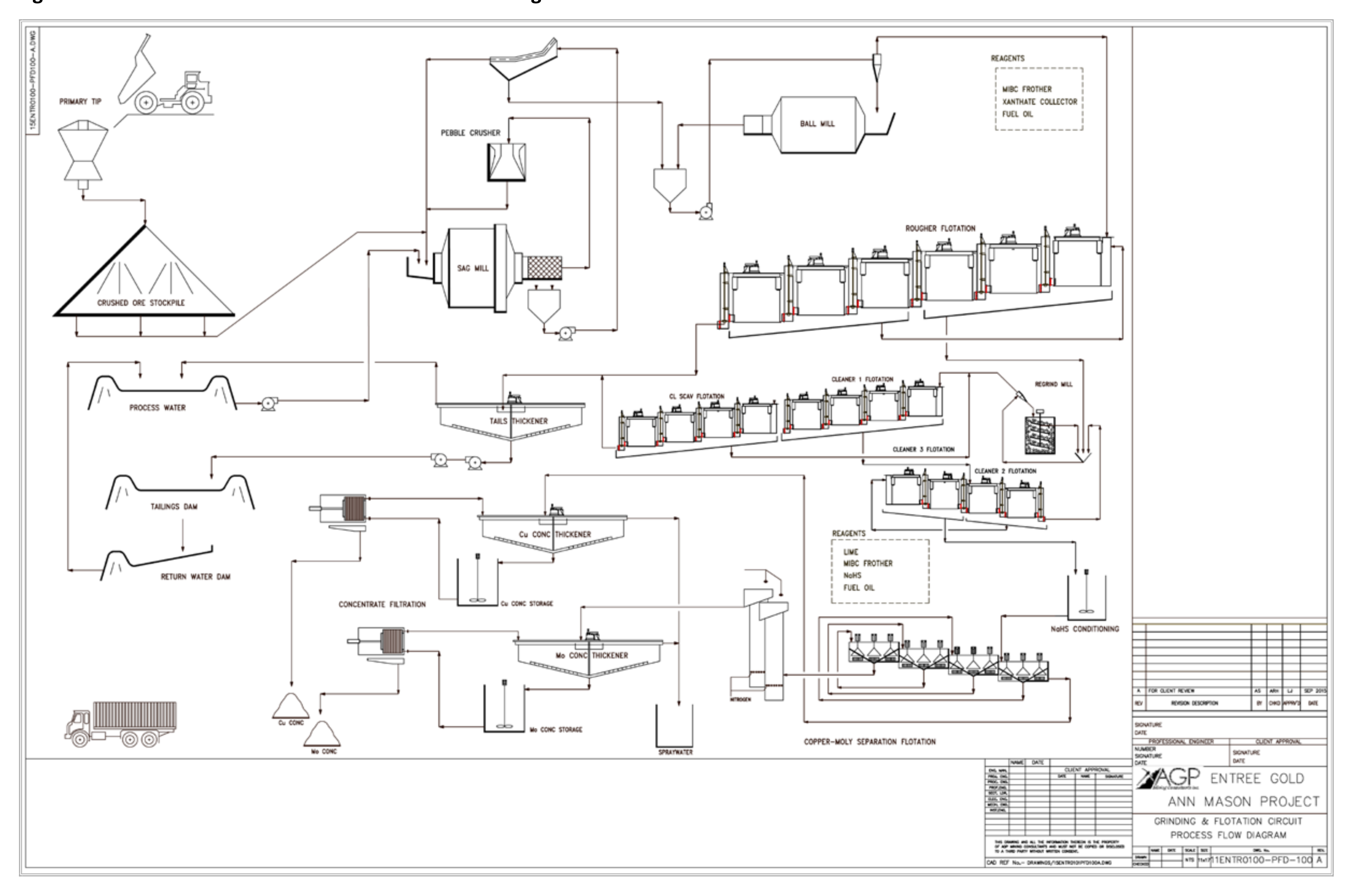
The 2017 updated preliminary economic assessment for the Ann Mason porphyry in Nevada designed a conventional SAG, ball mill and flotation plant, with copper and molybdenum concentrates split by nitrogen-sparged separation flotation.
The Ann Mason project lies in west-central Nevada, about 75 km southeast of Reno and 7 km west of Yerington, and its eastern side falls within the historic Yerington copper district in Lyon County. In 2017 Entrée Gold Inc. held the project and planned to transfer it to a new subsidiary, Mason Resources Corp. The 2017 Updated Preliminary Economic Assessment by AGP Mining Consultants and Amec Foster Wheeler, effective 03 March 2017, covers an early stage copper-molybdenum porphyry project. It envisioned an open pit feeding a conventional sulphide flotation mill at 120,000 t/d and was meant to support a future pre-feasibility study. The report gives no construction schedule.
Critical Data
| Parameter | Value | Unit | Notes |
|---|---|---|---|
| Plant design throughput | 100,000 | t/d | Section 17 design basis |
| Economic model throughput | 120,000 | t/d | Plant capital scaled from 100,000 t/d |
| Copper head grade | 0.2925 | % | Design criteria |
| Molybdenum head grade | 0.005 | % | Design criteria |
| Crushing circuit availability | 86.0 | % | Twin gyratory stations |
| Grinding and flotation availability | 92.0 | % | Design criteria |
| Primary grind size | 155 | µm P80 | Ball mill cyclone cut |
| Regrind size | 25 | µm P80 | Design criteria table |
| Copper recovery to copper concentrate | 92.0 | % | Design criteria |
| Copper concentrate grade | 30.0 | % Cu | Design criteria |
| Molybdenum recovery | 50.0 | % | To molybdenum concentrate |
| Molybdenum concentrate grade | 50.0 | % Mo | Design criteria |
| Fresh water consumption | 0.53 | m3/t | Process plant |
| Process plant power consumption | 23.1 | kW/t | As stated in the report |
Overview
The Ann Mason concentrator is designed as a nominal 3,000,000 tonne per month plant. Haul trucks tip into twin primary gyratory crushers. Two stockpiles of about 40,000 t each buffer the crushers from the mills. From there the plant runs as two lines, each with a SAG mill, a ball mill and rougher-scavenger flotation. Rougher concentrate is reground and cleaned in three stages. A copper-molybdenum separation circuit then floats molybdenite away from the copper concentrate. Both concentrates are thickened and pressure filtered and go by truck to toll smelters, while tailings are thickened and pumped to the tailings facility.
The flowsheet came from test work, and AGP built the preliminary design criteria from it to size and select equipment.
Key Process Stages
Primary crushing
Mill feed arrives in 360 t haul trucks, about seven an hour, with a peak delivery rate of 5,500 dmt/h. Trucks tip straight into the crusher throat, and a hydraulic rock breaker deals with oversize. Each primary crusher takes a 1,000 mm top size and runs at a 200 mm open side setting. Crushed ore drops into a 30 t surge pocket, and an apron feeder moves it onto a sacrificial conveyor and then the stockpile feed conveyor. The stockpiles hold about 18 hours of live production. Two variable speed apron feeders under each pile, one running and one on standby, can each supply the full mill feed rate.
SAG milling
Each line has a 40 ft by 24 ft grate discharge SAG mill. A high-speed camera system monitors the feed size distribution. Slurry and pebbles leave over a 40 mm trommel, and trommel oversize returns to the mill by a pebble conveyor. Trommel undersize is pumped to a multi-angle vibrating scalping screen cutting at 1.5 mm, whose oversize returns to the SAG mill.
Ball milling and classification
Scalping screen undersize flows by gravity to two 27 ft by 48 ft overflow ball mills in closed circuit with cyclones. Twelve 840 mm cyclones, ten running and two on standby, cut at a P80 of about 155 µm. A linear trash screen removes woodchips and other tramp material from the cyclone overflow ahead of flotation, and an automatic sampler takes samples from the screened stream.
Rougher flotation and regrind
Four rougher-scavenger banks each hold nine 300 m3 cells in series. The first six cells make rougher concentrate. The last three make scavenger concentrate, which returns to rougher feed. Rougher concentrate from all four banks goes to two 12 ft by 20 ft regrind ball mills, each with a cluster of eight 380 mm cyclones. The design criteria table and the detailed description set the regrind target at a P80 of 25 µm, while the process summary gives 45 µm.
Cleaner flotation
The first cleaner-scavenger bank has eight 20 m3 tank cells. The first six cells send concentrate to the second cleaner. The last two return concentrate to regrind, and their tailings go to the rougher-scavenger concentrate pump box. The second and third cleaners have five and four 10 m3 cells. Third cleaner concentrate is pumped to the separation circuit, although one passage in the report names the second cleaner concentrate as the separation feed.
Copper-molybdenum separation
Sodium hydrosulphide and fuel oil condition the bulk concentrate in a 3 m3 tank. Six 10 m3 tank cells form the molybdenum rougher. Five cleaning stages follow, with each stage's tailings flowing back to the one before. The first three stages each use three DR24 trough cells of 1.4 m3. The fourth and fifth are single flotation columns, 0.91 m in diameter and 6 m high, with cavitation tube sparging and wash water. Every cell in this circuit is sparged with nitrogen instead of air. Molybdenum rougher tailings make up the final copper concentrate.
Dewatering and tailings
Copper concentrate is thickened, stored in an agitated tank and pressure filtered. The cake is stockpiled in a shed and loaded into side tipping trucks, which are weighed and auger sampled before leaving for a toll smelter. Molybdenum concentrate goes through its own thickener and pressure filter, then a rotary screw dryer with an indirect diesel-fired heater, inert gas blanketing and a wet scrubber. The dried product is packed in drums and trucked to a toll smelter.
Rougher-scavenger tailings and first cleaner-scavenger tailings feed two 45 m high rate thickeners. Their overflow goes to the process water tank, and four centrifugal pumps, two running and two on standby, send the underflow to the tailings dam.
Additional Interesting Data and Summary
The design criteria allow 45 minutes of rougher-scavenger flotation, 18, 12 and 9 minutes in the three cleaner stages, and 10 minutes in the molybdenum rougher. The SAG feed has an F100 of 20 mm and a transfer size of 1 mm.
Reagents are sodium isopropyl xanthate as collector, mixed to a 10% solution in batches every 8 hours, along with diesel oil, MIBC frother, Magnafloc 10 flocculant and 40% sodium hydrosulphide. Liquid nitrogen arrives by tanker and is vaporized for the separation cells. Peristaltic pumps meter the reagents.
Process water is held in two insulated 500 m3 tanks, and clean water comes from wells. The process water tank also feeds a diesel firewater pump from a lower offtake.
The project also includes the Blue Hill deposit, which is mostly oxide copper. The 2014 to 2015 infill drilling brought about 95% of the material inside the ultimate PEA pit into the measured or indicated categories. The base case used US$3.00/lb copper and US$11.00/lb molybdenum, in Q2 2015 US dollars.
Key Processes
- Twin gyratory crushing to two crushed ore stockpiles
- Two lines of SAG milling with trommel and 1.5 mm scalping screen
- Closed circuit ball milling to 155 µm P80
- Rougher-scavenger flotation in 300 m3 tank cells
- Regrind milling and three stages of cleaner flotation
- Nitrogen-sparged copper-molybdenum separation with column cleaners
- Thickening and pressure filtration of both concentrates
- Rotary screw drying and drumming of molybdenum concentrate
- High rate thickening of tailings
Source: 2017 Updated Preliminary Economic Assessment on the Ann Mason Project, Nevada, U.S.A, 03 March 2017.
Project website: Ann Mason Project
