

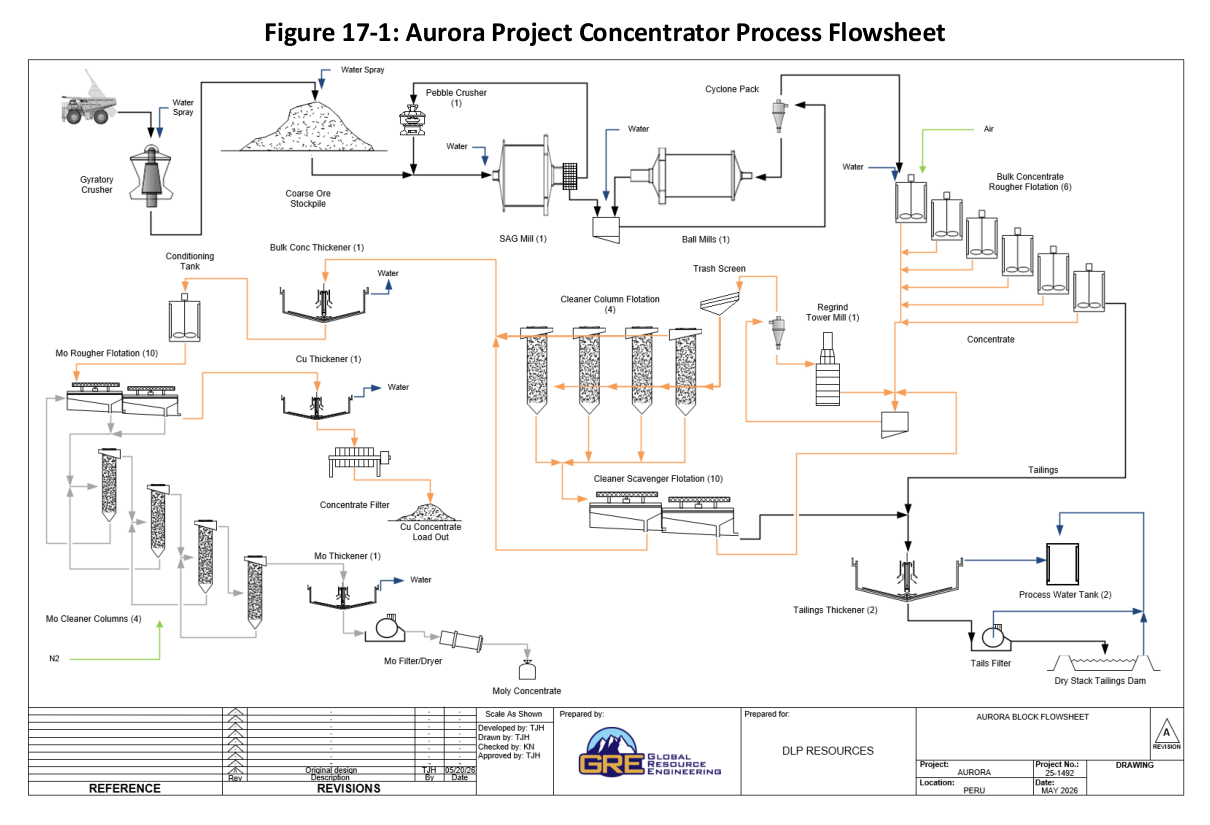
A look inside the process design for the proposed 65,000 tpd concentrator at the Aurora Cu-Mo-Ag project in Peru.
The Aurora Cu-Mo-Ag Mine Project is a proposed development in Calca Province, Peru, owned by DLP Resources Inc. The operation is designed to treat porphyry copper ore with varying molybdenum content. Chalcopyrite and molybdenite are the main minerals of interest, with silver as a primary by-product. The project is the subject of a Preliminary Economic Assessment (PEA) NI 43-101 Technical Report with an effective date of April 30, 2026. The report does not state a target date for the start of construction.
Critical Data
| Parameter | Value | Unit | Notes |
|---|---|---|---|
| Site Location | Calca Peru | Not applicable | |
| Elevation | 3,000 | AMSL | |
| Mineable Reserve | 403,301,337 | mt | |
| Mine Life | 17.0 | yr | |
| Ore Production Rate | 23,725,000 | mtpa | |
| Ore Production Rate | 65,000 | tpd | |
| Cu Grade | 0.222 | % | Average |
| Cu Recovery to Cu Conc | 85.5 | % | |
| Mo Grade | 0.089 | % | Average |
| Mo Recovery to Mo Conc | 88.5 | % | |
| Ag Grade | 2.37 | g/t | Average |
| Ag Recovery to Cu Conc | 74.0 | % | |
| Cu Production | 45,093 | tpa | Average |
| Mo Production | 18,708 | tpa | Average |
| Ag Production | 1,337,756 | oz/y | Average |
| Concentrator Availability | 92.0 | % | |
| Primary Crusher P80 | 150.0 | mm | |
| SAG Mill Specific Energy | 9.5 | kWh/t | |
| SAG Mill Required Power | 28,159.9 | kW | |
| Ball Mill Specific Energy | 4.0 | kWh/t | |
| Ball Mill Required Power | 12,578 | kW | |
| Cyclone Overflow P80 | 150 | um | |
| Regrind Mill Target P80 | 45 | um | |
| Regrind Mill Required Power | 1,776.8 | kW | |
| Target Final Cu Concentrate Grade | 22 | % | Minimum |
| Target Final Mo Concentrate Grade | 60 | % | Minimum |
| Filter Cake Moisture | 14.6 | % | Tailings filter |
Overview
The Aurora plant is a conventional copper-molybdenum porphyry concentrator. The process flowsheet includes primary crushing with a gyratory crusher, a SABC grinding circuit, bulk copper-molybdenum flotation, concentrate regrinding, and differential flotation to produce separate copper and molybdenum concentrates. The design includes concentrate and tailings thickening, filtration, and a dry stack tailings facility.
The process design criteria were developed from metallurgical test work, MetSim modeling, and in-house expertise. The target throughput is 65,000 tpd. The concentrator is designed for 92% availability.
Key Process Stages
Run-of-mine ore is delivered by haul truck to a 60-inch by 89-inch gyratory primary crusher set in a dump pocket that allows two truck access. Trucks can also discharge to a local static stockpile for blending. Crushed ore is withdrawn from a surge pocket by an apron feeder and discharged onto a rope-design primary conveyor that passes over a tramp metal magnet. The conveyor transports the ore to a coarse ore stockpile with a nominal live capacity of 35,500 tonnes. The stockpile sits under a dome to control dust, and ore is extracted through vibrating feeders. The primary crushed ore P80 is approximately 150 mm.
The comminution circuit consists of a SAG mill, a ball mill, and a pebble crusher. Material from the stockpile is conveyed to the SAG mill feed at a design rate of 2,955 tph. Water is added to create a slurry of approximately 70% solids. The SAG mill is designed to require 29.6 MW with a mill dimension of 12.2 m diameter and 6.8 m length. The SAG mill discharge passes over a trommel screen where coarse particles are removed and diverted to a pebble crusher. An estimated 25% of the discharge reports to the crusher at a design rate of 730 tph. The pebble crusher is an 84-inch shorthead cone with a closed side setting of 12 mm and a 740 kW motor. The crusher discharge returns to the SAG feed conveyor.
The combined slurry from the SAG and ball mills reports to a common sump feeding a cyclone pack with 14 by 33-inch cyclones. The cyclone underflow reports to the ball mill feed. The ball mill is sized on a discharge product size of 150 µm and a 300% circulating load. This mill requires 12.6 MW and is 7.9 m in diameter and 12.2 m long. The cyclone overflow, at 2,955 tph and 35% solids, reports to the rougher flotation circuit.
The flotation circuit is designed as a bulk copper and molybdenum process. Subsequent differential flotation produces the final individual copper and molybdenum concentrates. The rougher circuit is operated to maximize recovery of primary sulfide minerals from gangue. Cleaner flotation of the bulk concentrate is operated to maximize the copper concentrate grade while minimizing recovery losses. Flotation reagents include xanthate, dithiophosphate, diesel for molybdenum recovery, and a frother. The majority of reagents are added to the ball mill feed, with trim reagents added down the flotation bank as required. Regrinding of the rougher concentrate provides increased mineral liberation for the cleaner flotation stage.
The rougher flotation circuit consists of six 500 m3 tank cells configured as a single bank. Frother is added at the head of the cells with supplemental reagents added down the bank. The rougher section operates in open circuit, with the tailings reporting directly to final tailings. A Jameson-type cell is noted as a potential addition to improve recovery of coarse material.
The rougher concentrate is delivered to the regrind circuit, which consists of a tower mill with a 1.8 MW motor. The circuit operates in a reverse configuration. Rougher concentrate is combined with regrind mill discharge and pumped to a cyclone pack with ten 14-inch cyclones. The cyclone overflow passes over a trash screen before reporting to the cleaning circuit, while the underflow reports back to the regrind mill feed. The target product size is 45 µm.
The cleaner circuit has four 2.5-m diameter by 16.0-m tall column flotation cells operating in parallel. The bulk copper-molybdenum concentrate is 22% to 29% Cu and 5% to 11% Mo, depending on the material blend. Column cell tails go to a cleaner-scavenger flotation bank comprising twenty 11 m3 Denver-style cells. The first bank produces a final concentrate, and scavenger concentrate from the remaining cells is recirculated to the regrind circuit feed. The cleaner-scavenger bank tails report to final tailings.
The bulk copper-molybdenum concentrate from the cleaner circuit is thickened and conditioned before entering the molybdenum circuit. Sodium hydrosulfide is added to depress copper and iron sulfides using redox control. Additional diesel is added as a molybdenum promoter, and nitrogen gas is used as the mineral carrier. The molybdenum rougher is one bank of conventional Denver-style cells containing ten 3.5 m3 cells. The cleaning stage consists of four column flotation stages in series. Column tailings are fed back to the previous flotation stage. The columns decrease in volume down the bank from 7 m3 to 2.3 m3. The target minimum final concentrate grades are 22% for copper and 60% for molybdenum.
The molybdenum rougher tailing becomes the final copper concentrate and reports to a single 24-m diameter copper concentrate thickener. The final molybdenum product is thickened in an 8-m diameter thickener. The copper concentrate is thickened to a target 60% solids and flows to a concentrate stock tank, then pumped to the filter plant. A plate and frame pressure filter targets 10% moisture, and the concentrate is conveyed to a storage shed for loadout. The molybdenum concentrate is filtered in a plate and frame pressure filter targeting 10% moisture, dried in a rotary dryer, and bagged for shipment.
Tailings from the rougher bank and the cleaner-scavenger bank are combined and feed two 100-m diameter tailings thickeners. The overflow water is reclaimed and sent to process water tanks. Thickened tailings are pumped to a filter plant, then to sixteen plate and frame filters for further dewatering. Filtered solids are conveyed as filter cake to the dry stack storage facility. The filtrate is recycled back to the tailings thickener and used as process water.
Process water is primarily based on recycled streams from thickener overflows and filter plant filtrate. Makeup water comes from other site sources including pit or underground water and surface capture. The site is designed as a closed water system.
Additional Interesting Data and Summary
The Aurora concentrator design shows a standard flowsheet for a copper-molybdenum porphyry deposit. The process description covers primary crushing, SABC comminution, bulk flotation, regrinding, and differential flotation.
The report identifies risks for the operation. There are four metallurgical domains with varying grades for both copper and molybdenum. Copper circuits can generally respond reasonably well to changing grades, but molybdenum can be more challenging. Care needs to be taken to consider the changing grades across the mine life in the flotation circuit design. Process water recycle can negatively impact flotation performance, and it may be necessary to keep molybdenum process water separate from the bulk flotation circuit because of the presence of sodium hydrosulfide. The SAG and ball mill designs are large, and limited industry experience exists managing and maintaining mills of this size. Minimal test work has been conducted on solid or liquid separation, so the thickener and filter sizing may need modification.
The report also lists opportunities to improve the process design. Optimizing the primary grind size may allow for improved copper and molybdenum recovery. This could involve the use of alternative flotation technologies like the Jameson or Nova cells. Optimizing the silver that reports to the copper concentrate would improve silver payability. Using HPGR instead of a SAG mill could reduce overall power consumption in the comminution circuit.
The recommendations from the report focus on additional test work and value engineering. The comminution circuit design should be reviewed and optimized based on capital and operating costs. Alternative flotation reagents for molybdenum flotation could reduce the risk of using sodium hydrosulfide. Alternative flotation technologies should be examined to improve plant performance. Alternative tailings designs should be considered to avoid the capital and operating costs of dry stack tailings.
Key Processes
- Gyratory primary crushing to a P80 of approximately 150 mm.
- Semi-autogenous grinding with a pebble crusher (SABC), with a SAG mill design power of 29.6 MW and a ball mill design power of 12.6 MW. The cyclone overflow reports to rougher flotation at 35% solids.
- Bulk copper-molybdenum rougher flotation using six 500 m3 tank cells in a single bank. Rougher recovery targets are 86% for copper, 92% for molybdenite, and 76% for silver.
- Regrinding of the rougher concentrate in a tower mill with a 1.8 MW motor to a target P80 of 45 µm.
- Cleaner flotation using four 2.5-m diameter by 16.0-m tall column cells with a cleaner-scavenger bank of twenty 11 m3 Denver cells.
- Differential molybdenum flotation with a rougher bank of ten 3.5 m3 Denver cells, followed by four stages of column cleaning. Sodium hydrosulfide is used for copper and iron sulfide depression, and nitrogen is used as the mineral carrier.
- Concentrate dewatering with a 24-m diameter copper thickener and an 8-m diameter molybdenum thickener, followed by plate and frame pressure filters. Target product moistures are 10%.
- Tailings dewatering with two 100-m diameter thickeners and sixteen plate and frame filters, producing a filter cake at 14.6% moisture for a dry stack storage facility.
Source: Preliminary Economic Assessment NI 43-101 Technical Report, April 30, 2026. Project website: Aurora Cu-Mo-Ag Mine Project
