

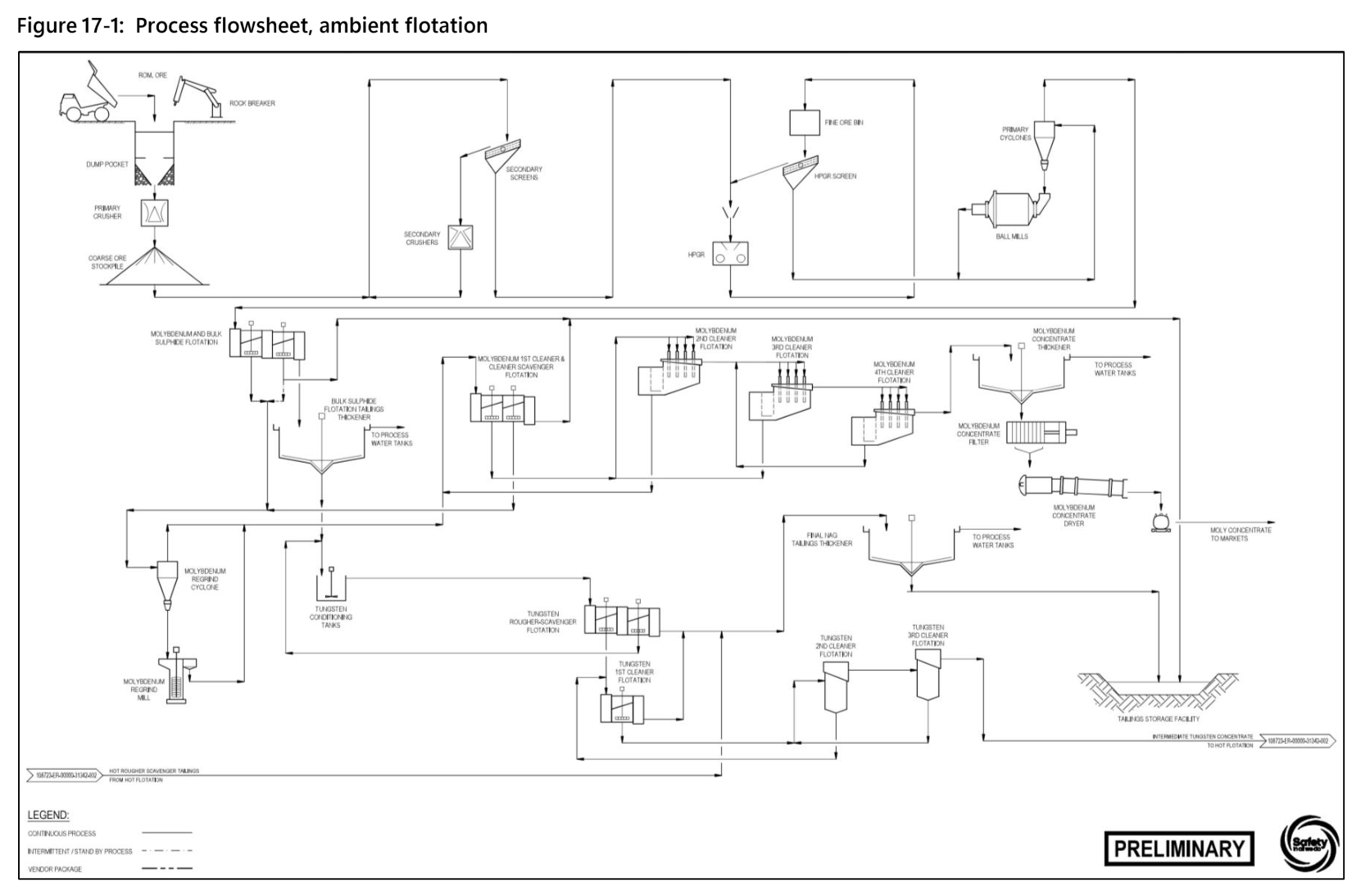
Northcliff Resources’ Sisson tungsten-molybdenum project in New Brunswick, Canada, is the focus of a feasibility study update. Here is a look at how the proposed process plant is designed to make two separate concentrates.
The Sisson Tungsten-Molybdenum Project is an advanced development project owned by Northcliff Resources Ltd., located roughly 60 kilometres northwest of Fredericton, New Brunswick, Canada. The proposed mine would be a greenfield site with a 30,000 tonne per day processing operation. Northcliff owns a collective 88.5% interest in the Sisson Project Limited Partnership, which holds the mineral claims. The project is past the feasibility study stage, with the latest report dated October 2026, but the source material does not state a construction start date.
Critical Data
| Parameter | Value | Unit | Notes |
|---|---|---|---|
| Nominal throughput | 30,000 | t/d | Process plant design |
| Annual throughput | 10.95 | Mt/a | Process design criteria |
| Plant feed grade, tungsten (design) | 0.110 | % WO₃ | Design value |
| Plant feed grade, molybdenum (design) | 0.027 | % Mo | Design value |
| Plant feed grade, sulphur (design) | 0.450 | % ST | Design value |
| Grinding product size (P80) | 140 | µm | Design value |
| Molybdenum final concentrate grade | 50.0 | % Mo | Design criteria |
| Tungsten final concentrate grade | 50 | % WO₃ | Design criteria |
| Molybdenum recovery to concentrate | 86 | % | Design criteria |
| Tungsten recovery to final concentrate | 82 | % | Design criteria |
| Process plant energy consumption | 363 | GWh/a | Nominal, includes building heating and water systems |
| Primary crushing availability | 75 | % | Nominal |
| Crushing, grinding, and flotation availability | 90 | % | Nominal |
| Fresh water consumption | 717,444 | m³/a | Nominal |
Overview
The Feasibility Study Update (FSU) presents a processing flowsheet built around crushing, grinding, and flotation. The design treats run-of-mine ore in a three-stage crushing circuit followed by a single-line ball mill grinding circuit that operates in closed circuit with a cyclone cluster. The selection of this flowsheet was informed by considerations of variable mineralogy, feed grades, and rock hardness. Trade-off studies were conducted on throughput and comminution equipment. High-pressure grinding rolls (HPGR) are included in the design to improve energy efficiency and enhance liberation ahead of tertiary screening. A key criterion in the equipment selection was minimizing scheelite slimes generation, as they can impact tungsten flotation recovery.
The process has been designed to recover molybdenum first, then bulk sulphides, and finally tungsten from the primary cyclone overflow. The molybdenum circuit includes rougher, regrind, and multi-stage cleaning stages. Tailings from this circuit are directed to a bulk sulphide flotation circuit to remove pyrite and other sulphide minerals before the scheelite flotation process. The resulting bulk sulphide concentrate is combined with PAG molybdenum tailings and sent for sub-aqueous deposition in the tailings storage facility. The bulk sulphide tailings proceed to the tungsten flotation circuits. After ambient and hot flotation stages, the final tungsten concentrate is thickened, filtered, dried, and packaged for transport.
Key Process Stages
The process plant is designed with a primary crushing circuit that handles incoming run-of-mine ore. Ore is tipped into a dump pocket equipped with a hydraulic rock breaker to manage oversized rocks. From there, the ore feeds a primary gyratory crusher with a 447 kW motor, which reduces the ore to a product size with an 80% passing size (P80) of 120 mm. The crushed ore is transferred via a series of conveyors to a coarse ore stockpile.
Two parallel apron feeders reclaim the crushed ore from the stockpile to feed the secondary crushing and screening area. This area has a double-deck vibrating screen with 80 mm and 50 mm aperture sizes. Oversize from this screen is sent to secondary cone crushers, which operate in a duty/standby configuration. Secondary cone crusher discharge is returned to the secondary screen for additional classification. The secondary screen undersize is forwarded to the tertiary HPGR circuit.
The tertiary crushing stage uses an HPGR unit with two 2.2 m diameter rolls and a 7,300 kW drive. A belt feeder delivers ore from the HPGR surge bin to the crusher, which is equipped with a metal detector and diverter chute to handle tramp metal. The HPGR product is conveyed to the fine ore bin and then to two tertiary screens with 8 mm and 4 mm apertures. Oversize is returned to the HPGR, while undersize from the screens feeds the grinding circuit.
The grinding circuit is a single line with a dual pinion ball mill (20 MW, 8.53 m diameter by 14.2 m EGL) operating in closed circuit with a cluster of primary cyclones. The circuit is designed to produce a grind size of 140 µm P80. Diesel is dosed at the primary cyclone feed pump box to precondition the ore for molybdenum flotation. Cyclone overflow feeds the flotation circuit, while underflow gravitates back to the ball mill.
The flotation area comprises several distinct circuits. A bank of forced air tank cells handles molybdenum rougher and bulk sulphide rougher flotation. The first five cells float a molybdenum rougher concentrate, and the remaining three cells float a bulk sulphide concentrate. The molybdenum rougher concentrate is sent to a regrind circuit targeting a P80 of 20 µm and then to a four-stage cleaner circuit. The molybdenum cleaner circuit consists of a conventional cell with a scavenger stage followed by three pneumatic cells. Sodium cyanide and sodium sulphide are dosed as depressants. The final molybdenum concentrate reports to its dedicated dewatering area.
The tungsten flotation circuit receives the bulk sulphide tailings. These tailings are first thickened in a 49 m diameter BSF tailings thickener. Underflow from the thickener passes through a series of conditioning tanks before entering a bank of conventional forced air tank cells for tungsten rougher and rougher scavenger flotation. Reagents added here include sodium carbonate as an activator, sodium hydroxide for pH control, sodium silicate as a gangue depressant, and a fatty acid collector. Rougher concentrate advances to a three-stage tungsten cleaner circuit. This circuit begins with a conventional cell and is followed by two column cells. Tailings from the rougher scavenger cells are sent to a 49 m diameter NAG tailings thickener.
The tungsten cleaner concentrate then enters the hot flotation process. This process conditions the slurry at 90°C with submersible electric heaters before forwarding it to hot rougher and rougher scavenger flotation cells. The hot circuit consists of a bank of conventional forced air tank cells for roughing, followed by a two-stage hot cleaner circuit with a conventional cell and a column cell. This hot process upgrades the concentrate to its final grade.
Each concentrate has a dedicated dewatering circuit. Molybdenum and tungsten concentrates are thickened, filtered with vertical plate and frame filters, and dried in indirect heated rotary dryers. Both dryers target a final moisture content of 5%. The dried products are then bagged and labelled for storage before offsite transport. The two handling circuits are physically separated from one another to prevent cross-contamination.
The plant also generates two distinct tailings streams. PAG tailings consist of molybdenum cleaner scavenger tailings blended with the bulk sulphide rougher concentrate. These are pumped to the TSF for sub-aqueous deposition. The NAG tailings, which originate from the tungsten rougher scavenger circuit, are thickened and then discharged to the tailings storage facility. Water reclaim systems return supernatant water to the plant for reuse.
Additional Interesting Data and Summary
The grinding circuit is designed for a circulating load of 350%. The molybdenum rougher circuit is designed for a concentrate mass pull of 2.7% of plant feed, and the bulk sulphide rougher circuit for 2.0% of plant feed. The tungsten rougher concentrate mass pull is set at 8.10% of plant feed, with the rougher scavenger at 2.23%. Reagent consumption estimates are based on testwork and standard industry practices. Estimated annual consumptions include 60,910 tonnes of sodium silicate, 11,000 tonnes of sodium carbonate, and 10,500 tonnes of ball mill steel media. The process water system relies primarily on thickener overflow and reclaim water from the TSF, with a process water tank providing a one-hour residence time. A separate tungsten process water tank has a 30-minute residence time and supplies the tungsten flotation area with a dedicated loop.
Additional process air services are part of the plant design. Flotation blowers supply low pressure air at 74 kPa to the flotation cells. Dedicated compressors service the concentrate filters for blowing, membrane squeezing, and drying. Plant air compressors supply general plant and instrument air at 750 kPa.
Key Processes
- Three-stage crushing circuit, including a primary gyratory crusher and HPGR.
- Single-line ball mill grinding circuit with a cyclone cluster in closed circuit.
- Molybdenum rougher, regrind, and multi-stage cleaner flotation circuits.
- Bulk sulphide flotation circuit to remove pyrite and other sulphides.
- Ambient tungsten rougher, scavenger, and cleaner flotation circuits.
- Hot conditioning at 90°C followed by hot rougher and cleaner flotation.
- Dedicated concentrate dewatering with high-rate thickeners, plate-and-frame filters, and indirect heated rotary dryers.
- Separate processing and disposal of PAG and NAG tailings streams.
- Reagent preparation and distribution area serving all flotation circuits.
Source: Sisson Tungsten-Molybdenum Project NI 43-101 Technical Report & Feasibility Study Update, New Brunswick, Canada, October 1, 2026. Project website: Sisson Tungsten-Molybdenum Project
