
admin

Campo Morado Project — 2018 Technical Report

This NI 43-101 Technical Report details the recovery methods and processing infrastructure for the Campo Morado Project located in Guerrero State, Mexico. The facility is designed to treat sulphide ore containing copper, lead, and zinc, with a current throughput ramping up to 2,200 tpd. The plant utilizes a combination of primary jaw crushing, SAG milling, and Vertimill grinding followed by selective flotation circuits for lead and zinc concentrates. Gold is present in the ore as preg-robbing carbonaceous material but is not the primary target commodity.

Campo Morado Project — 2018 Technical Report Read Post »
San Juan Mine — 2010 Technical Report

The San Juan mill, established in 1970, processes ore from various veins using a combination of flotation and Carbon-in-Pulp (CIP) circuits. Currently operating at 350 tonnes per day (tpd), the facility has the capacity to expand to 500 tpd with refurbished ball mills and potentially 700 tpd with further upgrades. The mill primarily handles sulphide ore via flotation, recovering 90% of the gold, while also treating oxidized ore through a CIP circuit with recoveries up to 88%.

San Juan Mine — 2010 Technical Report Read Post »

Prefeasibility Study (PFS) Phase I – Open Pit Granada Gold Project

This report outlines the recovery method for the Granada Gold Project (Gold Bullion), which involves processing ore in batches at the Iamgold Doyon mill (IMG). The mine plans to extract 175,000 to 200,000 tonnes of ore annually at a rate of 550 tonnes per day via open pit mining. Due to capacity constraints and development schedules, the ore will be processed in three distinct batches per year (April, July, November) to optimize mill utilization and avoid freezing muck issues in ore bins.

Prefeasibility Study (PFS) Phase I – Open Pit Granada Gold Project Read Post »

Process diagram from technical-report PDF page 137

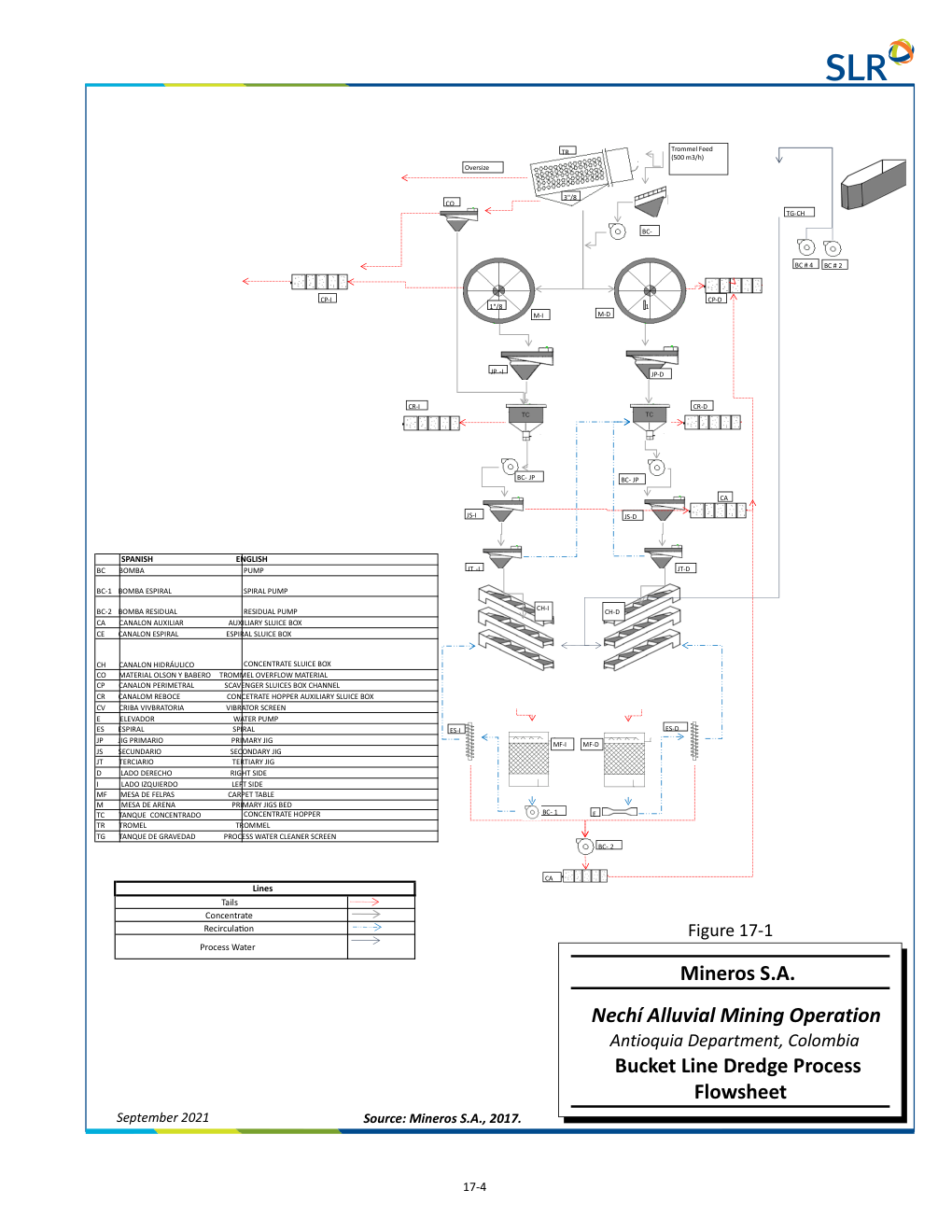
Nechí Alluvial Property — 2021 Technical Report

This section of the NI 43-101 Technical Report details the recovery methods employed at the Nechí Alluvial Property operated by Mineros S.A. in the Antioquia Department of Colombia. The operation utilizes four distinct mining methods: bucket line dredges, Brazilian suction dredges, the Llanuras production unit (wheel cutter suction dredge), and terrace mining. Each method employs specific on-board or floating processing plants designed for alluvial gold recovery, with concentrates transported to a central facility for final treatment.

Nechí Alluvial Property — 2021 Technical Report Read Post »

Bounty Potash Project — Technical Report

This technical report outlines the recovery methods planned for the Bounty Potash project. The proposed methods are modeled after the Intrepid processing facility at Wendover. The process involves pumping brine into solar evaporation ponds to precipitate salts. The ore is harvested and processed in a mill where potash is separated from salt via flotation. The material is then dried, compacted, and screened. The facility also produces Metal Recovery Salt (MRS) and Magnesium Chloride brine for de-icing.

Bounty Potash Project — Technical Report Read Post »

Reward Feasibility Study Plans 5,479 t/d Three-Stage Crushing and Two-Stage Heap Leaching at 79% Gold Recovery

This technical report outlines the metallurgical assessment and processing methods evaluated for the Reward Project. Various schemes including cyanide slurry leaching, heap leaching following crushing, and heap leaching at run-of-mine (ROM) size distribution were tested. Cyanide slurry leaching was eliminated from consideration due to low ore grades that could not economically justify the capital and operating costs associated with a milling scenario.

Reward Feasibility Study Plans 5,479 t/d Three-Stage Crushing and Two-Stage Heap Leaching at 79% Gold Recovery Read Post »

Bongará Zinc Project — 2014 Technical Report

This document is a snippet from the Bongará Zinc Project NI 43-101 Technical Report dated June 18, 2014. The excerpt includes the Table of Contents and Section 15 (Recovery Methods), which explicitly states there is nothing to report. Sections 16 (Project Infrastructure) and 17 (Market Studies) are listed but their content is not included in this text. The report focuses on the Bongará Zinc Project.

Bongará Zinc Project — 2014 Technical Report Read Post »

Kainantu 2024 Updated IDP Designs a 1.2 Mtpa SAB Plant With Flash Flotation, Gravity Tabling and Conventional Flotation for a Gold-Copper Concentrate

This Independent Technical Report outlines the Integrated Development Plan for the Kainantu Gold Mine in Papua New Guinea. The project is currently in the Definitive Feasibility Study stage, focusing on the development of an underground mine with a processing plant designed for a throughput of 1.2 million tonnes per annum (Mtpa). The flowsheet is engineered for optimal metal recovery of gold and copper from sulphide ore, utilizing a robust combination of comminution, gravity concentration, and flotation circuits.

Kainantu 2024 Updated IDP Designs a 1.2 Mtpa SAB Plant With Flash Flotation, Gravity Tabling and Conventional Flotation for a Gold-Copper Concentrate Read Post »

San Andrés 2014 Report Expands the Two-Stage Crush, Agglomerate and Heap Leach Operation Toward 7 Mtpa With a Hydraulically Separate Phase V Pad

The San Andrés Mine is an operating open pit project utilizing conventional mining methods with 6 m high benches. The mine production schedule is based on mineral reserves designed to support operations from the initial topography of December 31, 2010 up to the final pit geometry. The project has a Life of Mine (LOM) of 9 years, with a total ROM production of 45.8 Mt expected to contain approximately 784,000 oz Au at an average grade of 0.53 g/t.

San Andrés 2014 Report Expands the Two-Stage Crush, Agglomerate and Heap Leach Operation Toward 7 Mtpa With a Hydraulically Separate Phase V Pad Read Post »

Scroll to Top