

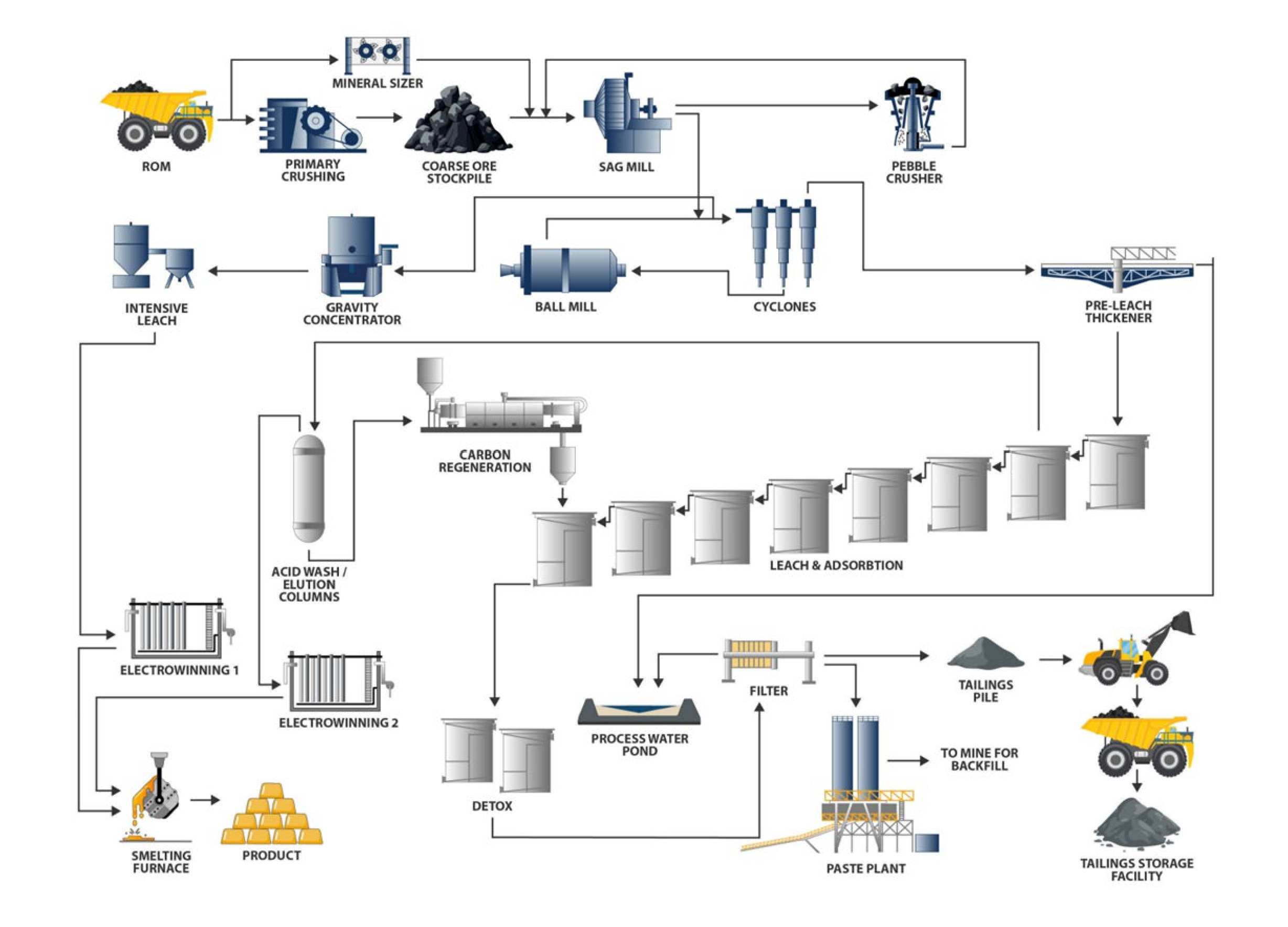
The 2025 definitive feasibility study for Predictive Discovery's Bankan gold project crushes hard and sticky ore in separate circuits, grinds through a SABC circuit to 75 µm and recovers gold by gravity, leach-CIL and Zadra elution.
The Bankan gold project lies in the Kouroussa Prefecture of northeast Guinea, about 450 km east-northeast of Conakry and 7 km southwest of Kouroussa town. Predictive Discovery Limited (PDI) holds the project through local subsidiaries. The main deposits, NEB and BC, sit in the peripheral zone of the Upper Niger National Park. The technical report, effective 31 July 2025, covers the definitive feasibility study that PDI released on 25 June 2025. Bankan is a development project. Its probable mineral reserve of 51.6 Mt at 1.78 g/t gold, for 2,953 koz, would be mined from open pits at NEB and BC and from underground at NEB. PDI applied for exploitation permits over parts of the Kaninko and Saman permits on 31 January 2025, and at the effective date those applications were still being processed.
Critical Data
| Parameter | Value | Unit | Notes |
|---|---|---|---|
| Plant throughput | 4.5 | Mtpa | Dry solids, nameplate |
| Grinding throughput | 563 | t/h | Dry solids |
| Primary crushing rate, fresh ore | 685 | t/h | Jaw crusher circuit |
| Nominal gold feed grade | 1.86 | g/t | Design criteria |
| Design gold feed grade | 2.50 | g/t | Design criteria |
| Design gold recovery | 93 | % | Design criteria |
| Average gold production | 249 | koz/a | Maximum equivalent rate 375 koz/a |
| Comminution design blend | 75 / 25 | % fresh / % weathered | Orway Mineral Consultants basis |
| Fresh ore Bond ball mill work index | 23.6 | kWh/t | Axb of 23.2 |
| Grind size | 75 | µm P80 | SABC circuit |
| SAG mill | 9.75 m x 5.0 m | Not applicable | 10 MW, high speed VSD |
| Ball mill | 7.32 m x 10.0 m | Not applicable | 10 MW, high speed VSD |
| Gravity gold recovery | 32 | % | Design criteria |
| Leach and CIL residence time | 24 | h | One leach tank and six CIL tanks |
| CIL design pulp density | 50 | % w/w solids | After pre-leach thickener |
| Detox discharge WAD cyanide | 20 | mg/L | INCO SO2 process |
| Tailings filtration rate | 734 | t/h | Plate and frame pressure filters |
| Mineral reserve | 51.6 | Mt | 1.78 g/t gold, probable |
Overview
DRA Global designed the Bankan plant for three ore types: saprolite, laterite and saprock, and fresh rock. Saprolite, laterite and saprock count as weathered ore. Sticky saprolite was judged a serious materials handling risk if mixed with fresh ore on the crushed ore stockpile. The design therefore receives and crushes it separately and sends it straight to SAG mill feed, keeping it moving.
Fresh ore passes a jaw crusher to the stockpile, and weathered ore passes a double roll mineral sizer. A SAG mill with a pebble crusher and a ball mill grind both to 75 µm. A gravity circuit pulls coarse gold from the mill circulating load for intensive cyanidation. A pre-leach thickener feeds a hybrid leach-CIL train, and loaded carbon goes through Zadra elution with electrowinning. Tailings are detoxified with sodium metabisulphite and air, then pressure filtered for a filtered stack. Part of the tailings is deslimed in cyclones and filtered separately as paste backfill feed.
Gravity and cyanidation variability tests returned gold extractions of 81.2% to 97.6%, depending on head grade. With coarse gold removed by gravity, most gold leached within four to eight hours, and the tests found no preg-robbing.
Key Process Stages
ROM pad and crushing
Haul trucks tip direct to the ROM bins or onto blending stockpiles, with separate areas for fresh and semi-competent ore and for sticky saprolite. A front-end loader reclaims from the stockpiles. In the fresh ore circuit a static grizzly protects the ROM 1 bin. A feeder and vibrating grizzly pass coarse ore to a Metso C140 single toggle jaw crusher, which takes 900 mm feed down to a P100 of 391 mm. Crushed ore, grizzly fines and feeder dribble go by conveyor to a stockpile with 9,450 t of live capacity. The weathered ore circuit feeds a double roll mineral sizer, which produces a 361 mm product that goes straight to the SAG mill feed conveyor. Both circuits have tramp magnets and metal detectors.
Grinding and pebble crushing
Two apron feeders under the stockpile, each able to supply the full SAG feed, reclaim ore at an equal rate. Quicklime is dosed onto the SAG feed conveyor from a silo. The grate discharge SAG mill runs in closed circuit with a discharge screen. Pebbles go through a magnet and metal detector to a Metso HP200 cone crusher, with a diverter to reject pebbles if required. The overflow ball mill runs in closed circuit with the grinding cyclones, and its discharge screen sends scats to a bunker.
Gravity and intensive leaching
A dedicated pump draws slurry from the ball mill side of the cyclone feed hopper to a scalping screen and a gravity concentrator rated at 420 t/h. The concentrator runs on a timed cycle, and each batch of concentrate is flushed to the intensive leach reactor feed hopper. Once a day the concentrate enters the reactor drum with cyanide, caustic soda and peroxide for a batch of up to about 21 hours. The pregnant solution and rinse go to a gravity eluate tank, and the residue returns to the grinding circuit. The report says gravity recovery improves gold accountability and security and gives a better chance of leaching gold from semi-refractory minerals.
Pre-leach thickening, leach and CIL
Cyclone overflow passes a trash screen and a multi-stage sampler to a 35 m high rate pre-leach thickener. Blends rich in saprolite struggled above 60% solids in thickening and filtration tests, so the CIL feed density was set at 50%. Thickener overflow becomes process water.
The train has one leach tank without carbon and six CIL tanks of about 3,000 m3 each, with two-stage agitators. Cyanide dosing is controlled by an on-line free cyanide analyser at the leach tank. Air is sparged into the leach tank and the first three CIL tanks. Swept wedge wire screens hold the carbon in each CIL tank, and recessed impeller pumps advance it counter-current once a day. The design carbon loading is 2,500 g/t.
Elution, electrowinning and reactivation
Loaded carbon from the first CIL tank is screened and acid washed in 3% hydrochloric acid in a 10 t column. Elution uses the pressurized Zadra method, normally six batches a week, with back-to-back stripping allowing seven. A few samples showed nuisance soluble copper, so a cold cyanide wash runs first whenever copper loading passes a set threshold. The wash solution is acidified to pH 2 to precipitate copper cyanide, neutralized above pH 8 and returned to process water. A diesel heater brings the caustic cyanide eluate to 95 °C for a soak and then 130 °C, and electrowinning runs at the same time as elution. A diesel-fired kiln reactivates the carbon at 750 °C in steam at 450 kg/h, and a sizing screen returns it to the last CIL tank. Electrowinning sludge is filtered, dried and smelted with fluxes to doré.
Detoxification and tailings filtration
Two 850 m3 tanks give 1.5 hours of INCO SO2 cyanide destruction. The design aims for WAD cyanide below 50 mg/L in the filtered tailings moisture, in line with International Cyanide Management Institute guidance. Three plate and frame filters, each with 74 plates of 2.5 m by 3.5 m, run 10 minute cycles at a combined 734 t/h. The paste plant can make up to 498,800 m3 a year of backfill.
Additional Interesting Data and Summary
Fresh Bankan ore is hard, with a rod mill work index of 23.5 kWh/t and a specific grinding power of 29.2 kWh/t to 75 µm. Saprolite needs only 5.5 kWh/t. Equipment such as pumps, screens and thickeners was sized on the worse of two cases: 100% fresh ore or a 50:50 blend of weathered and fresh ore.
Gold output averages 251 koz a year over the first six years and drops to about 156 koz a year for the next three. It then peaks at about 295 koz a year in Years 10 and 11.
The plant has hydrogen cyanide detectors throughout the grinding, leach, elution and intensive leach areas. A double security fence surrounds the process plant, and the mining and administration facilities sit close by so the site runs from a single centre.
Key Processes
- Separate jaw crushing of fresh ore and mineral sizing of sticky weathered ore
- SABC grinding with pebble crushing to 75 µm P80
- Gravity concentration and intensive cyanidation of coarse gold
- High rate pre-leach thickening
- One leach tank and six carbon-in-leach tanks
- Acid washing, Zadra elution and electrowinning with copper wash option
- Kiln reactivation of carbon
- INCO SO2 cyanide destruction
- Pressure filtration of tailings and paste backfill preparation
Source: Bankan Gold Project, Siguiri Basin, Guinea, Technical Report, 31 July 2025.
Project website: Bankan Gold Project
