

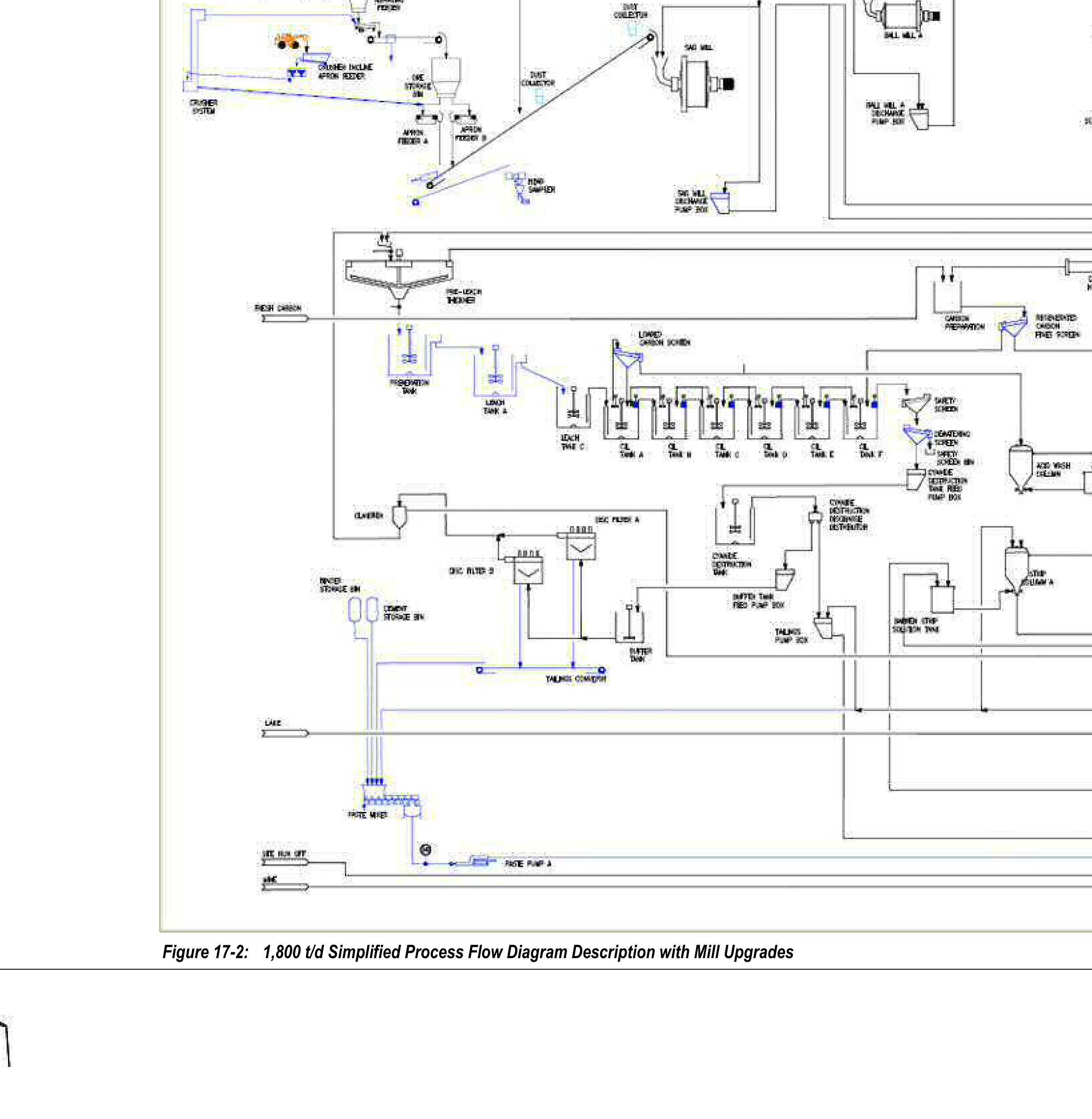
Battle North's 2021 feasibility study for the F2 gold deposit drew on two short runs of the Bateman mill, in 2015 and 2018, to plan its restart at 1,250 t/d and upgrades toward 1,800 t/d.
The Bateman gold project is at Cochenour in the Red Lake district of northwestern Ontario. Battle North Gold Corporation owned 100% of it, subject to NSR royalties held by Franco-Nevada and RGLD Gold. The feasibility study by Nordmin Engineering covers the F2 gold deposit and has a mineral reserve effective date of September 7, 2020, with the report dated January 27, 2021. Bateman already has a built mill, tailings facility and underground mine, all on care and maintenance after short campaigns in 2015 and 2018. The study plans a restart. Its proven and probable reserve is 3,563,000 tonnes at 5.54 g/t gold, or 635,000 oz. Initial capital of $109.3 million would be spent over a 1.8 year construction, development and commissioning period leading to commercial production.
Critical Data
| Parameter | Value | Unit | Notes |
|---|---|---|---|
| Current mill capacity | 1,250 | t/d | Leach capacity as built |
| Upgraded mill capacity | 1,800 | t/d | With feasibility study projects |
| Ultimate design capacity | 2,500 | t/d | Needs a second ball mill and more |
| Nominal head grade | 5.54 | g/t Au | Operating criteria |
| Design gold recovery | 92.5 | % | 2018 target 95.0% |
| Plant availability | 92 | % | 365 days per year |
| SAG mill power required | 1,474 | kW | Operating criteria |
| Ball mill power required | 429 | kW | Operating criteria |
| Ball mill work index | 11.5 | kWh/t | High titanium basalt |
| Design grind size | 105 | µm P80 | 2018 operation reached 75 µm |
| Leach and CIL residence time | 39 | h | Installed |
| 2018 bulk sample processed | 43,250 | t | 5,669 oz gold produced |
| 2018 overall gold recovery | 94.8 | % | Gravity recovery over 43% |
| Elution temperature | 140 | °C | Pressure Zadra at 400 kPa |
| Initial capital | 109.3 | $ million | Includes $10.5 million contingency |
| Mineral reserve | 3,563,000 | t | 5.54 g/t gold |
Overview
The Bateman mill, its ancillary facilities and the tailings management facility were built between 2013 and 2015. The mill ran from May to November 2015 at an average head grade of about 3.0 g/t, produced 5,610 oz of gold and then went onto care and maintenance. A 2018 bulk sample brought it back for 43,250 tonnes from three F2 stopes and secondary sources, for 5,669 oz and 94.8% recovery. The study's upgrade projects grew out of what operators learned in those two campaigns.
The flowsheet is conventional. Underground ore is trucked or hoisted to surface and crushed, then cleaned of scrap metal on its way to an ore bin. A SAG mill and a ball mill in closed circuit with cyclones grind it, and a gravity circuit in the circulating load recovers free gold. Carbon-in-leach (CIL) extracts the rest. Loaded carbon is acid washed, stripped by pressure Zadra elution and reactivated in a kiln. Gravity concentrate and electrowon gold are smelted together in an induction furnace to doré. Tailings pass an SO2/O2 cyanide destruction step before the TMF, and a paste plant can filter tailings and mix them with fly ash and cement for underground backfill. The paste plant was installed but had not been commissioned, since the mine had not needed backfill.
Key Process Stages
Ore handling
The 2018 run showed that the mill could take 250 mm run-of-mine ore, but ore handling and tramp metal removal became a problem above 200 mm. Operators flagged scrap removal from the raw ore bin conveyor, overloading of the reclaim feeders under the bin and the need to enclose the cross-belt magnet for winter.
Grinding
The grinding circuit performed well in 2018. Power draw, ball charge, grind size and pump duty all came in below design, which the report reads as a sign of a conservative original design. The SAG mill started with a 4.8% ball charge, 60% below design, and used half the expected grinding steel. It ran best at 72.5% of critical speed and 15 MPa bearing pressure. Throughput peaked at 90 to 95 t/h before settling at the 75 t/h design average, or 1,800 t/d. Better sump level and cyclone pressure control removed the surges that had sent coarse material over to CIL in 2015.
Gravity recovery
The original gravity circuit was sized to take 46% of the gold. In 2018, gold built up in the circulating load and locked up in the ball mill. Operators doubled the mass pull by cutting the Knelson wash cycle from 60 to 30 minutes, which lifted gravity recovery to a peak of 49.4% with one cyclone feeding and 57.3% with two. Screening the table feed at 20 mesh raised table concentrate from 48% to more than 65% gold, the minimum the report gives for induction furnace feed. The report adds that strong gravity recovery cuts in-process inventory, lowers CIL head grade and cyanide demand, and improves metallurgical accounting.
Thickening, pre-aeration and CIL
A 14 m high rate thickener raises cyclone overflow from 35% to 50% solids. A 499 m3 pre-aeration tank restores dissolved oxygen to 8 mg/L and breaks down flocculant before leaching, with lead nitrate added. Each CIL tank gives about 6.5 hours of residence. In 2018, CIL tails averaged 0.23 g/t total gold, and recovery from one high grade stope rose from 87.2% to 93.6% as residence time doubled from 26 to 52 hours. Poor access to the interstage screens led to blinding, overflowing tanks and spills, and the report treats screen availability as a key operating issue.
Elution and carbon handling
Loaded carbon is rinsed and acid washed in 3% to 5% hydrochloric acid, then stripped with caustic and cyanide at 140 °C and 400 kPa over a 12 hour cycle. In 2018 the cycle stretched to 36 hours because the barren solution pumps could not deliver the design 17 m3/h through the heat exchanger. A kiln at 650 °C reactivates the carbon. Carbon fines exceeded the 4.75 m3 fines system, probably because of damage across six transfers per batch. A 500 µm safety screen on the last CIL tank, bypassed in 2015, caught stray carbon once commissioned in 2018.
Cyanide destruction and tailings
The as-built cyanide destruction system could not hold 1 ppm cyanide in tailings once incoming total cyanide passed 150 ppm, although it was designed for 250 ppm. The new regulated discharge level is 0.5 mg/L. The 2018 campaign showed that high recovery is still possible with free cyanide at or below 150 ppm in the last CIL tank. Water from the process must be treated for ammonia, cyanate, metals and fine solids before release.
Additional Interesting Data and Summary
Reagent use in 2018 ran above design for most items. Cyanide averaged 0.57 kg/t against a 0.50 kg/t criterion and fell to 0.39 kg/t in the last three stope runs. Copper sulphate reached 0.46 kg/t against 0.09 kg/t, which the report links to the detox control algorithm. Grinding steel use was well below design.
The finer 2018 grind of 75 µm, against the 105 µm design basis, raises recovery but could affect paste backfill quality, which needs less than 15% finer than 20 µm. Scaling was significant in 2018 because the antiscalant system had been returned to the supplier, and the report recommends reinstalling it.
The mill building and layout allow expansion to 2,500 t/d by adding a second ball mill, a second cyclone cluster and a second stripping column. A third tailings disc filter is also provided for. Tests in 2020 on McFinley Zone material showed that the mill can treat it at design throughput with a moderate drop in gold extraction.
Key Processes
- Crushing and scrap removal ahead of an ore storage bin
- SAG milling and closed circuit ball milling with cyclones
- Knelson gravity concentration with tabling of concentrate
- High rate thickening and pre-aeration with lead nitrate
- Six-tank carbon-in-leach
- Acid washing, pressure Zadra elution and kiln reactivation
- Induction furnace smelting to doré
- SO2/O2 cyanide destruction
- Tailings filtration and paste backfill preparation
Source: National Instrument 43-101 Technical Report, Bateman Gold Project: F2 Gold Deposit Feasibility Study and McFinley Zone Mineral Resource Estimate, Cochenour, Ontario, September 7, 2020.
Project website: Bateman Gold Project
