

Besra's 2013 study for the Bau goldfield in Malaysia chose a flotation plant at Jugan that would ship gold concentrate for outside treatment, while costing pressure, biological and Albion oxidation as alternatives.
The Bau gold project lies in Sarawak, Malaysia, on the island of Borneo, around the town of Bau about 40 km west-southwest of Kuching. Besra Gold Inc., formerly Olympus Pacific Minerals, held it through North Borneo Gold Sdn Bhd. The tenements cover more than 1,340 km2 of the historic Bau goldfield. The feasibility study, effective 15 December 2013, treats Bau as a brownfield development project. Mining and processing would start at the Jugan Hill deposit, about 7 km from Bau town, with the BYG-Krian area to follow. The study does not give a construction start date. Its proven and probable reserve totals 10,662,570 tonnes at 1.70 g/t gold, most of it at Jugan.
Critical Data
| Parameter | Value | Unit | Notes |
|---|---|---|---|
| Base case throughput | 8,000 | tpd | 2,920,000 tpa |
| Throughput range studied | 4,000 to 12,000 | tpd | In 2,000 tpd steps |
| Plant head grade | 1.5 to 1.9 | g/t Au | Average 1.7 g/t |
| Crushing circuit rating | 670 | tph | 15 hours per day at 90% availability |
| Mill stockpile capacity | 12,000 | t | Crusher product at P100 210 mm |
| SAG mill | 8.54 m x 4.57 m | Not applicable | 6,200 kW |
| Grinding circuit design rate | 400 | tph | 95% availability |
| Primary grind size | 150 | µm P80 | Cyclone overflow at 35% solids |
| Rougher and scavenger cells | 8 | Not applicable | 200 m3 each |
| Regrind mill | 3.6 m x 7 m | Not applicable | 1,350 kW, to 30 µm P80 |
| Cleaner cells | 4 | Not applicable | 70 m3 each, 20 minutes |
| Concentrate production | 40 | tph | Filter feed |
| Filter cake moisture | 9 | % | Assumed |
| Proven and probable reserve | 10,662,570 | t | 1.70 g/t gold |
Overview
The study weighed 80 combinations of mining method, throughput and process route. Mining could be owner-operated or contracted, at 4,000 to 12,000 tpd. The process could stop at a flotation concentrate or go on to oxidize the concentrate by pressure oxidation (POX), BIOX or the Albion process, each followed by carbon-in-leach (CIL) and a gold room.
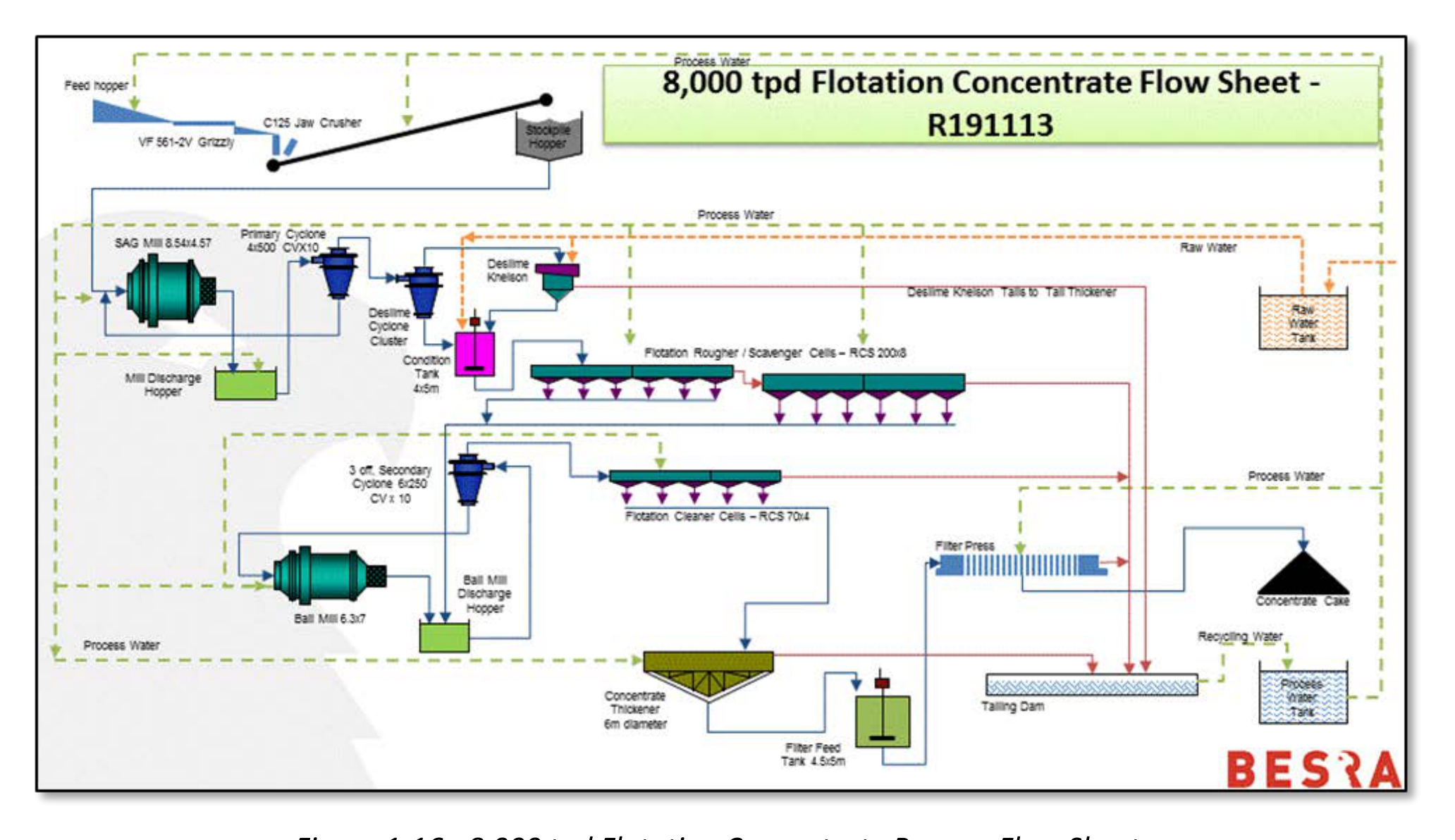
The base case is an 8,000 tpd flotation concentrate plant. Ore is crushed, ground and deslimed, then floated in rougher, scavenger and cleaner stages with regrinding between them. The concentrate is thickened and pressure filtered. Bagged filter cake is shipped to an outside smelting or processing facility, where the gold is recovered. The oxidation routes were costed for completeness and as options if the concentrate route stopped being viable.
Key Process Stages
Primary crushing
Trucks deliver ore to a run-of-mine pad. A front-end loader or direct tipping feeds a 30 kW vibrating grizzly feeder, and the +130 mm fraction goes to a 160 kW C125 jaw crusher. The crusher produces a P100 of 210 mm and a P80 of 130 mm. A belt carries the product to the 12,000 t mill stockpile, past a static belt magnet that operators swing aside to clear tramp metal.
Grinding and desliming
Three vibrating pan feeders in a tunnel under the stockpile feed the SAG mill. The single 6,200 kW mill runs in closed circuit with a 1.6 m by 3.6 m vibrating screen, and oversize is returned after pebble crushing. Mill discharge goes to a cluster of four 500 mm cyclones, three running and one on standby, at a 300% circulating load. Overflow at a P80 of 150 µm and 35% solids passes a trash screen and is deslimed in continuous Knelson CVD 64 units or a cyclone cluster.
Rougher and scavenger flotation
The deslimed slurry spends three minutes in a 90 kW conditioning tank, 4 m across and 5 m high. It then feeds four rougher and four scavenger cells of 200 m3 each, with 200 kW agitators, at about 435 tph and 27% solids. Roughing and scavenging each get 30 minutes. Flotation tails go to a tailings thickener or straight to the tailings dam.
Regrind and cleaner flotation
Rougher and scavenger concentrates, about 73 tph, feed a 3.6 m by 7 m overflow ball mill with a 1,350 kW motor. Three sets of 250 mm cyclones take the product from an F80 of 130 µm to a P80 of 30 µm at a 500% circulating load. The overflow, at 10% solids, goes to four 70 m3 cleaner cells with 20 minutes of retention. Cleaner tails join the tailings stream.
Concentrate thickening and filtration
A 6 m thickener takes the 40 tph of concentrate from 8% to 65% solids. An agitated tank holds two hours of filter feed. A Metso VPA 1540-40 air membrane pressure filter, with a 200 kW oil-free compressor and a 35 m3 air receiver, produces cake at about 9% moisture. The cake is packed into 2.5 t double-lined bags, loaded into sea containers and trucked to port.
Additional Interesting Data and Summary
The POX option would oxidize the concentrate in a 300 m3 autoclave at 180 °C, 500 kPa oxygen overpressure and 1,400 kPa total, with one hour of retention. The oxidized slurry would be washed in three counter-current thickeners, and the wash solution neutralized to pH 7 to precipitate arsenic as ferric arsenate. A four hour lime boil would prepare the solids for CIL.
The BIOX option uses 18 reactors in three parallel trains at 20% solids. The Albion option regrinds concentrate in an IsaMill to about 10 µm and oxidizes it in six tanks just below 100 °C with pure oxygen. Limestone and caustic hold the pH at 5.5, and about 75% of the sulphur is oxidized. The Albion residue grows by about 75% in mass, so its CIL circuit would be more than twice the size of the others.
For all three oxidation routes, the gold plant would use six CIL tanks with cyanide held near 500 mg/l in the last tank. BIOX and Albion residues would use up to 2.5 times more cyanide than POX residue, because partly oxidized sulphur forms thiocyanate. Carbon would be acid washed in 3% HCl, eluted at about 90 °C in closed loop with electrowinning onto steel wool cathodes, and reactivated in a kiln. Tailings would pass a copper-catalysed SO2/air cyanide destruction step at pH 8.5.
The goldfield stretches about 15 km northeast to southwest and is 6 to 8 km wide. The reserve and pit limits were set at a gold price of US$1,500/oz.
Key Processes
- Vibrating grizzly and jaw crushing to a 12,000 t stockpile
- SAG milling with pebble crushing and cyclone classification to 150 µm
- Knelson or cyclone desliming ahead of flotation
- Rougher and scavenger flotation in 200 m3 cells
- Regrinding to 30 µm and cleaner flotation
- Concentrate thickening and air membrane pressure filtration
- Bagged concentrate shipped for off-site gold recovery
Source: Bau Project – Feasibility Study, Bau, Sarawak, East Malaysia, 15th December 2013.
Project website: Bau Gold Project
