

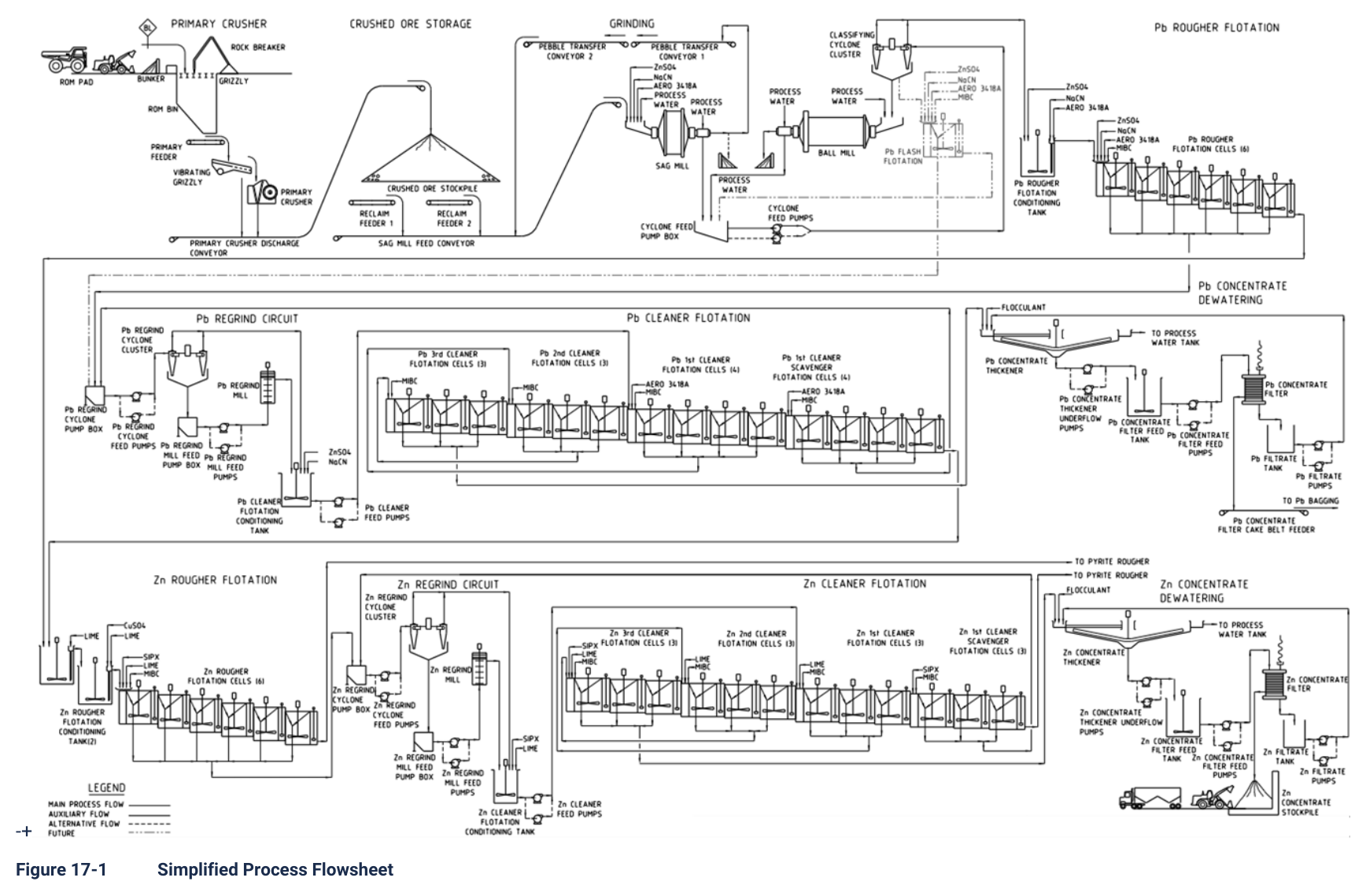
The Boumadine Polymetallic Project in Morocco has a planned conventional flotation plant sized for 2.92 million tonnes per year, with design criteria drawn from testwork on its polymetallic ore.
Boumadine is a polymetallic project in Morocco held by Aya Gold & Silver Inc. The proposed operation has a planned plant throughput of 2.92 Mtpa over an 11-year life of mine, recovering lead, zinc and pyrite concentrates from ore carrying gold and silver. The following describes the flotation flowsheet and its design criteria, which come from metallurgical testwork.
Critical Data
| Parameter | Value | Unit | Notes |
|---|---|---|---|
| Plant throughput | 2.92 | Mtpa | Nominal |
| Life of mine | 11 | y | Nominal |
| Head grade, gold | 3.15 | g/t Au | Testwork |
| Head grade, silver | 105 | g/t Ag | Testwork |
| Head grade, lead | 0.92 | % Pb | Testwork |
| Head grade, zinc | 1.87 | % Zn | Testwork |
| Lead recovery to lead concentrate | 82.0 | % | Testwork |
| Zinc recovery to zinc concentrate | 74.7 | % | Testwork |
| Gold recovery to pyrite concentrate | 71.4 | % | Testwork |
| Silver recovery to pyrite concentrate | 41.4 | % | Testwork |
| Lead concentrate grade | 29.6 | % Pb | Testwork |
| Zinc concentrate grade | 57.4 | % Zn | Testwork |
| Gold grade in pyrite concentrate | 4.2 | g/t Au | Testwork |
| Silver grade in pyrite concentrate | 81.0 | g/t Ag | Testwork |
| Grind size, P80 | 58 | µm | Testwork |
| Crushing work index | 10.2 | kWh/t | Assumption |
| Bond ball mill work index | 13.1 | kWh/t | Testwork |
| SMC Axb | 46.2 | Not applicable | Assumption |
| Bond abrasion index | 0.402 | Not applicable | Assumption |
| Crushing plant availability | 75 | % | Agreed |
| Milling and flotation availability | 91.3 | % | Agreed |
| Filtration circuit availability | 80 | % | Agreed |
| Lead regrind size, P80 | 16 | µm | Testwork |
| Zinc regrind size, P80 | 15 | µm | Testwork |
| Lead mass pull, rougher / cleaner | 9.7 / 2.6 | % | Testwork |
| Zinc mass pull, rougher / cleaner | 4.4 / 2.4 | % | Testwork |
| Pyrite rougher mass pull | 53.5 | % | Testwork |
| Daily raw water consumption | 2,997 | m3/d | Nominal |
| Daily potable water consumption | 128 | m3/d | Nominal |
| Total annual energy consumption | 172,396 | MWh/y | Estimated |
Overview
The plant design is built around a conventional flotation flowsheet. Lead, zinc and pyrite concentrates will be recovered and sold to market. The design criteria were chosen to keep operating costs down and to draw on proven technology. Equipment selection criteria put suitability for duty first, alongside safety, reliability and ease of maintenance.
The selected operation sequence runs from single stage crushing through SAG and ball mill grinding, three sequential flotation stages, and dewatering of each concentrate. Tailings are thickened and stored in a tailings management facility.
Grinding comminution test results include a Bond ball mill work index of 13.1 kWh/t. The crushing work index of 10.2 kWh/t, SMC Axb of 46.2 and Bond abrasion index of 0.402 appear in the criteria table as assumptions.
Key Process Stages
Crushing and stockpiling. Run-of-mine material arrives at a feed bin by mine truck. A static grizzly with 800×800 mm apertures keeps oversized rock out of the crusher, and a fixed rock breaker handles that oversize. An apron feeder delivers to a vibrating grizzly with 90 mm apertures. The undersize bypasses the primary crusher, while the oversize enters a 160 kW jaw crusher that reduces it at 444 dry t/h from an F80 of 501 mm to a P80 of 156 mm. Crushed rock joins the grizzly undersize on the discharge conveyor and reports to a stockpile with a live capacity of about 8,115 tonnes, equal to 24 hours of storage.
Grinding. Two apron feeders reclaim crushed material to the SAG mill feed conveyor. Zinc sulphate, sodium cyanide and Aero 3418A are added to the primary mill with process water to pre-condition the material. The SAG mill measures 7.92 m in diameter with a 4.39 m effective grinding length, carries a high-speed variable speed drive and a 6.1 MW motor, and is charged with forged steel balls up to 125 mm. It has a grate discharge and a trommel screen, with oversize going to a scats bunker or recirculating to the mill.
The ball mill measures 6.10 m in diameter with a 9.32 m effective grinding length. Its fixed speed drive uses a wound round induction motor and liquid resistance starter, with 6.1 MW installed. High-chromium steel balls up to 50 mm form the charge, and the mill discharges by overflow through a trommel screen.
Combined mill discharge is pumped to twelve cyclones, six in duty and six on standby, operating at 85 kPa(g) with a nominal recirculation rate of 382%. Cyclone overflow at a P80 of 58 µm gravitates to lead rougher flotation, and underflow returns to the ball mill.
Lead flotation and regrind. The lead rougher conditioning tank receives zinc sulphate, sodium cyanide and Aero 3418A for five minutes of conditioning. A single train of six forced-air mechanical cells carries out roughing, with the same reagents plus MIBC added to the cells. Rougher concentrate reports to regrind and cleaners, and the tails move on to zinc rougher flotation.
Lead regrind uses sixteen cyclones, eleven duty and five standby, at 64 kPa(g) and a target overflow d50 of 21 µm. Underflow feeds a stirred media mill charged with zirconia toughened alumina ceramic beads and driven by a 1.6 MW motor, reducing particles from an F80 of 58 µm to a P80 of 16 µm.
The lead cleaner circuit has three cleaning stages and one cleaner-scavenger stage. The first cleaner holds four forced-air mechanical cells, with three cells in each other stage. Concentrate and tails move counter-currently through the circuit. Final lead concentrate is thickened in an 11 m high-rate thickener to 55% (w/w) solids, filtered to 10% (w/w) moisture, and bagged for shipment on highway trucks.
Zinc flotation and regrind. Lead rougher tails and lead first cleaner-scavenger tails enter the first zinc conditioning tank, where lime lifts pH to a target of 11.5. A second tank adds more lime and copper sulphate, giving ten minutes of total conditioning. Roughing takes place in a single train of six forced-air mechanical cells with SIPX, lime and MIBC added.
Zinc regrind uses eight cyclones, five duty and three standby, at 81 kPa(g) and a target overflow d50 of 20 µm. A stirred media mill with a 700 kW motor reduces the underflow from an F80 of 58 µm to a P80 of 15 µm.
The zinc cleaner circuit has three cleaning stages and one cleaner-scavenger stage, each with three forced-air mechanical cells. Final zinc concentrate is thickened in an 11 m high-rate thickener to 55% (w/w) solids, filtered to 10% (w/w) moisture, and stockpiled in a covered shed before truck loading.
Pyrite flotation. Zinc rougher tails and zinc first cleaner-scavenger tails feed the pyrite conditioning tank, where sulphuric acid lowers pH to between 7 and 8.5 ahead of five minutes of conditioning. A single train of six forced-air mechanical cells performs roughing with PAX and MIBC.
Pyrite concentrate is thickened to 65% (w/w) solids in a 32 m high-rate thickener. Two parallel pressure filters dewater the cake to 15% (w/w) moisture. The filter cake forms a radially stacked dead stockpile with a live capacity of 7,250 m3, about 24 hours of production, and is loaded to highway trucks by front-end loader.
Tailings and water. Pyrite rougher tails are thickened to 40% (w/w) solids in a 22 m high-rate thickener and pumped to the flotation tailings management facility. An estimated 129 m3/h of water is decanted from the facility back to the process water pond.
Raw water comes from city sewage treatment effluent held in a raw water basin. Process water in the pond draws on thickener overflows, facility decant return and raw water makeup. Separate lead and zinc process water tanks serve the final cleaning and filtration stages of each circuit. Potable water comes from an aquifer and passes through an onsite treatment plant.
Additional Interesting Data and Summary
Annual energy consumption for the plant is estimated at 172,396 MWh/y. Milling for grinding and classification accounts for 93,487 MWh/y, and flotation and concentrate handling for 36,512 MWh/y. Crushing and stockpiling account for 2,012 MWh/y.
Reagent consumption at supply concentration totals 6,862 t/y of lime, 2,920 t/y of sulphuric acid, 1,051 t/y of zinc sulphate, 876 t/y of PAX and 657 t/y of copper sulphate. Grinding media consumption is 1,679 t/y for the SAG mill, 2,307 t/y for the ball mill and 59 t/y for the regrind mills. The site plans to hold six weeks of reagent inventory in the reagent shed. Lime arrives by truckload roughly once per day and is stored in a 150-tonne silo.
Thickener and filter design criteria for each concentrate will be defined further once dewatering testwork is complete.
Key Processes
- Single stage primary crushing in a 160 kW jaw crusher with a 24-hour crushed rock stockpile
- SAG and ball mill grinding to a P80 of 58 µm
- Lead rougher, regrind and cleaner flotation producing a 29.6% Pb concentrate
- Zinc rougher, regrind and cleaner flotation producing a 57.4% Zn concentrate
- Pyrite rougher flotation producing a concentrate grading 4.2 g/t Au and 81.0 g/t Ag
- Concentrate thickening, filtration and loadout for each product
- Flotation tailings thickening and storage in a tailings management facility
Source: Boumadine Polymetallic Project NI 43-101 Technical Report, 2026-02-28. Project website: Boumadine Polymetallic Project
