

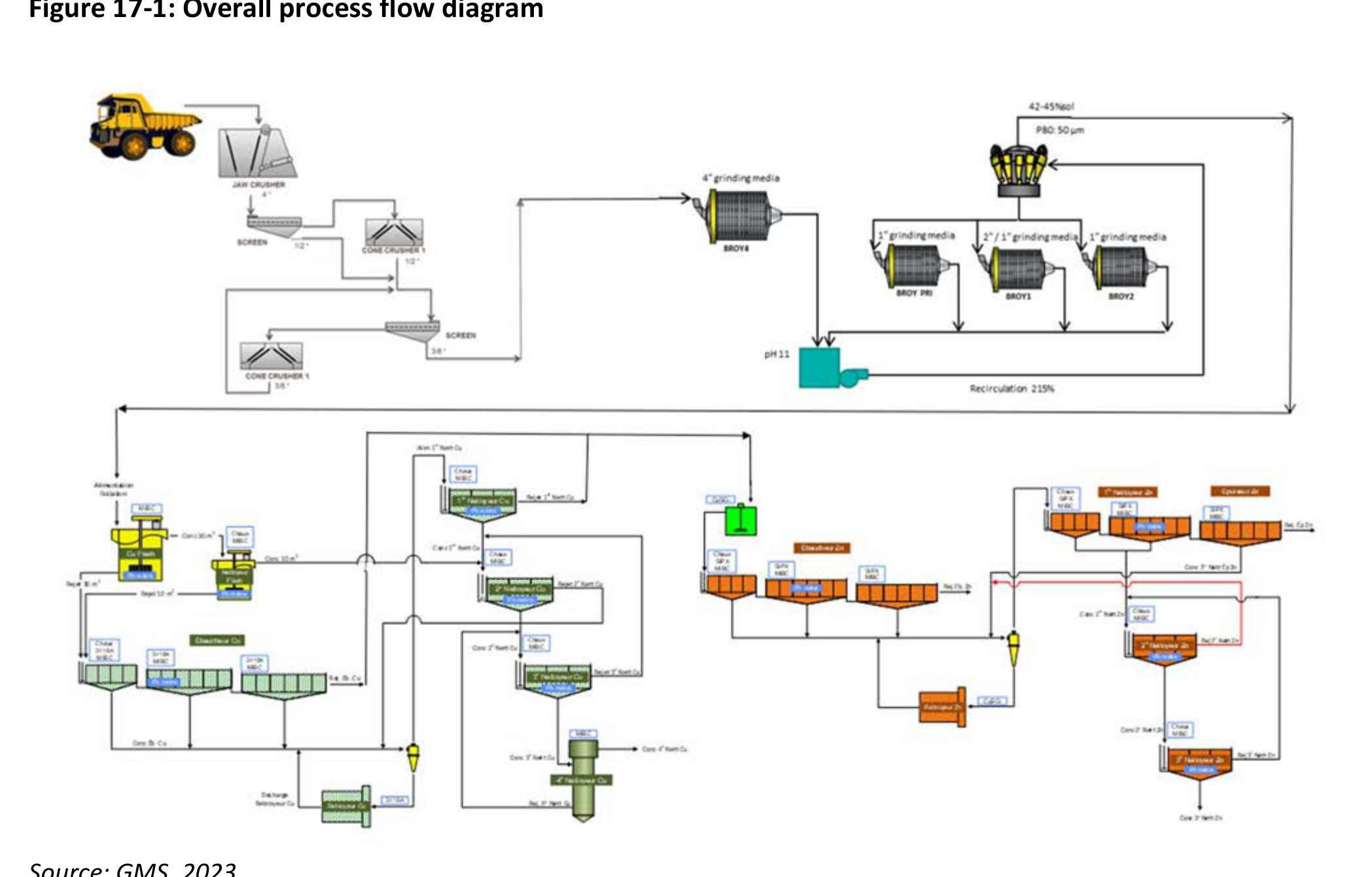
The May 2024 preliminary economic assessment for the Caber, Caber Nord and PD1 deposits in Québec proposes reusing a 1962 concentrator with three-stage crushing, four ball mills, four-stage copper cleaning and three-stage zinc cleaning.
The Caber Complex is a group of copper and zinc deposits, Caber, Caber Nord and PD1, in the Matagami mining camp of Québec, Canada. The NI 43-101 preliminary economic assessment (PEA) was prepared for Nuvau Minerals Corp. and Aardvark 2 Capital Corp. with an effective date of May 24, 2024. The basis for processing is to treat the copper and zinc bearing material through the existing Matagami process plant to produce separate copper and zinc concentrates. Tailings would go to a new tailings storage facility (TSF). The existing plant has operated since 1962 and is currently on care and maintenance. It has treated ore from 12 different mines, has been progressively upgraded and modernized, and had its most recent upgrade in 2012 to 2013.
Critical Data
| Parameter | Value | Unit | Notes |
|---|---|---|---|
| Nominal throughput | 3,000 | t/d | 1.1 Mt/y |
| Crushing plant availability | 65 | % | Existing surge bins and feeders |
| Wet plant availability | 90 | % | Existing bins and standby equipment |
| Average feed grade, copper | 0.96 | % Cu | Design |
| Average feed grade, zinc | 8.66 | % Zn | Design |
| Average feed grade, gold | 0.11 | g/t Au | Design |
| Average feed grade, silver | 14.57 | g/t Ag | Design |
| Bond work index | 11 to 12 | kWh/t | Material hardness |
| Primary grind | 50 | µm P80 | 50 to 60 µm in the process description |
| Copper and zinc regrind | 20 | µm P80 | Each rougher concentrate |
| Concentrate moisture | 8 | % | Copper and zinc |
| Copper recovery to copper concentrate | 88.4 | % | Plus 22.0% Au and 37.5% Ag |
| Zinc recovery to zinc concentrate | 93.7 | % | Plus 17.6% Au and 19.8% Ag |
| Installed grinding capacity | 2.8 | MW | Existing |
| Raw water requirement | About 35 | m3/h | Process |
Overview
The selected flowsheet is the existing Matagami flowsheet. It includes primary, secondary and tertiary crushing, storage bins with reclaim, primary and secondary grinding with classification, copper flash flotation, copper rougher flotation with regrind and four stages of cleaning, zinc rougher flotation with regrind and three stages of cleaning, concentrate thickening and filtration, and tailings pumping to the TSF. The plant has modern automated metallurgical and process control sampling and on-stream analysis (OSA) equipment, and updated instrumentation.
Key Process Stages
Crushing
Trucks bring material from Caber, Caber Nord or PD1 to a ROM bin or nearby storage. A Nordberg C125B jaw crusher runs in open circuit and feeds a single deck sizing screen. Oversize goes to a Symons 5 1/2 inch standard cone crusher, and its discharge with the screen undersize goes to a second sizing screen. Its oversize feeds a Symons 5 1/2 inch short head cone crusher, which returns to that screen. Undersize goes to storage. A 1,000 t bin sits between the primary and secondary crushing circuits, and there are three 3,000 t crushed material bins.
Grinding
Vibrating feeders reclaim crushed material to a primary ball mill, 12.5 ft by 16 ft. Three secondary ball mills, two of 11 ft by 15 ft and one of 11 ft by 13 ft, work with 12 Cavex hydrocyclones at 78% solids and 300% recirculating load around the secondary mills. Cyclone overflow passes a trash screen to the copper flotation circuit and underflow returns for secondary grinding.
Copper flotation
Slurry flows to two conditioning tanks and then to flash flotation, which has one 30 m3 and one 10 m3 forced air tank cell. Flash concentrate goes to the second cleaner. Tailings go to five banks of sixteen 1.13 m3 Gallagher forced air rougher cells. Rougher concentrate is reground to about 20 µm in a 9 ft by 11.5 ft ball mill with hydrocyclones. The cleaning circuit is four banks of Denver cells for the first cleaner, two for the second, one for the third and a column cell as an optional fourth cleaner. The first cleaner concentrate, flash product and third cleaner tails feed the second cleaner, and third cleaner tails go to the zinc circuit. Final copper concentrate is thickened and filtered in a Larox vertical pressure filter to 8% moisture, using 3418A collector and MIBC frother.
Zinc flotation
Zinc flotation follows with conditioning tanks, a rougher stage, a rougher concentrate regrind to 20 µm and three stages of cleaning, which are a first cleaner with a scavenger and then second and third cleaners. Copper sulphate activates zinc, SIPX is the collector, and lime controls pH. Zinc concentrate is thickened and filtered to 8% moisture.
Reagents and services
Reagents are lime, 3418A, MIBC, copper sulphate, SIPX and flocculant, delivered by road in bulk containers or bags and dosed with diaphragm pumps. Raw water is supplied from the river, though water conservation will be implemented at restart, and process water comes from thickener overflow and TSF return water. High-pressure air at about 700 kPa is dried and shared as plant and instrument air, and low-pressure air at 50 kPa supplies the flotation circuit.
Additional Interesting Data and Summary
The OSA system monitors all major streams for percent solids and copper, zinc, gold and silver assays, which lets the operator change air, level or reagent additions based on real-time assays. Cumulative shift samples for laboratory analysis are collected through the OSA sampling system, which has its own control, calibration and reporting system.
The report notes that the plant's crushing capacity relies on existing surge bins and dedicated feeders for choke feeding the cone crushers, and that grinding and flotation availability depends on reliable grid power supply. The design aims for enough automated plant control to minimize the need for continuous operator intervention.
Key Processes
- Three-stage crushing with jaw and cone crushers
- Primary and three secondary ball mills with hydrocyclones
- Copper flash and rougher flotation with regrind
- Four-stage copper cleaning
- Zinc rougher flotation with regrind and three-stage cleaning
- Thickening and Larox pressure filtration of concentrates
- Tailings disposal in a new tailings storage facility
Source: NI 43-101 Technical Report, Matagami Mining Camp, Québec, Canada, Preliminary Economic Assessment for the Caber Complex Project, May 24, 2024.
Project website: Caber Complex Project
