

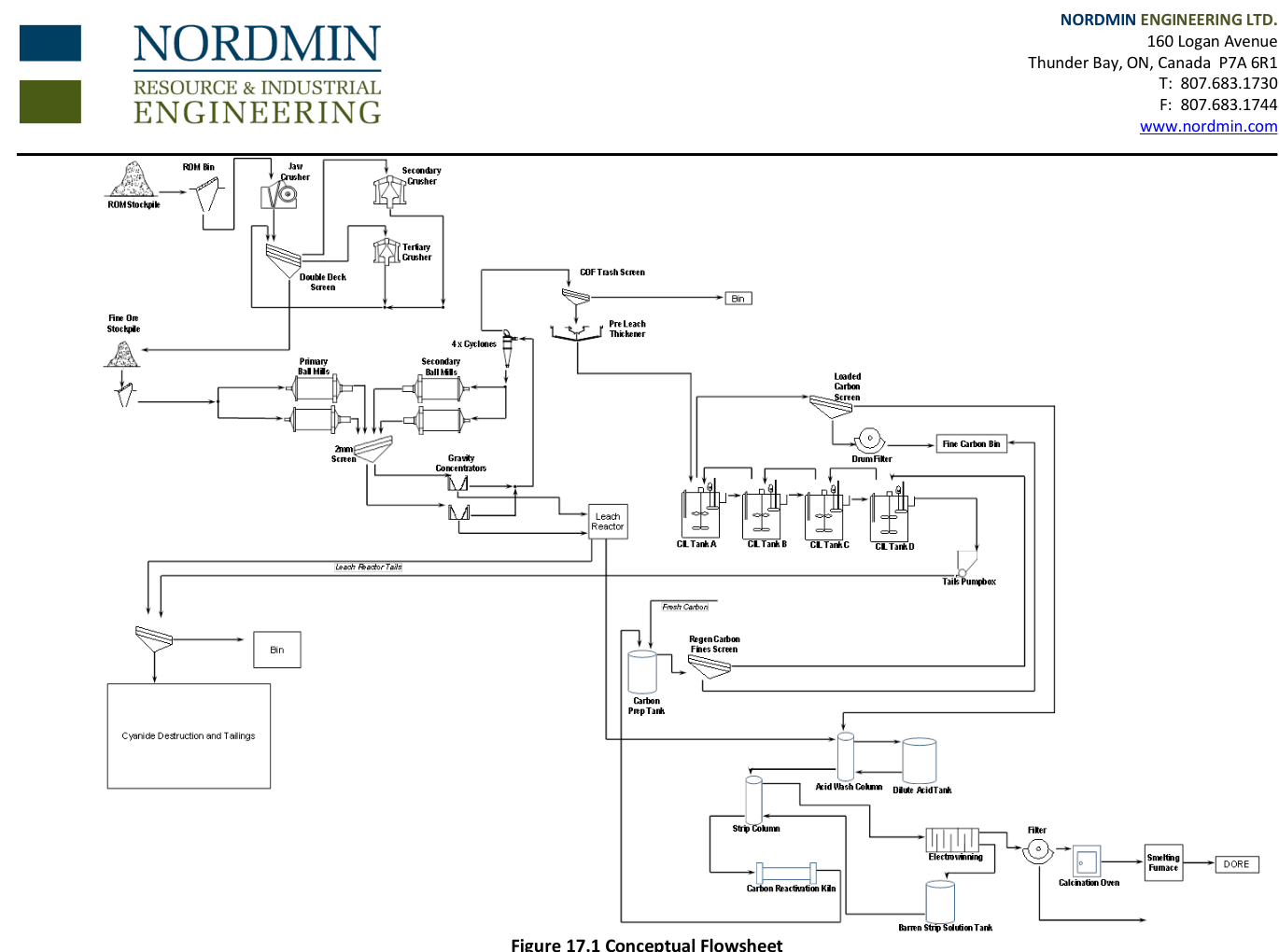
The March 2016 preliminary economic assessment for the Cape Ray gold property in Newfoundland and Labrador describes a conceptual plant with jaw and Blackhawk cone crushing, parallel primary mills, an intensive leach reactor, four CIL tanks and cyanide destruction.
Cape Ray is a gold property in the Isle aux Morts area of Newfoundland and Labrador, Canada, covering the 04, 41, 51 and Windowglass Hill deposits. The NI 43-101 technical report on the preliminary economic assessment (PEA) was prepared by Nordmin Engineering and others, with an effective date of March 7, 2016 and a signing date of April 21, 2016. The recovery methods section is a conceptual process flowsheet. Run of mine (ROM) material would be delivered to the mill feed stockpile at 1,000 t/d for six to seven months of the year from the open pit, while underground production would continue all year. The proposed processing rate is 36 t/h, or 850 t/d, with the mill operating at 92% availability, 365 days a year.
Critical Data
| Parameter | Value | Unit | Notes |
|---|---|---|---|
| Processing rate | 36 | t/h | 850 t/d |
| Mill availability | 92 | % | 365 days per year |
| ROM size | Minus 203.2 | mm | Reduced to minus 25.4 mm in the jaw crusher |
| Crushed product | Minus 12.7 | mm | Cone crushers; minus 10 mm to grinding |
| Crushing circuit capacity | 76 | tph | Nominal, decoupled from the plant |
| Jaw crusher | 30 x 42 | in | 150 hp, 20 t hopper |
| Grinding mills | 4 | Not applicable | 2.1 m x 6.0 m, 330 kW, tyre-mounted |
| Grind size | 100 | µm P80 | Cyclone overflow |
| Scalping screen | 2 | mm | Mill discharge |
| Gravity concentrators | 2 | Falcon SB 1350 | Intensive leach reactor: Sepro SLR 3000 |
| Pre-leach thickener | 45 | % solids by weight | Feed to CIL |
| CIL tanks | 4 | Not applicable | 7 m x 12 m, 30 hours residence |
| Pulp to CIL | 35 | % solids | pH 10.5 |
| Strip cycle | 8 to 12 | hours | Elevated temperature and pressure |
Overview
The conceptual flowsheet uses a single jaw crusher, two cone crushers, two parallel primary ball mills and two secondary mills, gravity concentration, intensive leaching of gravity concentrate, whole-ore cyanidation in carbon-in-leach (CIL) tanks, elution, electrowinning, and a cyanide destruction step before tailings disposal. ROM material is trucked one to three kilometres to the mill site, stockpiled through the summer and processed year round.
Key Process Stages
Crushing
A 20 t feed hopper with a 42 inch vibrating grizzly feeder feeds a 30 inch by 42 inch jaw crusher with a 150 hp motor, loaded by a front-end loader. Crushed ore passes under a cross-belt magnet and over a belt scale to a double deck 5 ft by 12 ft inclined vibrating screen. Oversize reports to a secondary crusher and the intermediate product to a tertiary crusher, and the minus 10 mm undersize is stockpiled outside the plant in an uncovered pile. The secondary crusher runs in open circuit and the tertiary in closed circuit with the screen. A Sepro Blackhawk 100 crusher with a 100 kW direct drive motor is recommended for both duties.
Grinding and gravity recovery
Four tyre-mounted mills, each 2.1 m by 6.0 m with a 330 kW drive, make up the circuit. Two primary mills run in parallel in open circuit and two identical secondary mills run in closed circuit with classifying cyclones. All mill discharge is pumped to a 2 mm scalping screen, with oversize returning to the primary mills and fines reporting to two Falcon SB 1350 gravity concentrators. Gravity tailings go to the cyclones. The cyclone overflow, with a target P80 of 100 µm, passes a trash screen to remove wood chips and plastic, then a primary thickener ahead of the CIL circuit. Gravity concentrate goes to a Sepro SLR 3000 intensive leach reactor that leaches under high cyanide and dissolved oxygen. Its pregnant solution goes to electrowinning, and its tailings return to the secondary mill discharge sump, so the entire ball mill discharge can pass through the gravity concentrators.
Carbon in leach
Pulp is thickened to 45% solids by weight, then flows through four agitated tanks, 7 m in diameter and 12 m high, that give a 30 hour residence time. Inter-tank flow is by gravity launders with inter-stage screening to maintain counter-current carbon flow. Sodium cyanide is added at the front of the circuit, lime controls pH at 10.5, and air is injected at the bottom of each tank. Any tank can be bypassed without shutting down the circuit. Gold is adsorbed onto carbon pumped counter-current to the slurry. Fresh and regenerated carbon is added to the last tank.
Elution and refining
Loaded carbon from the screen is acid washed with hydrochloric acid solution to remove carbonates, then pressure stripped in a cycle of 8 to 12 hours at elevated temperature and pressure. The pregnant solution flows to electrowinning cells, where gold plates on stainless wool cathodes. The cathodes are cleaned with high pressure water, and the sludge is pressed, calcined, mixed with flux and melted in an electric induction furnace to pour doré. Stripped carbon is reactivated in a kiln, and fine carbon is removed and recovered.
Cyanide destruction
Slurry from the last CIL tank passes over a safety screen to capture any escaping carbon and then goes to a cyanide destruction tank using the SO2-air process. After the cyanide is destroyed, the tailings are transported to the tailings pond.
Additional Interesting Data and Summary
Undersize from the loaded carbon screen is filtered and sold to recover the gold it contains. Fine carbon is constantly eliminated and recovered to avoid gold loss, while fresh carbon is added continuously.
The report's concentrator mill drawings show the general arrangement of the ground floor and building sections. The crushing circuit was designed with a nominal capacity of 76 tph to allow flexibility and decoupling between crushing and the processing plant.
Key Processes
- Jaw crushing and Blackhawk cone crushing with screening
- Parallel primary and secondary tyre-mounted grinding mills
- Falcon gravity concentration with intensive leaching
- Pre-leach thickening and four-tank carbon in leach
- Acid washing, pressure stripping and electrowinning
- Induction furnace smelting to doré
- SO2-air cyanide destruction of tailings
Source: NI 43-101 Technical Report on the Preliminary Economic Assessment for the Cape Ray Property; 04, 41, 51 and Windowglass Hill Deposits, Isle aux Morts Area, Newfoundland and Labrador, Canada, March 7, 2016.
