

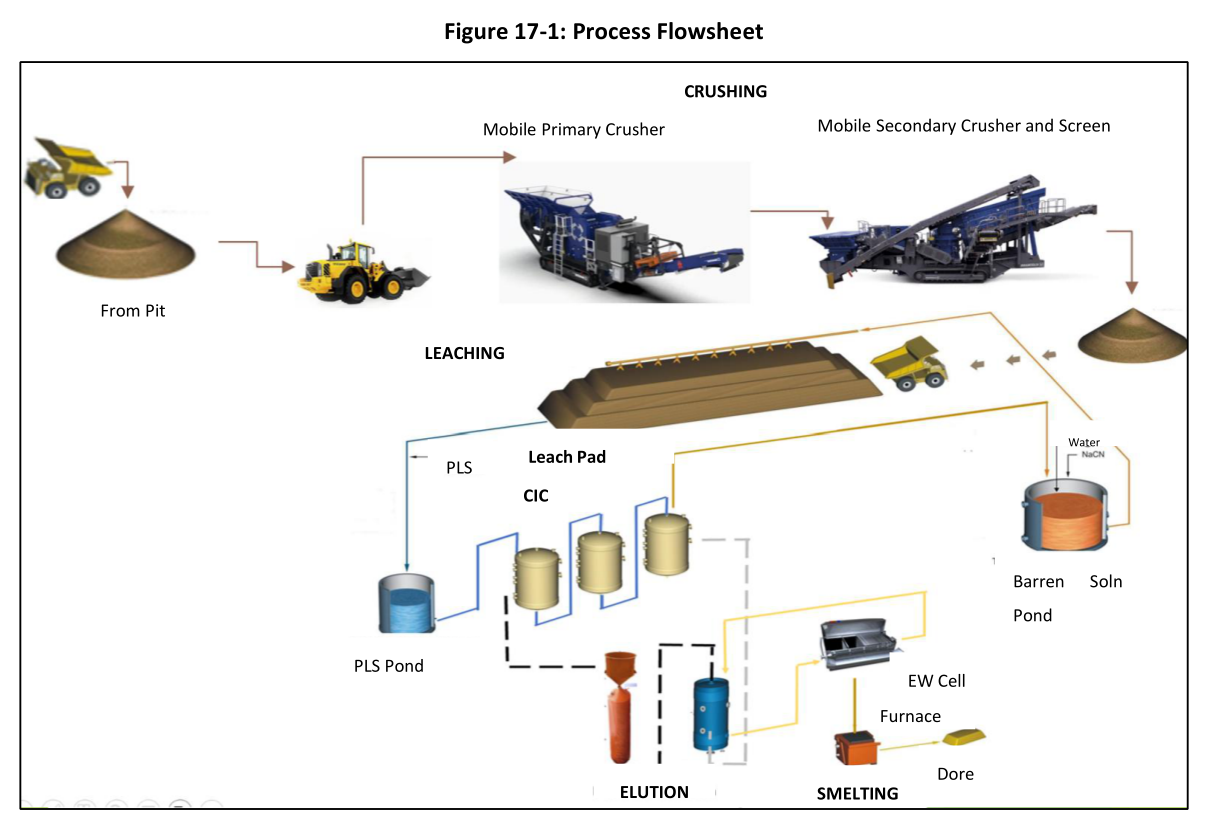
A 2,500 t/day cyanide heap leach with three-stage crushing, carbon in columns and an elution circuit forms the recovery route described for the Calcatreu gold-silver project in Rio Negro, Argentina.
Calcatreu is a low-sulfidation epithermal gold-silver project in Rio Negro Province, Argentina, roughly 40 km south of Ingeniero Jacobacci and near the province's south-southwest border with Chubut. Patagonia Gold Corp. owns the project 100%, held through its wholly owned subsidiary Mineral Calcatreu S.A.U. across 32 contiguous concessions covering more than 62,900 hectares. The initial pit is being developed on the Veta 49 deposit within the Nabel 4 concession. The technical report is a Preliminary Economic Assessment, and the recovery section describes a process plant with a design capacity of 2,500 t/day.
Critical Data
| Parameter | Value | Unit | Notes |
|---|---|---|---|
| Plant design capacity | 2,500 | t/day | Design basis |
| Design head grade, Au | 2.11 | g/t | Design criterion |
| Design head grade, Ag | 19.8 | g/t | Design criterion |
| Maximum ROM ore size | 600 | mm | Run of mine feed |
| Crushing product size | -6.3 | mm | Tertiary circuit product |
| Crushed ore moisture | 3 | % | Design criterion |
| Ore specific weight | 2.65 | t/m³ | Design criterion |
| Bulk ore density | 1.6 | t/m³ | Design criterion |
| Stacking height | 6 | m | Maximum discharge height |
| Leach pad area | 25 | ha | Five cells of 5 ha each |
| Stacking capacity | 4.5 | Mt | Total pad capacity |
| Leaching time | 60 | days | Design criterion |
| Irrigation rate | 12 | l/m²/h | Drip irrigation |
| Sodium cyanide concentration | 400 | ppm NaCN | Irrigation solution |
| CIC columns | 6 | units | 4 m³ bed volume each |
| Carbon per column | 2,000 | kg | Activated carbon |
| CIC design flowrate | 134 | m³/h | Nominal flow 90 m³/h |
| Elution temperature | 120 | °C | Elution column |
| NaOH in elution solution | 1.5 | % w/w | Design criterion |
| NaCN in elution solution | 2.5 | % w/w | Design criterion |
| Electrowinning current | 1,600 | A | DC output 10 V |
| Regeneration furnace temperature | 700-800 | °C | Rotary furnace |
| Smelting temperature | 1,200 | °C | Induction furnace, maximum 1,400 °C |
| Daily water requirement | 168 | m³/day | Heap leach balance estimate |
| Monthly water requirement | 5,039 | m³/month | Heap leach balance estimate |
| Required solution flow | 188 | m³/h | At operating flow |
Overview
Ore from the mine travels by truck to stockpiles near the crushing area. A 5.7 m³ front loader moves material from the stockpiles to the feed hopper of the primary crusher, and run of mine ore arrives at a maximum size of 600 mm. Size reduction happens in three stages.
The crushed product goes to a leach pad, where it is stacked and irrigated with cyanide solution. Pregnant leach solution drains from the heap and passes through a carbon in column circuit, where activated carbon captures gold and silver. Loaded carbon moves through acid washing, elution and electrowinning, and the resulting precipitate goes to a smelter that produces doré metal.
The flowsheet includes an irrigation cycle that returns barren solution to the pad after reconditioning with cyanide and adjustment of pH.
Key Process Stages
Crushing
The primary crushing station has a fixed grill, a feed hopper, a variable speed vibratory grizzly feeder and a jaw primary crusher. Discharge from the primary crusher feeds a conveyor that carries ore to the secondary crusher.
Secondary crushing runs as a closed circuit. A primary screen receives the conveyor feed from primary crushing together with the coarse product from the secondary crusher. Screen overflow feeds a standard head cone crusher, and that product returns to the screen by conveyor.
Tertiary crushing is also a closed circuit. A secondary screen takes classified material from the primary screen and the product of the tertiary crusher. Screen reject feeds a short head tertiary crusher, and crushed ore returns to the screen. The circuit product is -6.3 mm.
The design criteria table lists different equipment from the prose description, including a mobile compact plant, an impact primary crusher rated at 200 kW, horizontal screens measuring 2.05 by 5.0 m, and cone crushers of 355 kW for the secondary and tertiary duties.
Leach Pad
Crushed ore is loaded by a 5.7 m³ front loader and hauled in 55 t capacity trucks to the leach pad. The stacking area is divided into five cells, each 300 m long by 167 m wide, giving 5 ha per cell and 25 ha in total. Total stacking capacity is 4.5 Mt. Material is discharged on the pad at a maximum height of 6 m.
Irrigation uses a pipe network with drippers delivering solution at 400 ppm NaCN and a rate of 12 l/h/m². Solution percolating through the heap is collected as pregnant leach solution through collector pipes and transferred to the process plant.
Four HDPE-lined ponds and a pumping system support the solution circuit. The PLS pond holds 1,136 m³, the barren pond 2,415 m³, the emergency pond 21,807 m³ and the fresh water pond 2,415 m³. All ponds have 3H:1V slopes, and emergency overflow is directed to the emergency pond.
Carbon in Columns
Pregnant leach solution is pumped from the PLS pond to the CIC circuit, where metals are absorbed onto activated carbon. The circuit consists of six columns of 4 m³ each. Solution passes from column to column in counter current flow, reducing the metal concentration in solution as the carbon becomes enriched.
Saturated carbon is removed from the circuit and replaced with new or reactivated carbon. Loaded carbon is transferred to the elution plant. Barren solution leaving the CIC circuit is reconditioned with cyanide and pH adjustment before it is pumped back to the leach pad.
Elution, Electrowinning and Smelting
Loaded carbon enters an acid washing column, where a dilute nitric acid solution removes some impurities while leaving the metals on the carbon. The carbon then moves to the elution column, where solutions containing NaCN, NaOH and demineralized water at 120°C transfer the metals into an aqueous solution. The elution solution contains 1.5% w/w NaOH and 2.5% w/w NaCN.
Stripped carbon goes to a regeneration circuit for heat treatment in a furnace, which restores its adsorbent properties before it returns to the CIC process. The furnace operates at 700-800°C and burns diesel, with a design capacity of 200-250 kg/h and a residence time of 15-20 minutes.
The enriched electrolyte goes to an electrowinning cell with an anode and a cathode. Metals electrodeposit onto stainless-steel cathodes coated with steel wool to increase surface area. The precipitate is harvested with the steel wool and sent to the smelter. Electrowinning operates at 50°C with a DC output of 10 V and 1,600 A, producing about 150 kg per week of dry precipitate.
The smelter includes a drying oven operating at 150-300°C with a maximum of 500°C and a drying time of 30 hours. The melt furnace is an induction unit with a 250 kg capacity and a silica crucible. It operates at 1,200°C with a maximum of 1,400°C, and smelting takes 5 hours.
Water Balance
The heap leach water balance estimates 143 m³/day of water retained in irrigated ore and 25 m³/day lost through evaporation, giving a daily requirement of about 168 m³/day, or 5,039 m³/month. The hourly requirement is estimated at 7 m³/h.
Irrigation builds in stages. One cell is completed in about 5 days, each cell holding about 11,200 t of ore over 1,167 m², with an irrigation flow of 14 m³/h. Two cells are under irrigation after 10 days at 28 m³/h, and three cells after 15 days at 42 m³/h. At 65 days, 13 cells are expected to be under irrigation and the operating flow of 188 m³/h is reached.
At start-up, about 3,552 m³ of fresh water is required in the barren and PLS ponds. Filling begins a month before irrigation, with pH conditioning and fresh water dosing as needed until the circuit stabilizes.
Additional Interesting Data and Summary
The pad design holds 4.5 Mt against a leach cycle of 60 days for the crushed ore. Each cell takes about 7,000 m³ of solution volume and 11,200 t of ore, and the total irrigated area at operating flow is 15,628 m². Ore under irrigation amounts to 9.6 t/m², with a feed surface of 260 m²/day.
The CIC design flowrate is 134 m³/h with a nominal flow of 90 m³/h. Each column has a bed height of 1.27 m, a diameter of 2 m, a height of 1.7 m and a column volume of 5.2 m³, and solution velocity is 0.71 m/min.
The acid rinse circuit handles 2 t batches at a carbon transfer flowrate of 23 m³/h with 15% w/w solids, a 3.64 m³ bed volume, a 4.91 m³ column volume, a height of 4.3 m and a diameter of 1.2 m. Acid solution recirculation is 3.6 m³/h, and retention time is 60 minutes.
The elution circuit also handles 2 t batches at 23 m³/h and 15% w/w solids, with a 4 m³ bed volume, a 5.4 m³ column volume, a height of 6.9 m and a diameter of 1 m. Elution solution volume is 3 bed volumes at 4 m³/h, with an overall retention time of 4.5 hours. The water rinse uses 1 bed volume at 6 m³/h with an overall retention time of 550 minutes.
The dry precipitate amounts to 150 kg/week, with a wet precipitate density of 3.6 t/m³ and 22% moisture.
The equipment list names one primary crusher, one standard cone crusher, one short head cone crusher, two double deck screens, eight conveyor belts, the four ponds, six CIC columns, a process water tank, an elution column, an acid washing column, a coal regeneration furnace, a water treatment plant, two electrochemical cells, a precipitate dryer oven and an induction melt furnace.
Key Processes
- Three-stage crushing to a -6.3 mm product
- Heap leaching at 400 ppm NaCN and 12 l/m²/h
- Carbon in column adsorption across six columns
- Acid washing and elution at 120°C
- Electrowinning onto steel wool cathodes
- Carbon regeneration at 700-800°C
- Drying and induction smelting to doré
Source: Calcatreu Project, Rio Negro Province, Argentina Preliminary Economic Assessment NI 43-101 Technical Report, 2026-10-02. Project website: Calcatreu Project
