Mineral Processing Circuit

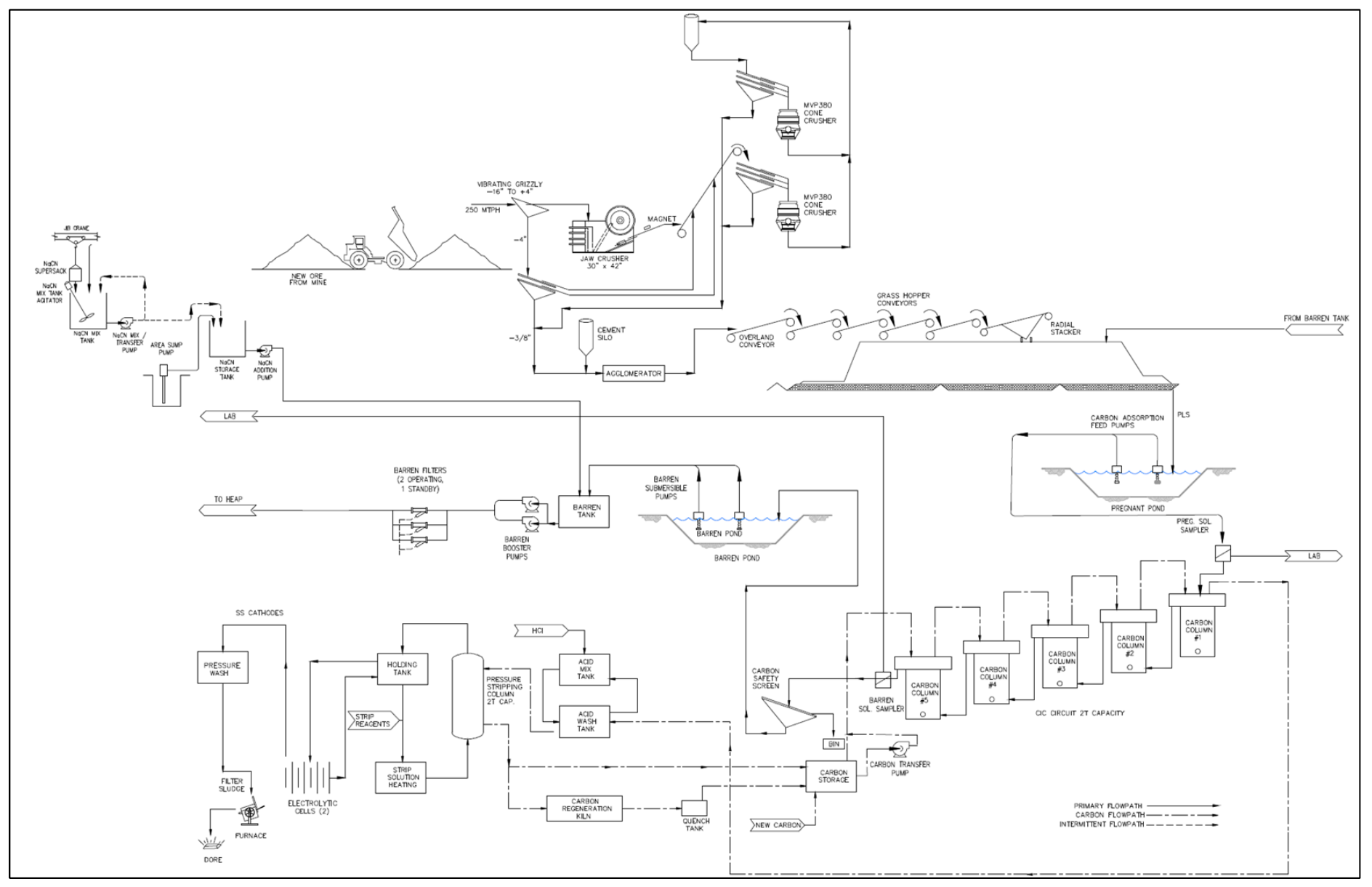
Trinidad/Taunus Project process flowsheet: Trinidad Process Flow Sheet

Trinidad/Taunus Project — 2012 Technical Report

This 2012 Pre-Feasibility Study outlines the processing methodology for the Trinidad/Taunus Project, focusing on a heap leach recovery circuit. The proposed operation involves crushing run-of-mine ore to a fine size, agglomerating it with cement, and stacking it on a lined pad for cyanide leaching. The design targets an average throughput of 4,300 tonnes per day, with an annual capacity of 1.55 million tonnes.

Trinidad/Taunus Project — 2012 Technical Report Read Post »

Zafranal Project — 2023 Technical Report

The Zafranal Project in Peru features a dual processing strategy comprising a concentrator and a dump leach/SX-EW facility. The concentrator is designed to process 44,000 t/d of copper and gold-bearing plant feed material from an open pit operation, producing a marketable copper flotation concentrate containing 28% copper and approximately 3 g/t of gold. The metallurgical processing procedures were based on test work performed at G&T and Plenge.

Zafranal Project — 2023 Technical Report Read Post »

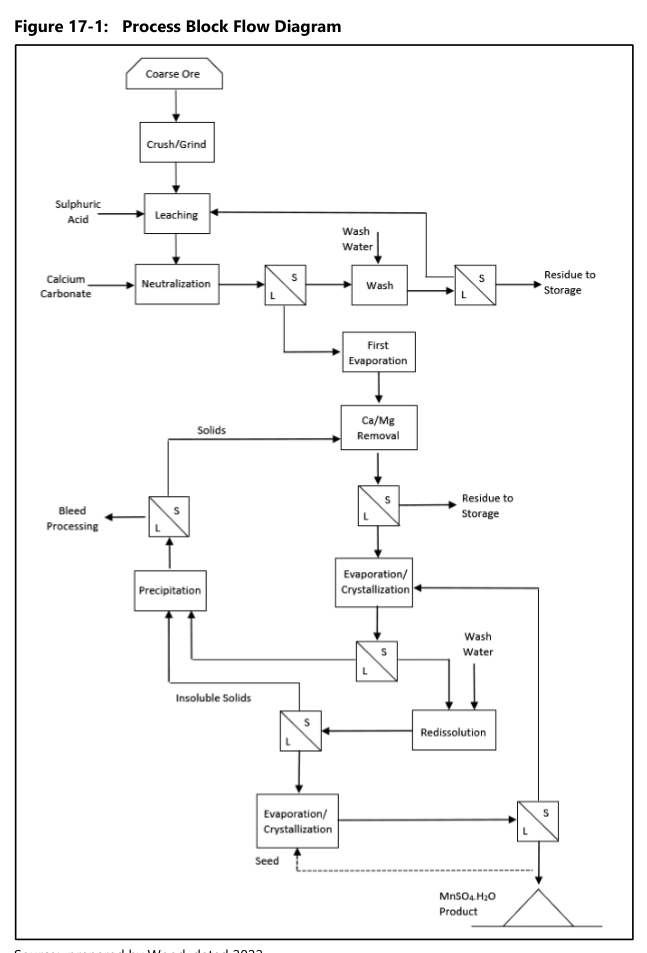
Figure 17-1: Process Block Flow Diagram

Battery Hill Manganese Project — 2022 Technical Report

This NI 43-101 Technical Report outlines the recovery methods for the Battery Hill Manganese Project located in New Brunswick, Canada. The project focuses on the production of High Purity Manganese Sulphate Monohydrate (HPMSM), a specialty product used primarily for battery applications. The process design is based on the reactivity of manganese silicate mineralization to dilute sulphuric acid, supported by developmental test programs and mass balance modeling using Metsim.

Battery Hill Manganese Project — 2022 Technical Report Read Post »

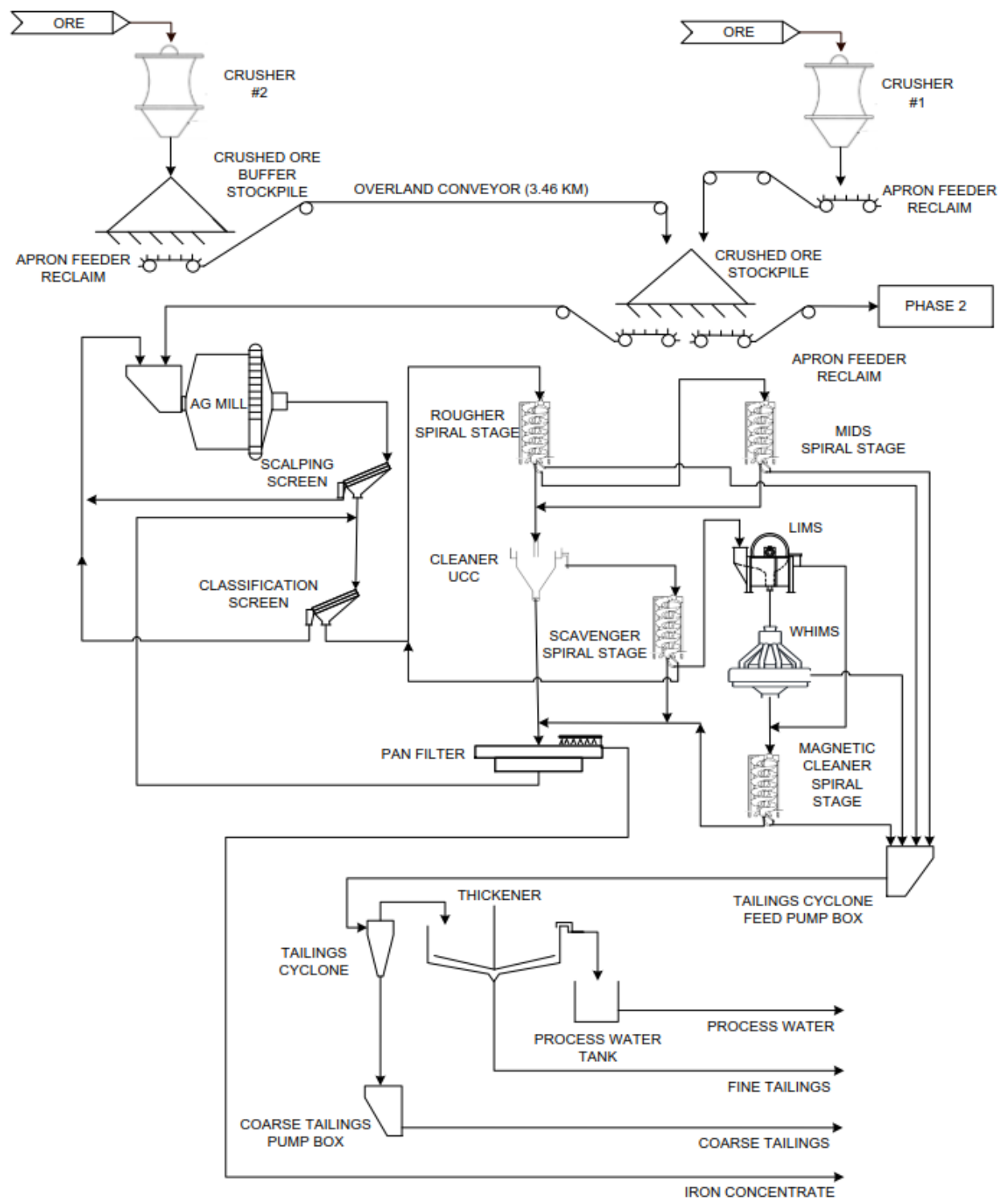
Bloom Lake Mine process flowsheet: Simplified block flow diagram Phase I (QIO)

Bloom Lake Mine — 2023 Technical Report

Quebec Iron Ore (QIO) operates the Bloom Lake Mine facilities, which include two distinct concentrator phases. Phase I was restarted in 2018, while Phase II commenced operations in 2022. The combined design yearly production capacity for the facility is 15 million tonnes per year (Mtpy) of concentrate, sourced from the Pignac, West, and Chief’s Peak pits. The processing flowsheets were developed based on initial Phase II designs and extensive testing and piloting results conducted in partnership with Mineral Technologies.

Bloom Lake Mine — 2023 Technical Report Read Post »

Los Ricos North PEA — 2023 Technical Report

This report details the recovery methods for the Los Ricos North project, designed to treat both oxide and sulphide deposits. The process plant is designed for a nominal throughput of 8,000 tpd. Initially, four oxide deposits will be processed via conventional tank leaching and Merrill Crowe precipitation. Commencing in year nine, the plant will transition to processing sulphide material from the Orito Deposit via conventional flotation operations, at which point the leaching and Merrill Crowe operations will shut down.

Los Ricos North PEA — 2023 Technical Report Read Post »

Yellow Giant — 2011 Technical Report

This technical report outlines the recovery methods for the Yellow Giant mineralization on the Banks Island Mineral Property. The report establishes that gold is strongly associated with sulphide mineralization, specifically massive sulphides, which allows for effective separation from low-density gangue using gravity methods. Heavy Liquid Separation (HLS) testing conducted in 2011 demonstrated high gold recoveries of 87.6% at a coarse crush size of ¼ inch, supporting the viability of a gravity process.

Yellow Giant — 2011 Technical Report Read Post »

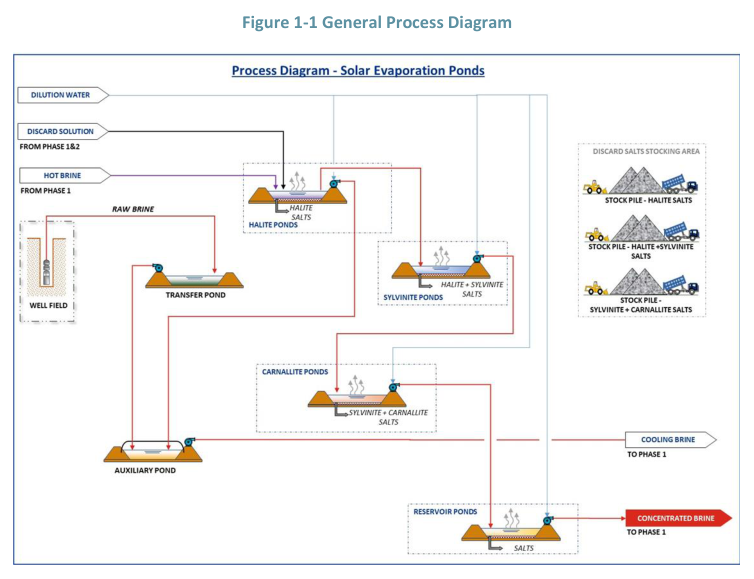
Figure 1-1 General Process Diagram

NI 43-101 Definitive Feasibility Study — Minera Salar Blanco

This NI 43-101 Definitive Feasibility Study outlines the Stage One project for Minera Salar Blanco located in the Atacama Region of Chile. The project focuses on the extraction of lithium from brine resources within the Salar de Maricunga area. The facilities are designed to produce an average of 15,200 tons per year of battery-grade lithium carbonate over a 20-year mine life. The process utilizes solar evaporation ponds to concentrate lithium-rich brine before further purification and precipitation in a production plant.

NI 43-101 Definitive Feasibility Study — Minera Salar Blanco Read Post »

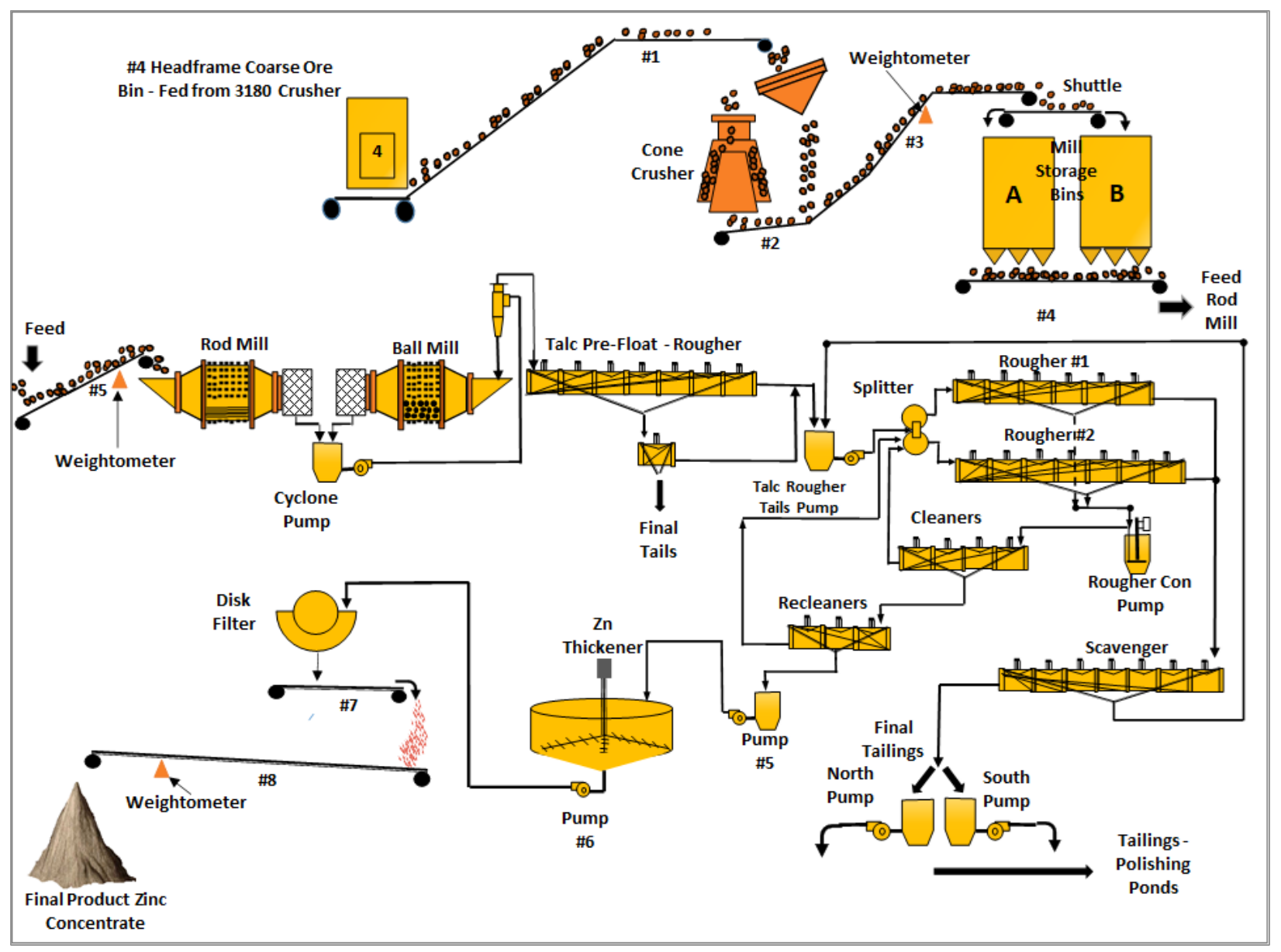
Empire State Mines process flowsheet: Concentrator flowsheet current state

Empire State Mines — 2025 Technical Report

The Empire State Mines (ESM) concentrator, originally commissioned in 1970 and last shut down in 2008, was refurbished in late 2017 and resumed processing mineralization in 2018. The facility is designed to handle 5,000 short tons per day, though current operations run on a reduced schedule of one shift per day, four days per week, processing between 10,124 and 11,375 tons per week. The mine operates underground, with mining production typically not exceeding 2,275 tons per day, projected to peak at 2,800 tons per day in 2028.

Empire State Mines — 2025 Technical Report Read Post »

Scroll to Top