Mineral Processing Circuit

Minera Tres Valles Copper Project — 2018 Technical Report

The Minera Tres Valles Copper Project, located in the Coquimbo Region of Chile, is currently operating using a heap-leach and solvent extraction-electrowinning (SX-EW) process to produce high-grade copper cathodes. The ore is sourced from open pits including Don Gabriel, Papomono, and Cumbre. The current process involves crushing the ore to a target size of 80% < 6.4mm, followed by agglomeration with water and sulfuric acid. The material is then stacked on leach pads where oxide ore is leached first, followed by sulphide ore extraction.

Minera Tres Valles Copper Project — 2018 Technical Report Read Post »
La Libertad Complex — 2021 Technical Report

The La Libertad processing plant is a conventional facility designed to treat approximately 2.25 million tonnes per annum (Mtpa) of ore. The plant utilizes a circuit comprising comminution, agitated cyanide leaching, and carbon adsorption, followed by carbon elution, electrowinning, and doré production. Current gold recoveries are reported to be between 92% and 95%. The plant processes a blend of ore from open pit and underground mines, as well as reclaimed material from historical heap leach operations, which currently constitutes approximately two-thirds of the feed.

La Libertad Complex — 2021 Technical Report Read Post »

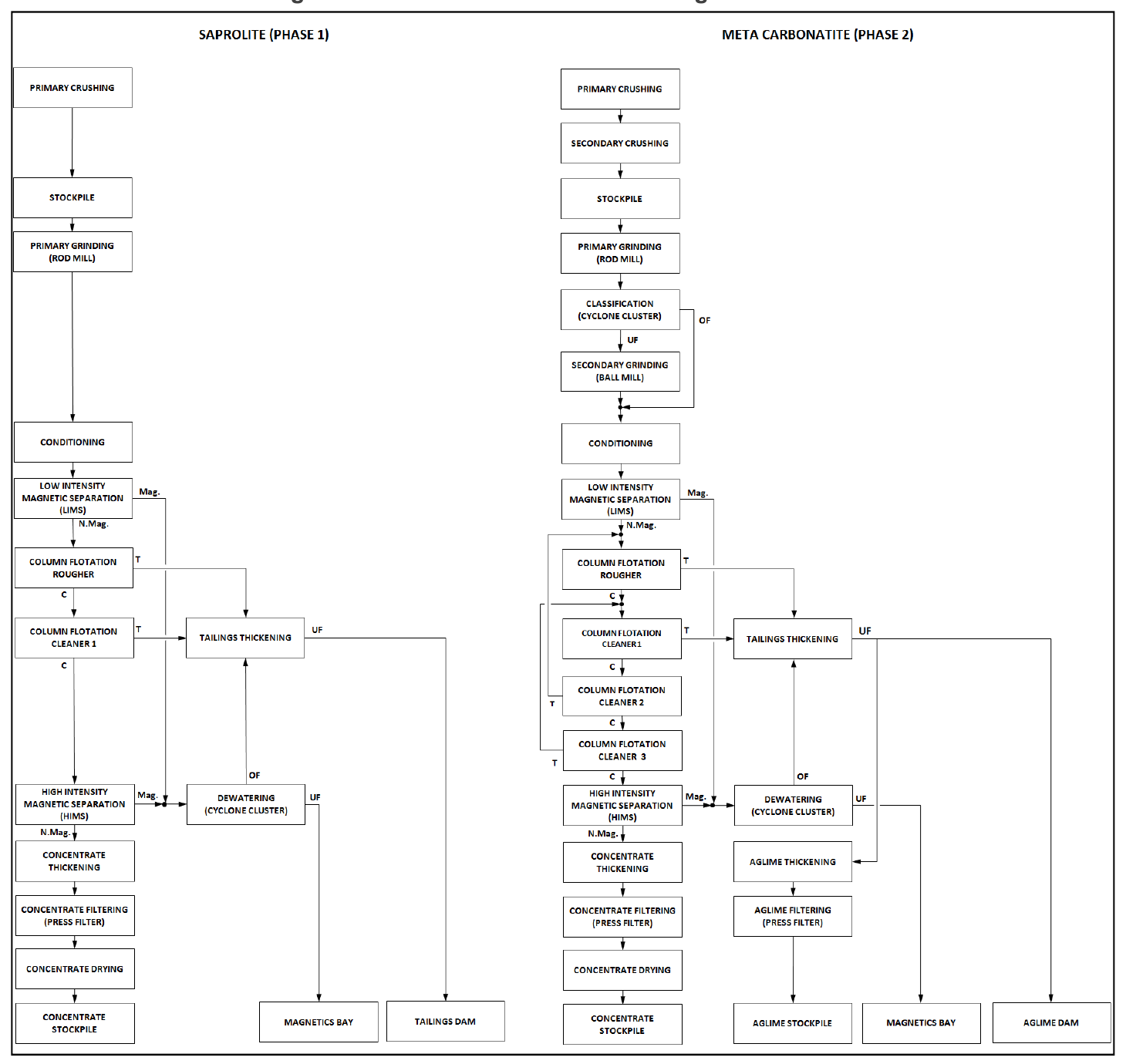
Três Estradas Phosphate Project process flowsheet: Process Route - Block Diagram

Três Estradas Phosphate Project — 2018 Technical Report

The Três Estradas Phosphate Project, developed by Águia Resources, Ltd., outlines a three-phase mineral processing strategy for phosphate recovery in Brazil. Phase 1 focuses on treating saprolite ore to produce phosphate concentrate (phosrock) at a rate of 300,000 t/y. Phase 2 transitions to carbonatite ore, maintaining phosrock production while introducing agricultural lime (aglime) production from flotation tailings at 1,000,000 t/y. Phase 3 involves reclaiming and selling stored aglime. The processing plant utilizes column flotation technology, magnetic separation, and drying systems to achieve product specifications.

Três Estradas Phosphate Project — 2018 Technical Report Read Post »
Banio Potash Project — 2024 Technical Report

The Banio Potash Project Preliminary Economic Assessment (PEA) outlines a solution mining approach for extracting potash-rich brines from the wellfield, favoring this over conventional underground mining. The proposed processing regime targets the production of Muriate of Potash (MOP) at three capacity scenarios: 400 kt/a, 600 kt/a, and 800 kt/a, primarily as granular solids with a K60 grade (95% KCl purity). The process is designed to maximize resource recovery, producing a high-grade vacuum salt by-product alongside the potash.

Banio Potash Project — 2024 Technical Report Read Post »

Blue River Tantalum–Niobium Project — 2012 Technical Report

This section outlines the recovery methods for the Blue River Tantalum–Niobium Project based on a Preliminary Economic Assessment (PEA) effective September 29, 2011. The process plant is designed for a nominal capacity of 7,500 tonnes per day, handling Run-of-Mine (ROM) material from underground operations. The flowsheet utilizes conventional technology to crush, grind, and separate tantalum and niobium minerals via flotation, followed by refining processes to produce high-purity chlorides and oxides.

Blue River Tantalum–Niobium Project — 2012 Technical Report Read Post »

West Cache PEA Favours Toll Milling at a Nearby Gravity-CIP Plant, With Gravity Recovering a Third of the Gold

This Pre-Feasibility Study (PEA) for the West Cache Gold Property outlines metallurgical testwork and processing options for gold recovery. Based on recent testwork, two primary flowsheets were evaluated: a dedicated gravity-float-leach option and toll processing at existing regional facilities. The preferred flowsheet involves gravity concentration of free gold using centrifuges and tabling, followed by flotation of a gold-sulphide concentrate and cyanidation of the reground float concentrate. This option achieved combined recoveries averaging 97% and produces cyanide-free flotation tailings suitable for mine backfill.

West Cache PEA Favours Toll Milling at a Nearby Gravity-CIP Plant, With Gravity Recovering a Third of the Gold Read Post »

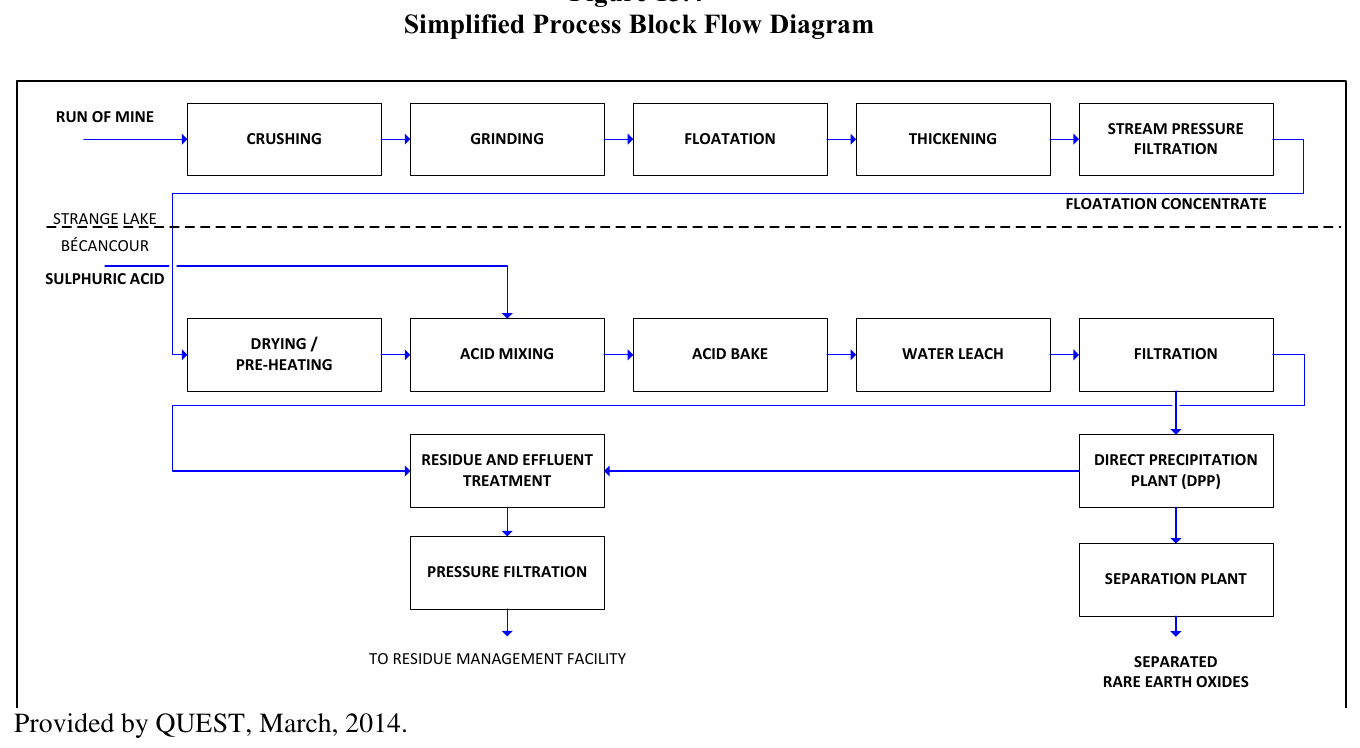
Strange Lake Project process flowsheet: Simplified Process Block Flow Diagram

Strange Lake Project — 2014 Technical Report

The Strange Lake project involves the mining and beneficiation of mineral resources at the Strange Lake site, followed by transport of the flotation concentrate to a processing facility at the Bécancour Industrial Park for the recovery of rare earths and yttrium. The beneficiation process at Strange Lake comprises crushing, grinding, and flotation, while the Bécancour facility utilizes acid thermal processing (acid bake) and water leaching to extract payable elements into solution.

Strange Lake Project — 2014 Technical Report Read Post »

Gemfield Project — Technical Report

The Gemfield Project Technical Report outlines a comprehensive recovery method designed to produce doré bars containing gold and silver. The process flowsheet includes three-stage crushing and screening to produce leach feed, followed by heap leaching using sodium cyanide solution. The pregnant solution is processed through a carbon adsorption plant, followed by stripping, regeneration, electrowinning, and smelting to produce doré bars for shipment to third-party refiners.

Gemfield Project — Technical Report Read Post »

Cauchari-Olaroz process flowsheet: Process Block Diagram

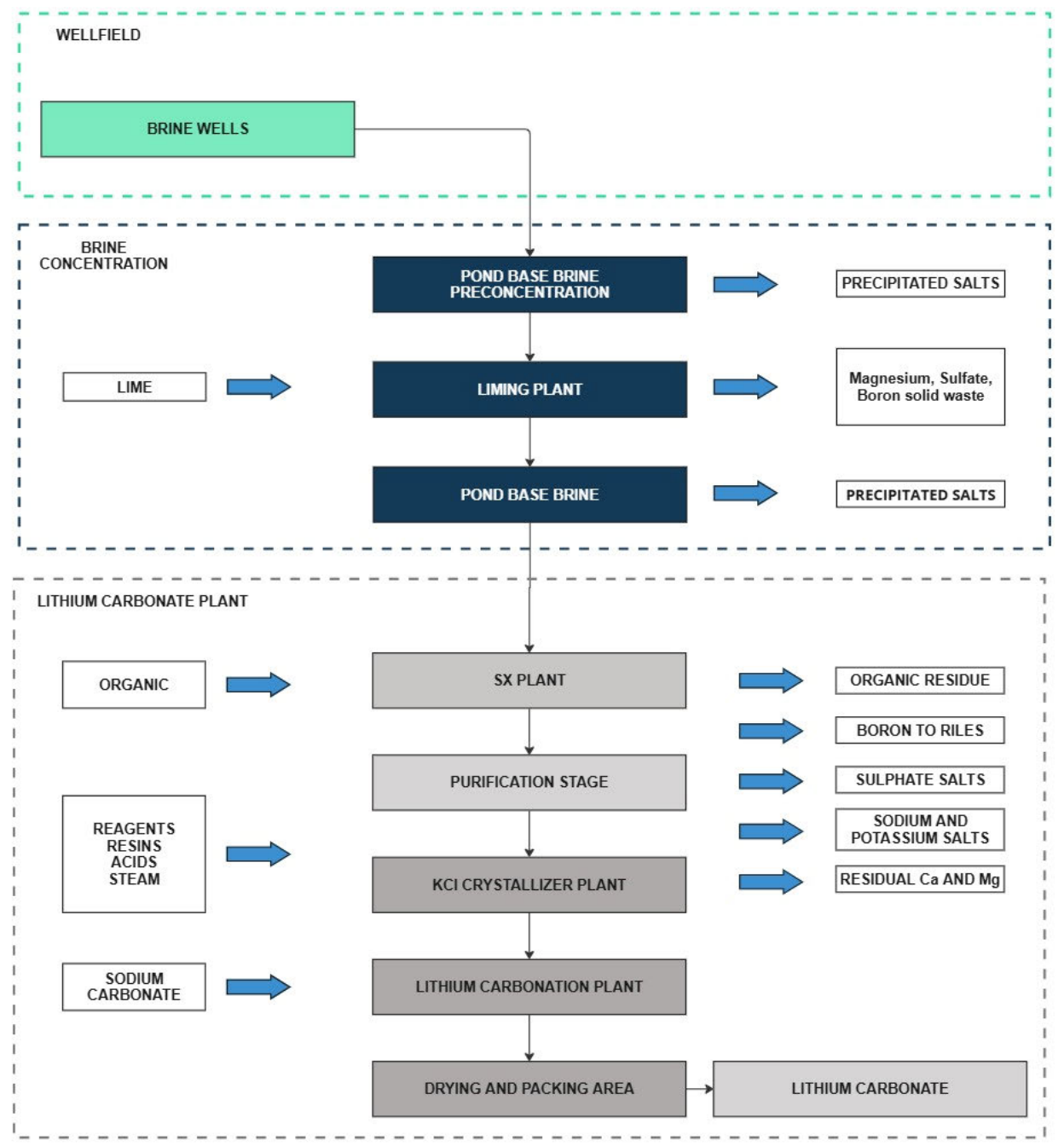
Cauchari-Olaroz Concentrates Brine in 28 Evaporation Ponds and Makes Battery-Grade Lithium Carbonate in a 40,000 t/a Plant

The 2026 technical report for the Exar joint venture in Jujuy describes a working pond and plant route, from wells and liming through boron solvent extraction, purification and carbonation, and a planned second stage adding 45,000 t/a by direct lithium extraction.

Cauchari-Olaroz Concentrates Brine in 28 Evaporation Ponds and Makes Battery-Grade Lithium Carbonate in a 40,000 t/a Plant Read Post »

Scroll to Top