

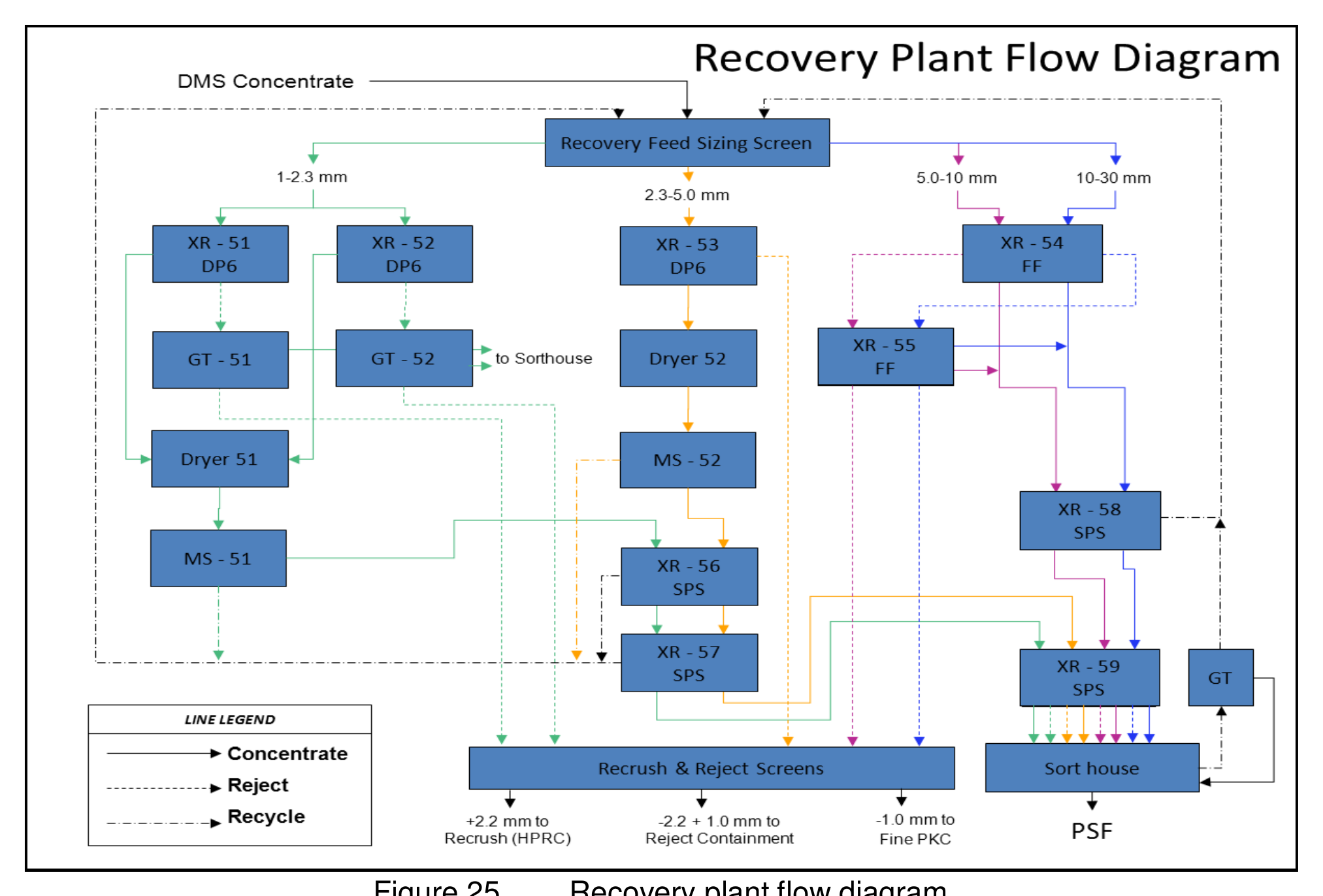
The 2015 technical report on the Diavik mine at Lac de Gras describes a chemical-free gravity and X-ray recovery plant that has run since 2002 and recovers diamonds down to about 1 mm.
The Diavik Diamond Mine is an operating rough diamond mine at Lac de Gras in Canada's Northwest Territories. It is run through the Diavik Joint Venture, in which Dominion Diamond Corporation's subsidiary held a 40% interest at the time of the report. Diavik Diamond Mines (2012) Inc., a wholly owned subsidiary of Rio Tinto, manages and operates the mine. The technical report, effective 18 March 2015, describes four kimberlite pipes under the lake, held back by dikes. Three pipes were in production and the fourth, A21, was in development. Open pit mining ran from 2003 to 2012, and the mine has been fully underground since then. The A21 open pit was due to add feed from late 2018. Output had exceeded 6 million carats a year in every year after 2003 except 2009.
Critical Data
| Parameter | Value | Unit | Notes |
|---|---|---|---|
| Plant commissioning | Late 2002 | Not applicable | Continuous operation since |
| Original design throughput | 1.5 | Mtpa | Kimberlite feed |
| Peak throughput | 2.4 | Mtpa | 2007 and 2008 |
| Throughput in 2014 | 2.3 | Mt | 100% JV basis |
| Bottom screen size | 0.85 | mm | Nominally reported as 1 mm |
| Annual output | Over 6 | million carats | Most years since 2003 |
| Proven and probable reserve | 18.1 | Mt | 2.9 carats per tonne |
| Contained carats in reserve | 53.3 | million carats | As of December 31, 2014 |
| Grade reconciliation, 2014 | 104 | % | Model to actual |
| PKC final dimensions | About 1 x 1.3 | km | Up to 40 m of processed kimberlite |
| Chemical reagents used | None | Not applicable | Gravity and X-ray methods |
Overview
Diavik recovers diamonds without chemicals. The plant separates them from kimberlite by density, because diamonds are heavier than most of the rock around them. The recovery section then uses X-rays, under which diamonds glow. Photoelectric sensors detect the glow and trigger air blasts that knock each diamond into a collection bin.
The plant was built for 1.5 Mtpa. Continuous improvement took it above 2 Mtpa without capital expansion, and it reached 2.4 Mtpa during a period when the ore handled unusually well. The open pits were also sized for 1.5 Mtpa but kept pace by adding equipment. In 2009, throughput was cut to 1.4 Mt by a planned curtailment during the global financial crisis.
The feed is a blend of hard and soft kimberlites from the A154S, A154N and A418 pipes. Granite and mud can cause processing difficulties. The operation handles them by sorting as much granite as possible out of the feed and blending kimberlites from different pipes and domains for the best throughput.
Key Process Stages
Gravity concentration
The report's flow diagram shows the processing route, although the text gives few equipment details. Kimberlite is broken down and the diamond-bearing material concentrated by gravity-based methods, which include thickening and dense media separation (DMS) circuits. The report notes these circuits when it discusses future clay-rich feed.
X-ray recovery
In the recovery plant, X-ray sorters pick out diamonds from the concentrate. Waste material above a set size is re-crushed and run through again. Smaller waste is classed as rejects and stockpiled in case it is reprocessed later. The recovered stones pass through more sorters to the bottom of the plant, where an authorized employee, under tight security surveillance, weighs and records them and removes any non-diamonds.
Small diamond recovery
Diavik aims to recover every stone larger than the screen aperture, because small diamonds are worth recovering at this mine. Grease tables in the recovery plant help with this. The screen started at 1 mm and was later reduced to 0.85 mm, and 1 mm is still the nominal figure, which leaves a small allowance for wear.
Security and product splitting
Recovered diamonds wait in a secure vault and are then flown under escort to Yellowknife. There they are cleaned, sorted, sized and weighed, then packed in a special case. At Diavik's product splitting facility in Yellowknife, the diamonds are split by size and value into the shares of the two joint venture partners. The facility's quality management system is ISO 9001 certified. Staff also watch for breakage from mining, especially from blasting, and the report says breakage has not been a problem.
Processed kimberlite containment
Processed kimberlite is stored in the processed kimberlite containment (PKC), built in a natural valley on site and closed by dams at each end. At the end of mining it will be about 1 km long and 1.3 km wide and hold up to 40 vertical metres of processed kimberlite. A closure plan is in place.
Additional Interesting Data and Summary
Diavik reconciles production against the resource model every month and every year. Tonnes measured on the plant feed weightometer are compared with tonnes calculated from the model using as-mined surveys, and model grade is compared with recovered carats per tonne. Grade reconciliation has been good, apart from 2008 and 2010, when it fell to 87%. The report blames insufficient representative sampling, which was quickly fixed. In 2014 tonnage reconciled at 98%, grade at 104% and carats at 101%.
The A21 pipe is expected to carry more clay than the other pipes. That could load the thickening and DMS circuits and may require upgrades to thickeners, pumps and DMS cyclones. Bulk samples processed in 2007 gave reasonable feasibility-level confidence that current performance can be held with A21 in the blend. Densimetric, grindability and strength tests were planned to calibrate a SysCAD model that would set how much A21 the plant can take.
At the effective date, reserves stood at 13.1 Mt of proven ore at 3.0 carats per tonne and 5.0 Mt of probable ore at 2.7 carats per tonne, across the three underground pipes, A21 and a small stockpile. The site also has water treatment, diesel and wind power generation, accommodation and an airport.
Key Processes
- Blending of hard and soft kimberlites from several pipes
- Sorting granite out of the plant feed
- Gravity-based concentration, including dense media separation
- X-ray sorting with air-blast ejection of diamonds
- Re-crushing of oversize waste and stockpiling of rejects
- Grease tables for small diamond recovery
- Secure weighing, vaulting and off-site product splitting
Source: Diavik Diamond Mine, Northwest Territories, Canada, NI 43-101 Technical Report, 18 March 2015.
Project website: Diavik Diamond Mine
