

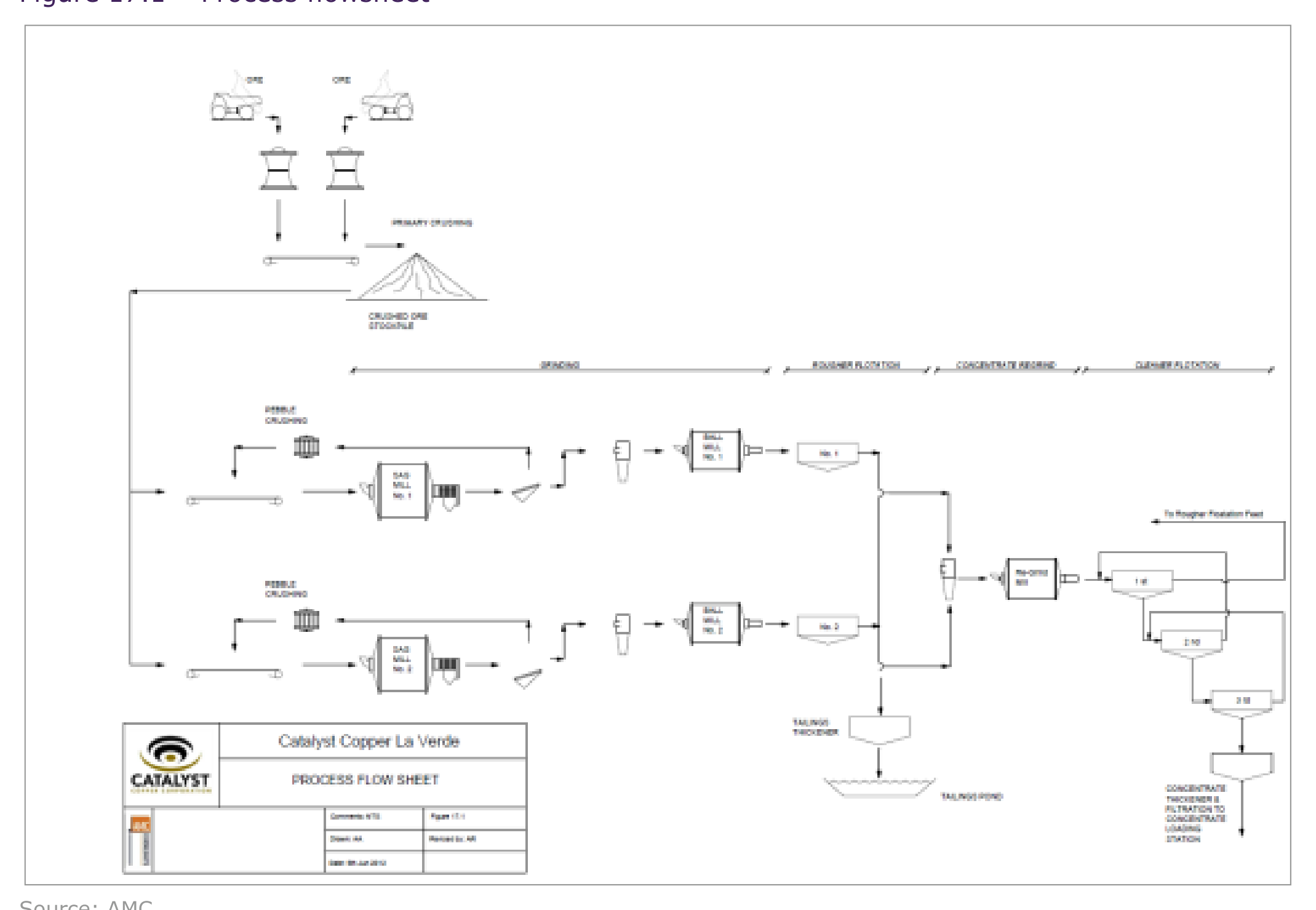
The June 2018 technical report on the La Verde copper project in Mexico describes two 22 MW SAG mills, two 15 MW ball mills, 300 m3 roughers, three stages of cleaning and a fluidized bed roaster that removes arsenic from the concentrate.
La Verde is a copper project in Michoacán State, Mexico. AMC Mining Consultants prepared the Technical Report on the La Verde Copper Project for Equinox Gold Corp. and Solaris Copper Inc., with an effective date of 20 June 2018. The proposed flowsheet is a conventional copper concentrator comprising crushing, grinding in a SAG mill, ball mill and pebble crusher circuit (SABC), and flotation with concentrate regrind and three stages of cleaning. There will be two trains of grinding and two rougher flotation banks followed by a common regrind and cleaner circuit. The metallurgical parameters come from the test work in the report's Section 13, combined with generic industry standards for items such as availabilities and AMC's experience of similar projects. The report notes that flotation kinetics were not specifically reported in the test work, though the residence times used fall within the range in the raw test data.
Critical Data
| Parameter | Value | Unit | Notes |
|---|---|---|---|
| Operating days | 360 | per year | Design |
| Crusher availability | 70 | % | Grinding and flotation 95% |
| Crushers | 2 | 60 x 89 in gyratory | AMC database benchmark |
| SAG mills | 2 | 12.2 m x 6.7 m | 22 MW wraparound gearless motors |
| Ball mills | 2 | 15 MW | Closed circuit with cyclones |
| Regrind mill | 1 | 2.15 MW | Feed 100 µm, product 40 µm |
| SAG feed and product | 125 mm / 1,000 µm | F80 / P80 | A*b 35.7 |
| Ball mill product | 220 | µm P80 | Bond work index 16.2 |
| Abrasion index | 0.134 | g | Design |
| Rougher flotation | 2 trains of 10 | x 300 m3 cells | Rougher-scavenger, 33% solids |
| Cleaner cells | 9 / 7 / 5 | x 40 m3 | First, second and third cleaners |
| Flotation residence times (lab) | 10 / 5 | min | Roughers / cleaners; scale-up 3x |
| Tailings thickener underflow | 60 | % solids | Design |
| Tailings pumping | 7 | MW | About 3,500 tph over up to 10 km |
| Concentrate grade | 26 / 27.5 / 29 | % Cu | By ore type parameters |
Overview
A tailings thickener is included to maximize settled density in the tailings storage facility, which the report says matters because it is difficult to find suitable sites and enough storage volume, and also to cut net water use by reducing evaporation losses and water lock-up in tailings solids. Following the concentrate treatment test work in Section 13, partial roasting of the concentrates for arsenic removal is also included in the flowsheet.
Key Process Stages
Equipment sizing
Sizing of critical equipment like grinding mills and flotation cells was done from first principles for the mineralization, with benchmark comparables for less critical equipment. Grinding is based on SMC test results with a 20% allowance for losses and design margin. Flotation is sized on the maximum annual feed grade of 0.59% Cu in the production schedule, with a 20% margin for grade fluctuations, relevant to cleaning, and at least five cells per bank to limit short-circuiting. The report notes an opportunity to improve capital and power efficiency by using 500 m3 cells, newly released by one manufacturer.
Concentrate dewatering and tailings
No thickening or filtration test work had been done, so AMC did not size concentrate dewatering equipment. The regrind size would indicate that a pressure filter is needed, and the capital cost estimate relies on benchmark comparables from a similar sized project. Tailings pumping is significant, particularly if storage sites are far away. High-level calculations on thickened tailings found about 7 MW would be needed to pump just over 3,500 tph up to 10 km over flat non-farmed land to the north-west of the project, with several parallel pumping stations and lines, probably four.
Partial roasting
Partial roasting in a fluidized bed roaster is established technology. It prepares concentrates for later pyrometallurgical or hydrometallurgical operations by lowering sulphur, removing arsenic and antimony or making the concentrate leachable. It works by controlling air access, so a set amount of sulphur is removed and only part of the iron sulphide is oxidized, while most volatile elements such as arsenic and antimony are driven off and copper sulphide is left relatively unchanged. The report cites operating examples in China, the Philippines and Europe, and an advanced project with a major South American copper producer.
Arsenic fixation
Roaster exhaust gases are wet scrubbed to capture arsenic as water-soluble arsenic trioxide and the oxidized particulate, mainly iron oxide. The iron oxide dissolves in the acid scrub liquor to provide iron at a minimum 4:1 Fe to As stoichiometric ratio, and limestone and air oxidation then stabilize the arsenic as hydrated ferric arsenate (FeAsO4.2H2O), called artificial scorodite. The report says this is stable over a much wider range of pH and oxidation potential than calcium arsenate made by simple neutralization with lime, and that modern flue gas treatment would also capture SO2. It prefers iron stabilization over an electrostatic precipitator and baghouse, which are capital intensive and high maintenance, and assumes on-site disposal of the ferric arsenate is viable, with a sensitivity run for off-site registered landfill disposal.
Additional Interesting Data and Summary
The metallurgical recovery and concentrate grade parameters from Section 13 feed a high-level mass balance and the power and water calculations, and are summarized in the report by ore type.
The design criteria set cleaner flotation at 15% solids, rougher flotation at 33% solids and a rougher and cleaner residence time scale-up of 3 times laboratory time.
Key Processes
- Gyratory crushing
- SAG mill, ball mill and pebble crusher grinding in two trains
- Rougher-scavenger flotation in 300 m3 cells
- Concentrate regrinding and three stages of cleaning
- Partial roasting of concentrate in a fluidized bed
- Wet scrubbing and ferric arsenate fixation of arsenic
- Tailings thickening and long-distance pumping
Source: Technical Report, La Verde Copper Project, Michoacán State, Mexico, June 20, 2018.
