

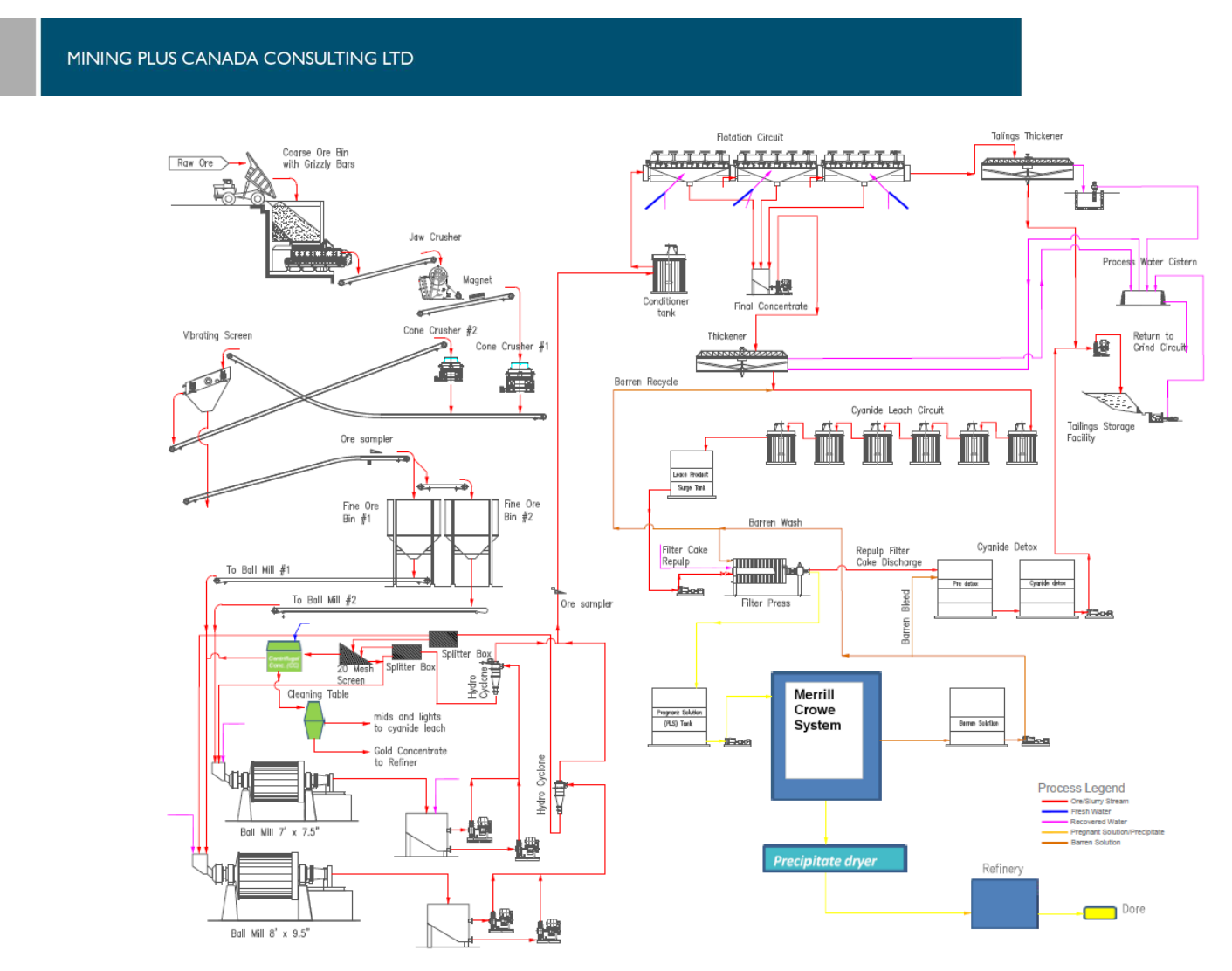
Canarc's February 2016 technical report on the El Compas project describes treating 483 t/d at a 500 t/d toll mill 20 km from the mine, with added gravity and tabling, flotation concentrate leaching and an on-site refinery, for 83% gold recovery.
El Compas is a gold and silver project in Zacatecas State, Mexico. Canarc Resource Corp. is the issuer of the NI 43-101 Technical Report for the El Compas Project, with an effective date of January 19, 2016 and a report date of February 4, 2016. Treatment of the El Compas material would take place at the La Plata processing facility, 20 km from the mine and reached by all-weather roads from the mine and the city of Zacatecas. The facility includes a mineral processing plant, tailings management facility (TMF) and related infrastructure. It was built with Zacatecas State government support to toll mill ore from smaller local mines, with a reported design capacity of 500 tonnes per day, and has been shut down since October 2014. It used conventional comminution and froth flotation to make concentrate for nearby smelters and refiners.
Critical Data
| Parameter | Value | Unit | Notes |
|---|---|---|---|
| Daily processing rate | 483 | t/d dry | 20.1 t/h at 93% availability |
| Annual production | 163,954 | tpa | Process design |
| Head grade, gold | 3.92 | g/t | Range 1.8 to 10 |
| Head grade, silver | 46.3 | g/t | Range 16 to 92 |
| Bond ball mill work index | 19 | kWh/t | Design |
| Crushed product | 9 | mm | 100% passing, three-eighths inch |
| Tabled gold gravity recovery | 12 | % | Silver 1% |
| Combined gravity and float recovery | 87 / 71 | % Au / % Ag | Design |
| Recovery on leaching concentrate | 98 / 80 | % Au / % Ag | Design |
| Other losses | 3.0 | % | Recycle, wash and slag |
| Total recovery | 83 / 55 | % Au / % Ag | Overall |
| Existing ball mills | 8 ft x 9 ft / 7 ft x 7.5 ft | Not applicable | 350 hp and 250 hp |
| Fine ore bins | 2 | x 410 ton | Existing |
| Thickeners | 30 / 50 | ft | Existing |
Overview
The existing crushing circuit has a jaw crusher and two cone crushers in closed circuit with a vibrating screen to make a ball mill feed of 100% passing 9 mm. Fine material goes separately to two ball mills, each in closed circuit with its own hydrocyclone, with overflow sent to flotation. A one-third split of the cyclone underflow goes to a centrifugal concentrator, and the concentrate is cleaned by tabling. The flotation concentrate will be cyanide leached and the pregnant solution treated in a Merrill-Crowe system. The precipitate and the tabled concentrate will be smelted to make doré bars.
Key Process Stages
Existing plant
The existing equipment includes a platform scale, a 63 tonne coarse ore bin, a primary jaw crusher, a belt magnet, a Symons 4 ft secondary cone crusher and a 4 1/4 ft short head cone crusher, a 5 ft by 12 ft double deck screen, two fine ore bins, two ball mills with hydrocyclones, mix tanks, Gardner Denver rougher flotation cells from 25 to 100 cubic feet and two Eimco thickeners. Some of it needs refurbishment, and pumps, piping, electrical and instrumentation items may need alteration or replacement. The facility infrastructure, including power, water supply, shops, assay laboratory and the TMF, would be leased from the government.
Modifications
Canarc would add a gravity circuit, a concentrate leaching and recovery circuit and a refinery so that doré can be made on site. The new equipment covers gravity pre-treatment, cyanide leaching, cyanide detoxification and precious metal recovery, including a Merrill-Crowe circuit, and the modified circuit would reuse as much existing equipment as possible to reduce capital expenditure.
Recovery basis
Precious metal recoveries rest on laboratory results for gravity, flotation and leaching. The report notes some extrapolation for the assumed gravity cleaning by tabling, with table rejects forwarded to cyanidation, and minor assumed losses during precipitation, washing and doré production. The plant would operate two 12-hour shifts, 365 days a year.
Water
The processing facility would use municipal water, through an agreement with Minera Capstone, which has operations nearby. The report states there has been no testing of this water supply as part of the study.
Additional Interesting Data and Summary
The report uses the term ore to mean potentially economic mineable inventory delivered to the processing facility. The process design criteria table records the operating schedule, throughput, ore properties and recoveries with their sources, which are flagged as client data, calculation or test work.
The ore has a specific gravity of 2.6 t/m3 and moisture of 4.0 wt%.
Reagents and consumables
Reagent doses come from preliminary metallurgical test work. Flotation uses MIBC frother at 25 g/t of ore, specialty collectors A3477 at 100 g/t and AF65 at 10 g/t, potassium amyl xanthate at 50 g/t and copper sulphate at 110 g/t. Flocculant is Magnafloc 919 or equivalent at 40 g/t. Leaching of flotation concentrate uses 0.56 kg/t of sodium cyanide, with lime at 0.70 kg/t, zinc dust at 15 g/t and diatomaceous earth at 12 g/t for Merrill-Crowe, smelting flux, and 0.07 kg/t of sodium metabisulphite for detoxification. Collectors and cyanide arrive as solids in bags or drums and are dissolved in fresh make-up water. Lime arrives as bulk quick lime and is hydrated in process water. Average power for processing is expected to be 1,215 kW, oxygen for leaching and detoxification comes from air sparged through rings under the tank impellers, and grinding media are 50 mm alloy steel balls at 0.95 kg per tonne of ore.
Key Processes
- Jaw and cone crushing in closed circuit with a screen
- Ball milling with hydrocyclones
- Centrifugal gravity concentration and tabling
- Flotation of gold-silver concentrate
- Cyanide leaching of concentrate
- Merrill-Crowe precipitation
- On-site smelting to doré
Source: NI 43-101 Technical Report for the El Compas Project, Zacatecas State, Mexico, February 4, 2016.
