

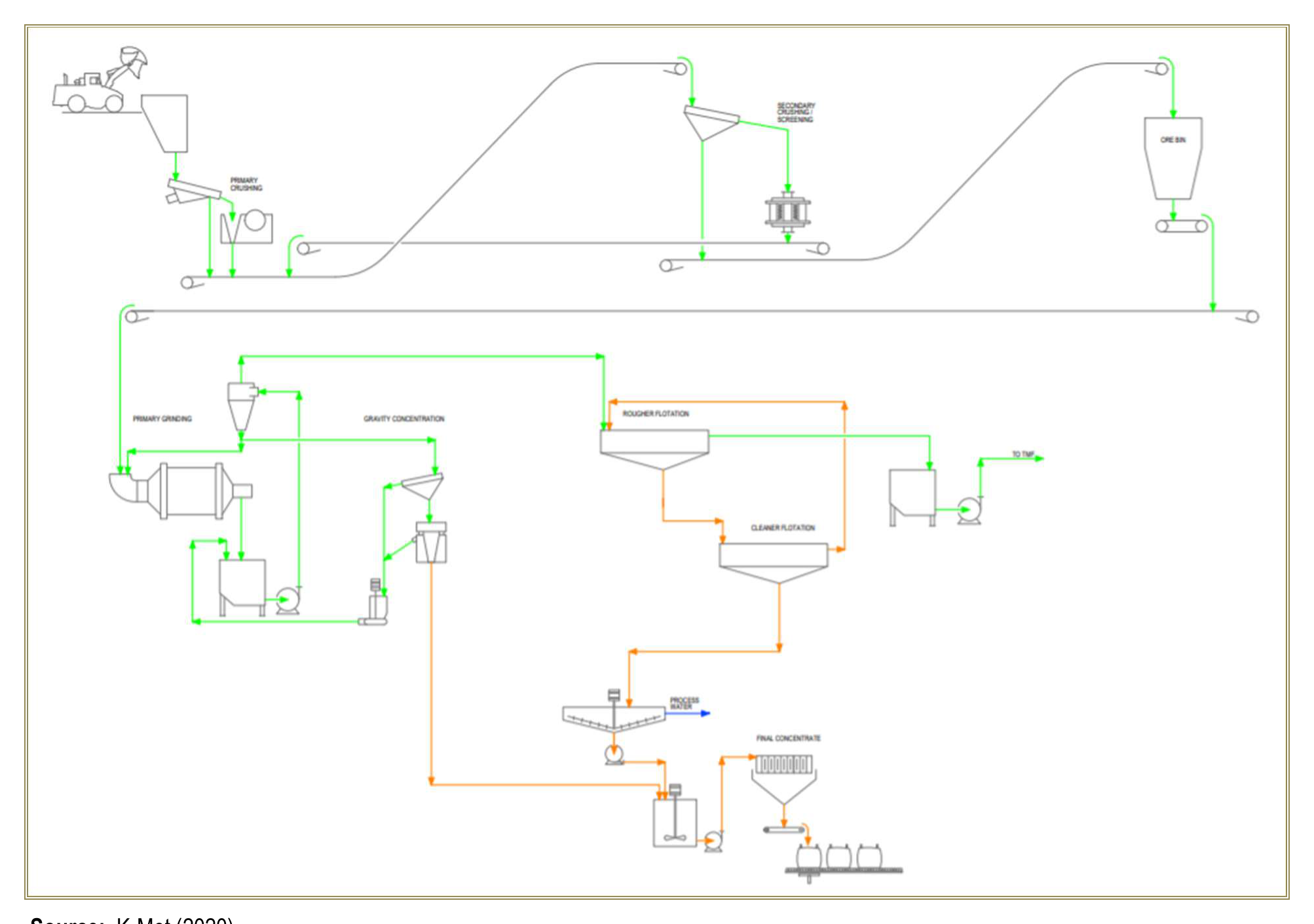
The September 2020 preliminary economic assessment for the Elk Gold project in British Columbia describes two-stage crushing, a 746 kW ball mill with a gravity circuit, six rougher and five cleaner flotation cells, and a pressure-filtered concentrate at 114 g/t gold.
Elk Gold is a gold and silver project near Merritt, British Columbia, Canada. The NI 43-101 Technical Report, a Preliminary Economic Assessment (PEA) prepared for Freeform Capital Partners Inc., has an effective date of July 3, 2020 and a report date of September 21, 2020. Freeform would toll-treat the mineralized material from the mine for the first few years of operation, with the intent of building a flotation plant at site for the start of year 4. The process design criteria and mass balance detail the production capabilities, mass flows and availability for the plant, and the flowsheet is built to make a saleable gold concentrate. The crushing plant has a throughput of 900 t/d, with an average life-of-mine head grade of 5.26 g/t gold and 8.77 g/t silver.
Critical Data
| Parameter | Value | Unit | Notes |
|---|---|---|---|
| Plant throughput | 900 | t/d | 2020 mine plan |
| Crushing throughput | 75 | t/h | 50% availability |
| Process plant throughput | 42 | t/h | 90% availability |
| Head grade | 5.26 / 8.77 | g/t Au / g/t Ag | Life-of-mine average |
| Gravity gold recovery | 46 | % | Concentrate 276 g/t Au |
| Overall gold recovery | 95.4 | % | Concentrate 114 g/t Au |
| Crusher product | 10 | mm P80 | 14 mm screen aperture |
| Primary jaw crusher | 30 x 42 | in | 110 kW, 101 mm CSS |
| Secondary cone crusher | 160 | kW | 44 mm CSS, P80 about 42 mm |
| Surge bin | 900 | t | 24 hours live |
| Ball mill | 3.2 x 5.2 | m | 746 kW; 300% circulating load |
| Grind size | 150 | µm P80 | Maximum Bond work index 14.1 kWh/t |
| Rougher flotation | 6 | x 10 m3 | 20 minutes installed; mass pull 15% to 20% |
| Cleaner flotation | 5 | x 3 m3 | 40 minutes installed; mass pull 5% to 7% |
| Concentrate thickener | 4 | m high-rate | Loading 0.4 t/h/m2 |
| Final concentrate moisture | 8 | % | Pressure filter |
Overview
The process plant has two stages of crushing, a single ball mill grinding in reverse closed circuit with cyclones and a gravity circuit, rougher flotation and one stage of cleaner flotation, concentrate dewatering with thickeners and pressure filters, and concentrate storage and load-out. The grinding and flotation circuits operate 24 hours a day, 365 days a year, at a design throughput of 42 t/h. Final concentrate at about 8% moisture is bagged and sold to a smelter for further processing into doré.
Key Process Stages
Crushing
Mineralized material is stockpiled near the jaw crusher or tipped through a 500 mm static grizzly into a dump pocket, with oversize broken by a rock breaker. A front-end loader feeds the hopper, and a grizzly feeder passes oversize to a 30 inch by 42 inch jaw crusher of 110 kW with a closed side setting of 101 mm. A 1.8 m by 6 m double deck screen takes the combined crushed product. The plus 14 mm material goes to a 160 kW secondary cone crusher at a 44 mm setting, and minus 14 mm undersize, P80 10 mm, goes to a 900 t surge bin. A variable frequency drive belt feeder reclaims it at 42 t/h.
Grinding and gravity
The 746 kW ball mill runs in reverse closed circuit with hydrocyclones designed for a 300% circulating load. Mill discharge combines with gravity concentrator tailings in the cyclone feed pump box. Coarse underflow returns to the mill and to the gravity circuit, while overflow at P80 150 µm goes to flotation. Gravity concentrate, from an XD20 or equivalent unit, reports to the concentrate thickener, and gravity tailings return to the pump box.
Flotation
Cyclone overflow flows to six 10 m3 rougher cells in series, giving 20 minutes of residence, using MIBC frother and PAX sulphide collector at natural pH. Rougher concentrate goes to one stage of cleaning in five 3 m3 cells. Time scale-up factors are 2.5 for roughers and 4.0 for cleaners.
Dewatering and tailings
Cleaner and gravity concentrates go to a 4 m high-rate thickener, then a stock tank and a pressure filter. Rougher and cleaner tailings combine in a final tailings pump box and are pumped to a dewatering circuit, with dewatered tailings expected to be commingled with non-mineralized rock in the rock management storage facility, so no tailings storage facility is included in the report.
Reagents
Reagents are PAX, MIBC and flocculant, prepared on site in bermed areas with sump pumps returning spills to the final tailings pump box, and flocculant spills returned to the flocculant tank. Dosages are controlled by flow meters and manual control valves, and storage tanks are sized for one day of production.
Additional Interesting Data and Summary
Test work for the design came from G&T Metallurgical Services programs KM2121 and KM2522. Laboratory rougher time was 8 minutes and cleaner time 10 minutes, scaled up by the factors above to the installed retention times.
The report text describes three crushing stages in its crushing section, while the design criteria table lists two, and it gives crushing a 12 or 16 hour daily schedule in different places.
The design's other equipment parameters are a thickener loading rate of 0.4 t/h per square metre and a final product of high-rate thickening followed by pressure filtration, both described as industry standard. The consumption rates for major operating and maintenance consumables are set out in the operating cost estimate, as outlined in the toll treatment agreement. The report also gives gravity concentrate grade as 276 g/t gold and overall concentrate grade as 114 g/t gold, based on the G&T test results.
Key Processes
- Jaw and cone crushing with a double deck screen
- Ball milling in reverse closed circuit with cyclones
- Gravity concentration
- Rougher and single-stage cleaner flotation
- Thickening and pressure filtration of concentrate
- Dewatered tailings placed with waste rock
Source: NI 43-101 Technical Report, Preliminary Economic Assessment on the Elk Gold Project, Merritt, British Columbia, Canada, September 21, 2020.
