

Aura Minerals' 2016 technical report on the Ernesto/Pau-a-Pique project in Brazil describes a 1 Mtpy plant at Ernesto that ran for about two years under Yamana before going onto care and maintenance in late 2014.
The EPP project groups the Ernesto, Lavrinha and Pau-a-Pique gold deposits near Pontes e Lacerda in southwest Mato Grosso, Brazil, about 450 km west of Cuiabá. Aura Minerals Inc. acquired the project from Yamana Gold in June 2016 and held it through Brazilian subsidiaries. The technical report and updated resource estimate by P&E Mining Consultants, effective May 25, 2016, describes a project with a built process plant next to the Ernesto deposit. Yamana studied EPP from 2009 to 2011 and put it into production in 2013. It ran for about two years before going onto care and maintenance in late 2014. Lavrinha is a potential open pit, Ernesto and Pau-a-Pique are potential underground mines, and the report gives no restart date.
Critical Data
| Parameter | Value | Unit | Notes |
|---|---|---|---|
| Plant capacity | Up to 1 | Mtpy | Ernesto plant |
| Grizzly feeder rate | 130 | tph | Average |
| Jaw crusher | 1,045 mm x 840 mm | Not applicable | Product 80 to 100 mm |
| SAG mill | 5.8 m x 5.8 m | Not applicable | 2.65 MW installed |
| SAG circulating load | 4.5 | times new feed | Design |
| Trommel aperture | 15 | mm | About 33 tph of pebbles |
| Share of cyclone underflow to gravity | About 25 | % | Via 2 mm scalping screen |
| CIL feed density | 50 to 52 | % solids | After lime and barren eluate |
| CIL feed rate | 176 | m3/h | 260 tph |
| Leach and CIL residence time | 24 | hours | One leach and six CIL tanks |
| Inter-tank screen aperture | 0.8 | mm | Slotted |
| Acid wash strength | 3 | % HCl | Soak and rinse |
| Strip solution | 3 / 3 | % NaOH / % NaCN | Six bed volumes |
Overview
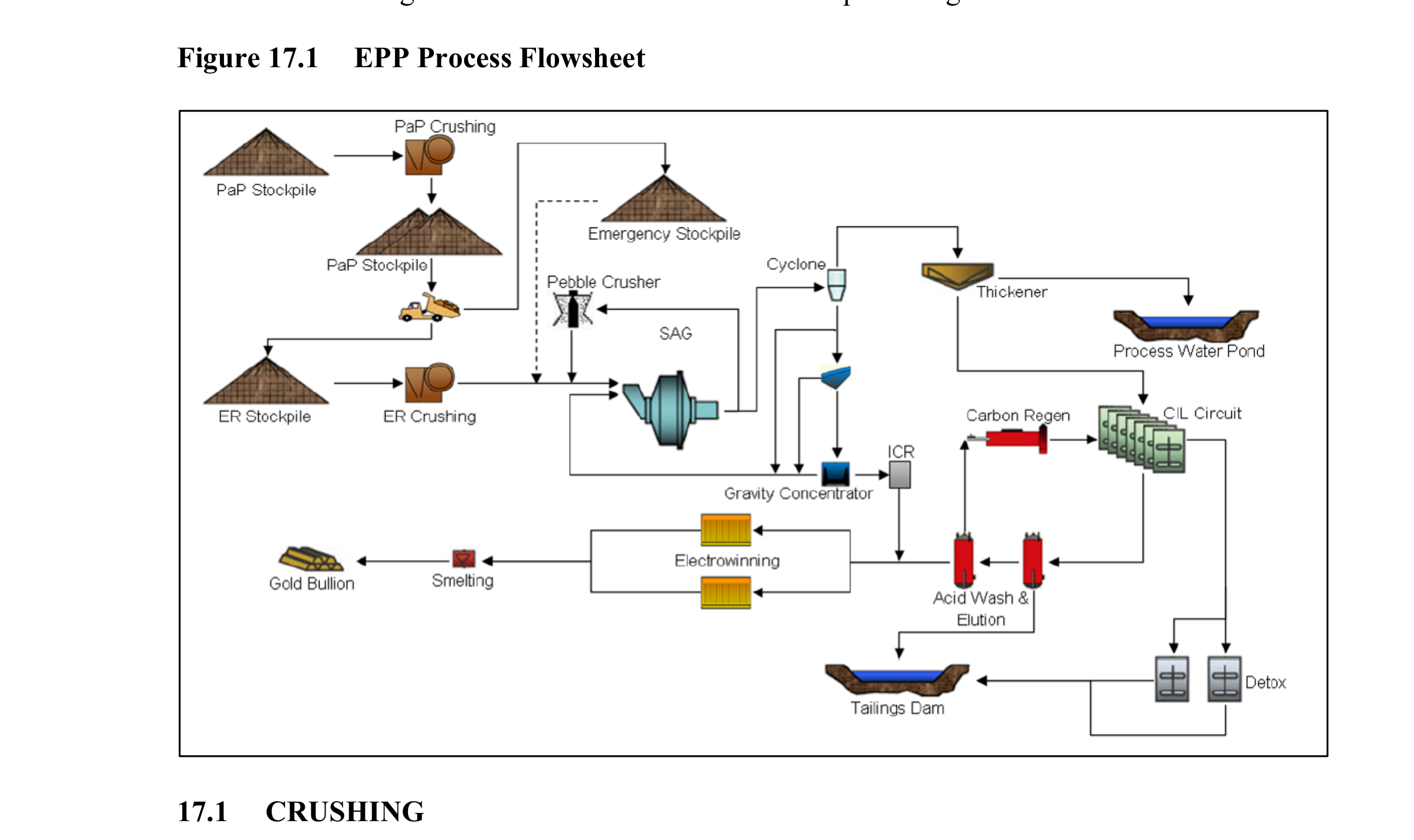
The EPP plant uses a single-stage SAG mill with gravity recovery and carbon-in-leach (CIL). Blended run-of-mine feed is screened and the oversize crushed in a jaw crusher. A SAG mill in closed circuit with cyclones grinds the combined feed, and part of the cyclone underflow passes a gravity concentrator whose concentrate goes to an intensive cyanidation reactor. The ground slurry is thickened and leached in one leach tank followed by six CIL tanks. Loaded carbon is acid washed and eluted, gold is electrowon onto stainless steel cathodes, and the dried sludge is smelted to bullion. Tailings pass a cyanide reduction tank before going to the tailings dam.
The report calls the flowsheet a low-risk, proven configuration for gold-bearing feed.
Key Process Stages
Crushing
Haul trucks deliver ore to the ROM pad, and a front-end loader feeds a bin fitted with 600 mm static grizzly bars. A grizzly feeder with a 150 mm aperture draws about 130 tph and passes oversize to the 1,045 mm by 840 mm jaw crusher, which produces 80 to 100 mm. Grizzly undersize and crusher product combine on a conveyor with a belt magnet and discharge to a feed hopper that a loader can also fill.
Grinding and gravity recovery
Crushed feed, pebbles, cyclone underflow and gravity tailings all enter the SAG mill feed chute. The 5.8 m by 5.8 m mill has 2.65 MW installed, and the circulating load is 4.5 times new feed. A 15 mm trommel removes about 33 tph of pebbles, which return to the mill on a recycle conveyor past a magnet and metal detector. Trommel undersize goes to the cyclone feed hopper. Half of the cyclone underflow goes to a 2 mm scalping screen and half straight back to the mill. Scalping screen undersize feeds the gravity concentrator, whose concentrate goes intermittently to the intensive cyanidation reactor package. The reactor sends leached residue back to the cyclone feed and pregnant solution to the gold room.
Thickening
Cyclone overflow passes a trash screen with 0.8 mm by 18 mm apertures to the pre-leach thickener, with dilute flocculant added in the feed box and feed well. Thickener underflow is pumped to the CIL feed distributor, and overflow goes to the process water pond. A primary and secondary sampler takes the CIL feed sample.
Leach and CIL
The circuit has seven agitated, air-sparged tanks in series, one leach tank and six CIL tanks, for 24 hours of residence. Cyanide goes to the leach tank and can also go to CIL tanks 1 and 2, under control of an on-line analyser. Each CIL tank holds its carbon behind a 0.8 mm slotted screen. Transfer pumps move carbon one tank upstream at a time. Loaded carbon from the first CIL tank is caught on a 0.8 mm recovery screen and sent to acid washing. Regenerated and new carbon pass a 1.0 mm sizing screen before returning to CIL tank 6.
Acid wash, elution and regeneration
A 3% hydrochloric acid soak removes calcium carbonate from the loaded carbon, followed by a raw water rinse. The strip solution, with 3% sodium hydroxide and 3% sodium cyanide, is preheated through a recovery heat exchanger and a primary heat exchanger fed with thermal oil from an LPG heater. Elution runs until six bed volumes have reached the eluate tanks, and heating stops for the last bed volume to cool the carbon. A screw feeder takes dewatered carbon into the regeneration kiln. Regenerated carbon is quenched, and new carbon is attritioned in a 2.5 m3 tank before sizing.
Gold room and tailings
Eluate and intensive leach solution feed the electrowinning cells. Operators wash the cathode slimes off with a high pressure cleaner into a pan filter, dry the sludge in an oven and smelt it with flux in a barring furnace about once a week. CIL tailings receive lime, sodium metabisulphite and copper sulphate in an agitated, air-sparged cyanide reduction tank. They then pass a 1.0 mm carbon safety screen and are pumped to the tailings dam.
Additional Interesting Data and Summary
Aura held SBMM, the company that owns the Ernesto mining rights, through its 49% owned subsidiary Mineração Apoena. The remaining 51% belonged to Brazilian quota holders, as the law requires for companies operating near the border, and Aura held call options over those quotas. At the time Aura also owned the operating São Francisco mine about 60 km north of Ernesto.
Lavrinha and Ernesto sit close to the plant, about 12 km south of Pontes e Lacerda. Pau-a-Pique lies about 40 km further south. Three exploration areas within 20 km of the plant were to be evaluated in 2017 and 2018.
The plant recycles spillage from the grinding, CIL, gold room and cyanide reduction areas to the circuit through sump pumps. Barren eluate from the gold room returns to the CIL feed.
Key Processes
- Grizzly scalping and single jaw crushing
- Single-stage SAG milling in closed circuit with cyclones
- Gravity concentration of cyclone underflow with intensive cyanidation
- Pre-leach thickening with trash screening
- One leach tank and six carbon-in-leach tanks
- Acid washing, heated elution and kiln regeneration of carbon
- Electrowinning and barring furnace smelting
- SO2/air cyanide reduction of tailings
Source: Technical Report and Updated Resource Estimate on the EPP Project, Mato Grosso, Brazil, May 25, 2016.
Project website: EPP Project
