

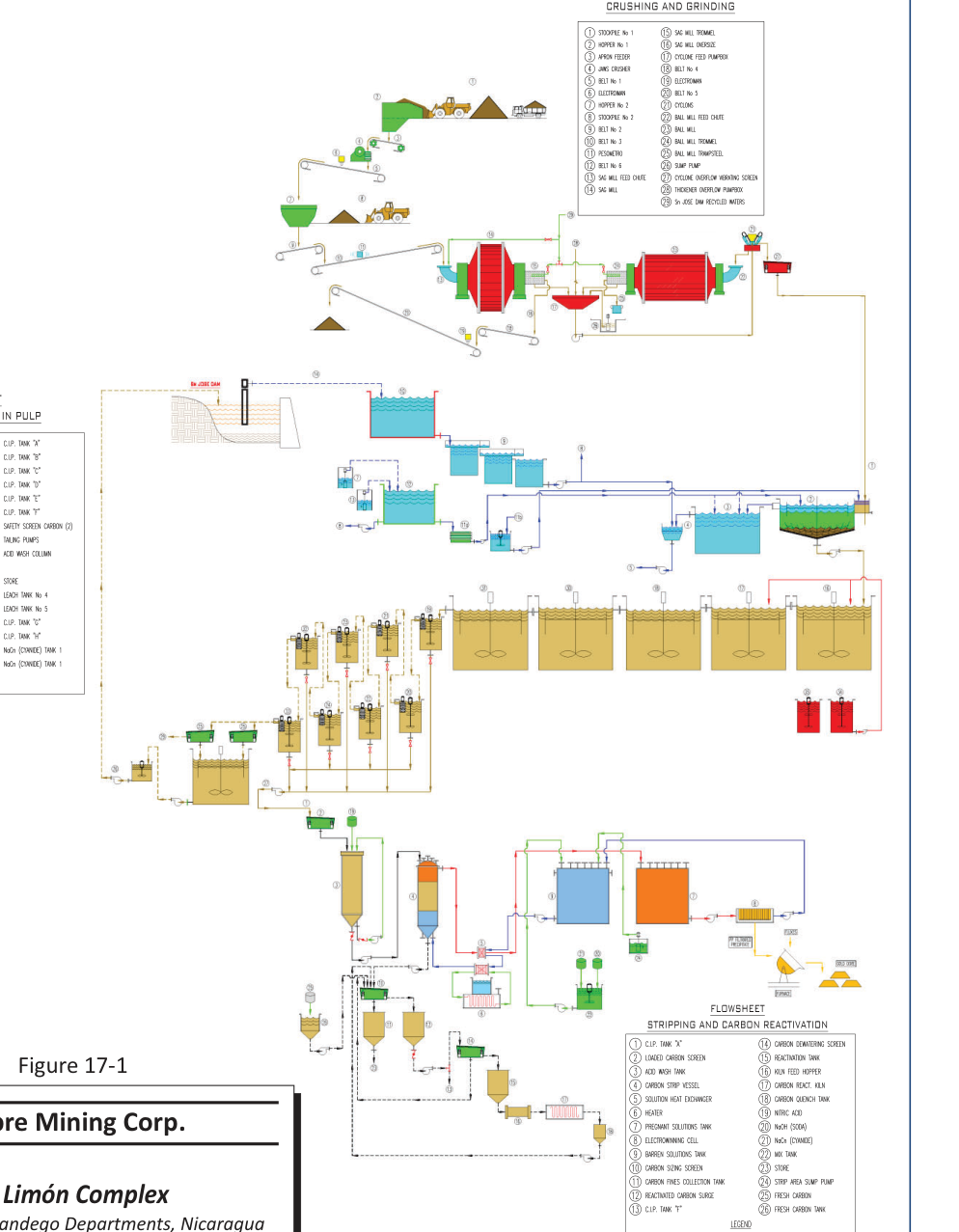
Calibre Mining's 2021 technical report on the El Limón complex describes a 500,000 tpa plant with single-stage crushing, SAG and ball milling, oxygen-assisted leaching and pressure Zadra stripping.
The El Limón complex is an operating gold mine about 100 km northwest of Managua, in the León and Chinandego Departments of Nicaragua. Calibre Mining Corp. bought it from B2Gold in a deal agreed in July 2019, along with La Libertad and the Pavón project, and made the final payment in October 2020. The technical report by SLR Consulting supports mineral resources and reserves as of December 31, 2020 and is dated March 30, 2021. It covers low-sulphidation epithermal deposits mined from the Limón Central open pit and the Santa Pancha and Veta Nueva underground mines. The processing plant treats about 500,000 tonnes a year at gold recoveries of 88% to 93%.
Critical Data
| Parameter | Value | Unit | Notes |
|---|---|---|---|
| Annual throughput | About 500,000 | tpa | 494,000 tpa at 60 tph and 94% availability |
| Crusher capacity | About 100 | tph | Single jaw crusher |
| SAG mill | 17.5 ft x 6.7 ft | Not applicable | 745 kW, no pebble crusher |
| Ball mill | 12 ft x 16 ft | Not applicable | 1,050 kW |
| Grind size | 90% passing 75 | µm | Two-stage grinding |
| Pre-leach thickener underflow | 43 | % solids | Ahead of leaching |
| Leach tanks | 5 | Not applicable | 2 x 1,100 m3 and 3 x 955 m3 |
| CIP tanks | 8 | Not applicable | 40 m3 each |
| Loaded carbon grade | 2,000 to 3,000 | g/t Au | Stripped about four times a week |
| Gold recovery, 2019 | 92.5 | % | 89.8% in 2020 |
| Doré composition | 70 to 85 | % Au | 15% to 30% silver |
| Processing cost, 2020 | 29.40 | US$/t | Average total |
| Indicated resources | 13.2 | Mt | 2.71 g/t gold |
Overview
The El Limón flowsheet is conventional. A jaw crusher feeds a crushed ore stockpile. A SAG mill and ball mill grind the ore to 90% passing 75 µm. The slurry is thickened, leached with oxygen in five tanks and passed through eight carbon-in-pulp (CIP) tanks. Loaded carbon is stripped by pressure Zadra, gold is electrowon, and the precipitate is smelted to doré. Tailings go to the lined San José tailings storage facility, which had capacity to mid-2022 at the report date. Return water is treated to remove heavy metals and to destroy cyanide with sodium hypochlorite before release.
The plant has been modified many times since 2009. Two leach tanks, two CIP tanks and a larger SAG mill motor were added, and throughput and recovery rose between 2009 and 2015 as a result.
Key Process Stages
Crushing
A single jaw crusher with a capacity of about 100 tph reduces run-of-mine ore and feeds a crushed ore stockpile ahead of the mill.
Grinding
Grinding runs in two stages in a conventional SAG and ball mill circuit. The 17.5 ft by 6.7 ft SAG mill has a 745 kW motor, and the 12 ft by 16 ft ball mill has a 1,050 kW motor. There is no pebble crusher, so pebbles are returned to the grinding circuit from time to time. The circuit grinds to 90% passing 75 µm. The report describes the ore as very hard and abrasive, and grinding media, liners, wear parts and power are the largest processing costs.
Thickening, leaching and adsorption
A pre-leach thickener brings the slurry to 43% solids. Leaching takes place in five agitated tanks, two of 1,100 m3 and three of 955 m3, with oxygen addition. The leached slurry then passes eight 40 m3 CIP tanks, where activated carbon adsorbs the gold.
Elution, electrowinning and smelting
Carbon is pulled from the circuit once it carries 2,000 to 3,000 g/t gold and stripped in a pressure Zadra circuit, typically four times a week. Stripped carbon, with 40 to 150 g/t gold left on it, is regenerated in a kiln and returned to adsorption. Electrowinning recovers gold from the pregnant eluate. Once a week the precipitate is smelted in an LPG-fired furnace into doré bars of 20 to 28 kg, which carry 70% to 85% gold and 15% to 30% silver and are sent to the United States for refining.
Tailings and water
Tailings are pumped to the lined San José facility. Water returning from the tailings is treated for heavy metals and passes a sodium hypochlorite cyanide destruction step before it is released.
Additional Interesting Data and Summary
The plant can treat about 60 tph, or 494,000 tpa at 94% availability, the rate it reached in 2014 and 2019. Gold recovery was 92.5% in 2019 and 89.8% in 2020, and 88.9% in the first two months of 2021. Metallurgical tests in 2018 and 2021 gave average gold recoveries of 88.2% and 90.9%. Silver is not reported in the mine's monthly reports. In the 2021 tests, silver extraction ranged from 53% to 91.9% and averaged about 80%.
The plant has had several interruptions. In April 2016 a 13-day shutdown replaced the ball mill feed head and ring gear and the SAG mill ring gear and pinion. Blockades cost 25 days of production in June and July 2018, and a ball mill motor failure cost three days that December, after which a spare motor was bought. The plant was shut in April and May 2020 during the COVID-19 pandemic. Over the following seven months it averaged 41,933 t per month, equal to about 503,196 t a year.
Unit processing costs have run between US$25/t and US$30/t since 2009 and have held near US$30/t since 2018. Energy and consumable use were not expected to change materially unless the expansion options in a 2018 feasibility study went ahead.
Key Processes
- Single-stage jaw crushing to a stockpile
- SAG and ball milling to 90% passing 75 µm, with pebble return
- Pre-leach thickening to 43% solids
- Oxygen-assisted cyanide leaching in five tanks
- Carbon-in-pulp adsorption in eight tanks
- Pressure Zadra stripping, kiln regeneration and electrowinning
- LPG-fired smelting to doré
- Heavy metal removal and hypochlorite cyanide destruction on return water
Source: Technical Report on El Limón Complex, León and Chinandego Departments, Nicaragua, December 31, 2020.
Project website: El Limón Complex
