

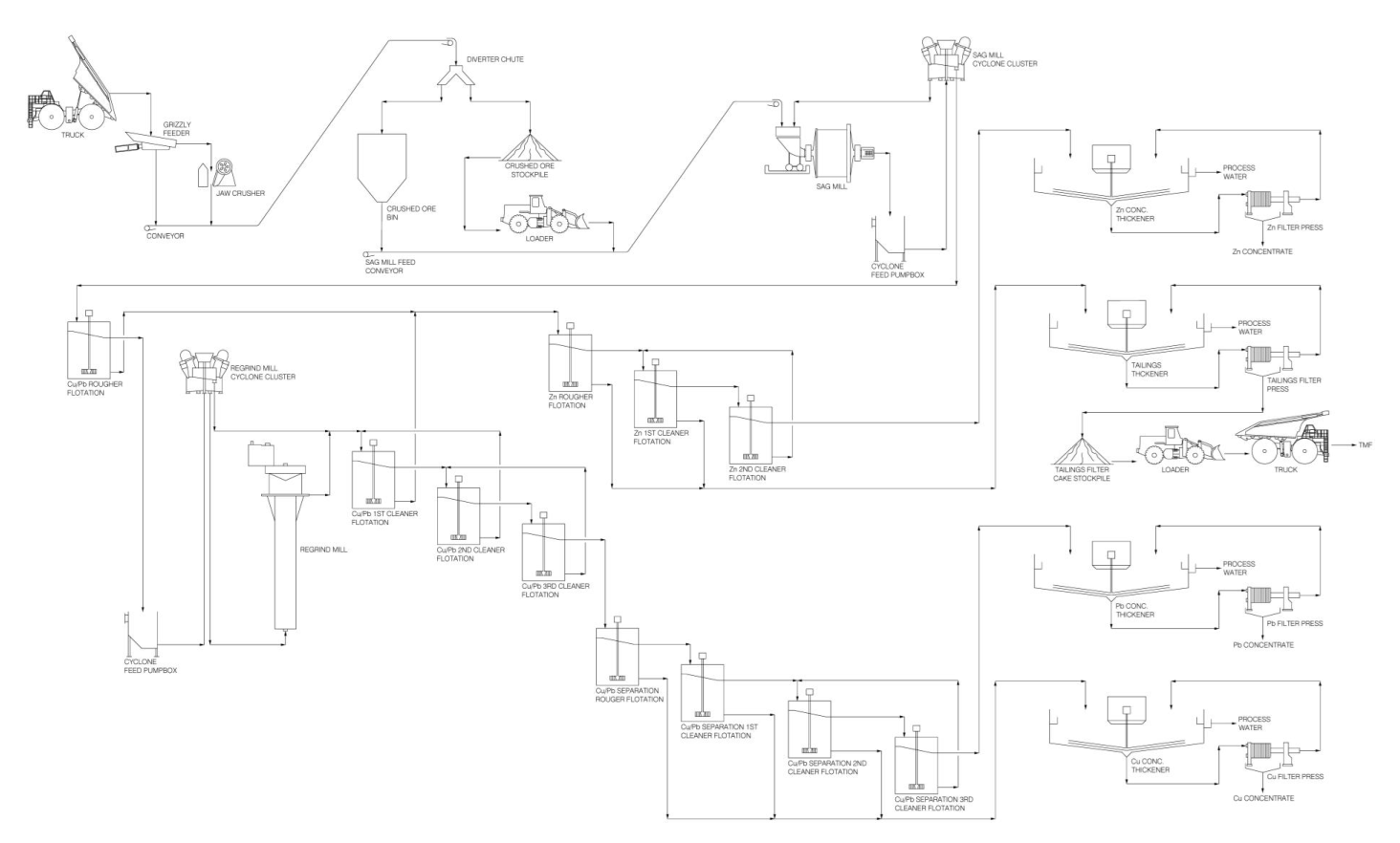
Galway Metals' February 2026 preliminary economic assessment for Estrades describes a stand-alone design with three-stage crushing, four ball mills and three concentrates, adapted for toll milling at an existing plant within about 150 km.
Estrades is a copper, lead, zinc, gold and silver project in northwestern Québec, Canada. The NI 43-101 Preliminary Economic Assessment (PEA) was prepared for Galway Metals Inc. by BBA E&C and others, with an effective date of January 21, 2026 and a signature date of February 18, 2026. The recovery flowsheet was originally conceived as a stand-alone circuit. The current plan, however, is to integrate it into an existing concentrator, using existing infrastructure and facilities while keeping the intended process objectives. Two mills within 150 km driving distance of the Estrades site have been identified as potential toll milling sites. The report states that no discussions were underway between Galway and the owners of these operations. The process described is the optimal plant design if a stand-alone facility were built.
Critical Data
| Parameter | Value | Unit | Notes |
|---|---|---|---|
| Annual throughput | 547,500 | tpa | 1,500 tpd |
| Crushing plant availability | 65 | % | Design |
| Mill availability | 92 | % | Design |
| Feed grades | 0.67 / 0.31 / 4.33 | % Cu / % Pb / % Zn | Average |
| Feed gold and silver | 1.87 / 69 | g/t Au / g/t Ag | Average |
| Bond work index | 11 | kWh/t | Material hardness |
| Primary grind | 50 | µm P80 | Design |
| Copper flotation regrind | 20 | µm P80 | Bulk Cu/Pb regrind |
| Primary ball mill | 12.5 ft x 16 ft | Not applicable | 12 hydrocyclones |
| Secondary ball mills | 3 | Not applicable | Two 11 x 15 ft and one 11 x 13 ft |
| Installed grinding power | 2.8 | MW | Circuit total |
| Concentrate moisture | 8 to 10 | % | Copper, lead and zinc |
| Mill energy | 34.9 | GWh/y | Estimated |
| Crushing bins | 1,000 t + 3 x 3,000 t | Not applicable | Between circuits |
Overview
The design is a conventional base metal flowsheet. Ore is crushed, ground in a primary and three secondary ball mills, floated in a bulk copper-lead circuit and separated into copper and lead concentrates, then zinc is floated from the bulk circuit tailings. Each concentrate is thickened and filter pressed. Tailings are thickened and pumped to the tailings management facility (TMF). Mineralized material would be trucked to an existing processing facility within about 150 km of the mine.
Key Process Stages
Crushing and grinding
Material is fed from the ROM bin to a jaw crusher and transported to a primary single-deck sizing screen. Oversize goes to a secondary cone crusher, whose product joins the screen undersize to feed a secondary single-deck sizing screen. The oversize of that screen passes through a tertiary cone crusher. A 1,000 t bin sits between the primary and secondary crushing circuits, and three 3,000 t bins buffer crushing from grinding. Crushed material goes by vibrating feeders to a 12.5 ft by 16 ft primary ball mill, whose discharge goes to a cluster of 12 hydrocyclones. Underflow goes to three secondary ball mills in parallel, and their discharge goes to the cyclone feed pumpbox.
Bulk copper-lead flotation
Bulk feed goes to two conditioning tanks and the bulk copper-lead rougher circuit. Rougher concentrate goes to regrind cyclones, whose underflow goes to a 9 ft by 11.5 ft regrind ball mill and whose overflow goes to three cleaning stages. Combined bulk rougher tails and first cleaner tails go to zinc rougher flotation. The third cleaner concentrate goes to the copper-lead separation rougher.
Copper and lead separation
The separation rougher concentrate is cleaned in three stages. The third cleaner concentrate is the final lead concentrate, sent to the lead concentrate thickener. The combined tails of the separation rougher and the first and second cleaners are the final copper concentrate, sent to the copper concentrate thickener.
Zinc flotation
Slurry from the bulk circuit flows to conditioning tanks and a zinc rougher. Zinc rougher concentrate goes to two stages of cleaning, and the second cleaner concentrate goes to the zinc thickener. Combined zinc rougher tails and first cleaner tails go to the tailings thickener.
Dewatering
Copper concentrate goes to a thickener and a filter press, to a target moisture of 8% to 10%. Lead concentrate has its own thickener and filter press. Zinc concentrate goes to a thickener and filter press to give 8% to 10% moisture. Tailings are thickened and pumped to the TMF, though no one has verified the available TMF capacity at either potential toll milling site.
Reagents, water and power
Reagents include quicklime as pH modifier in grinding, copper-lead cleaner and zinc flotation, zinc cyanide as zinc depressant, sodium cyanide as copper depressant, Aerophine 3418A as copper-lead collector, Aerofloat 241 as lead collector, MIBC frother, copper sulphate as zinc activator, SIPX as zinc collector, Aero 5100 as copper-lead collector in zinc flotation, and activated carbon for gold recovery in the process water storage tank. No detailed water balance has been calculated. The project is expected to have a negative water balance because tailings go in slurry form, though much make-up water is typically recoverable from the TMF and contact water ponds. Total mill energy consumption is estimated at 34.9 GWh/y.
Additional Interesting Data and Summary
The Estrades circuit would be implemented in an existing processing facility, and modifications are expected because of differences in flowsheet, process criteria and equipment availability. A dedicated budget is included for these modifications even though no toll milling facility has been identified.
The process design criteria for toll milling of Estrades material assume an average feed of 0.67% copper, 0.31% lead, 4.33% zinc, 1.87 g/t gold and 69 g/t silver, at 1,500 tpd and a primary grind of 50 µm P80. The two potential toll mills lie within about 150 km driving distance, which is why the flowsheet is described as the design for a stand-alone plant that would be adapted rather than built new.
Key Processes
- Three-stage crushing with a ROM bin
- Primary and secondary ball milling with hydrocyclones
- Bulk copper-lead flotation with regrind and three-stage cleaning
- Copper-lead separation
- Zinc flotation with two-stage cleaning
- Thickening and filter press dewatering of three concentrates
- Tailings thickening and pumping to a TMF
Source: NI 43-101 Technical Report, Preliminary Economic Assessment for the Estrades Project, Northwestern Québec, Canada, February 18, 2026.
