

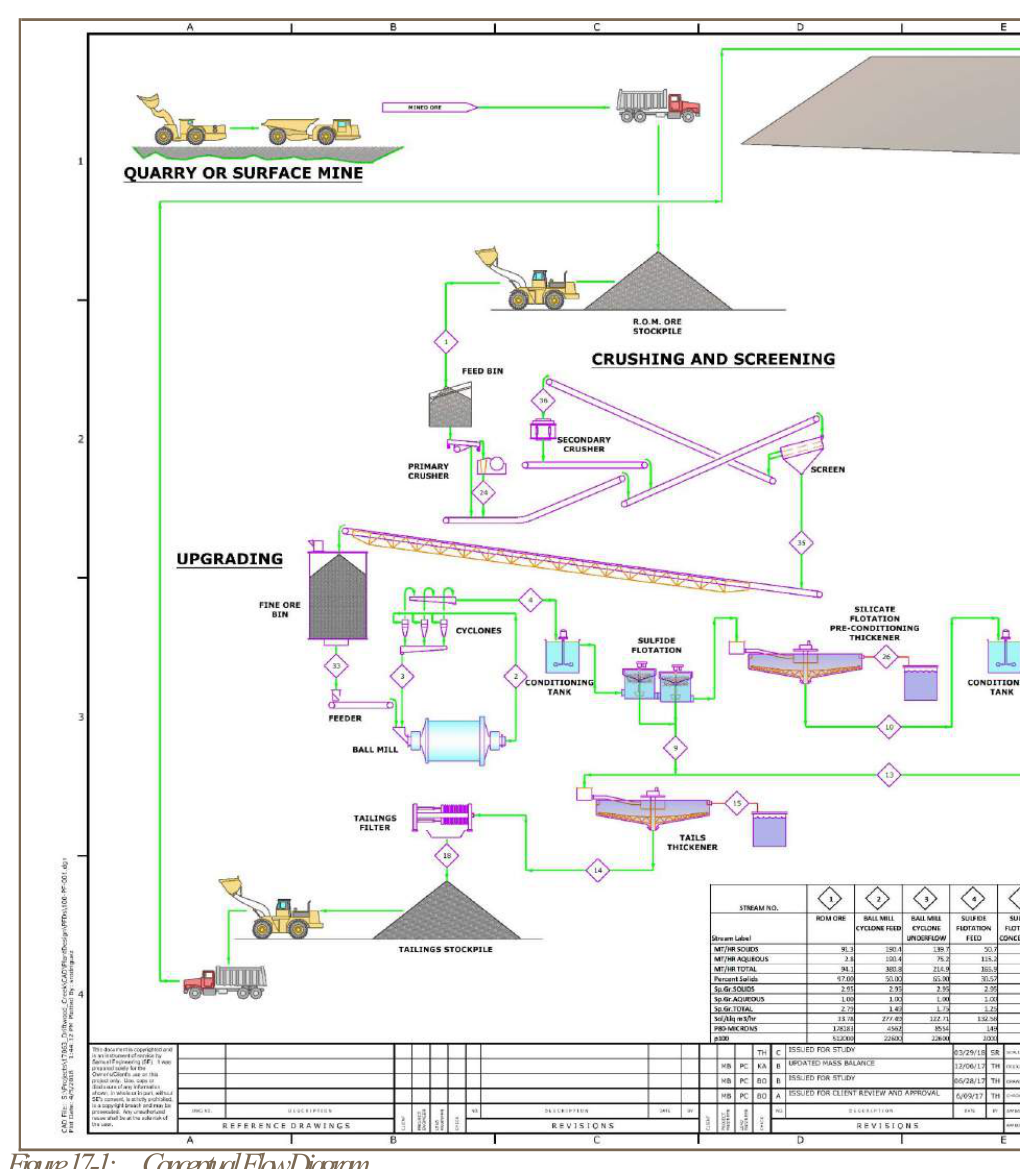
The April 2018 preliminary economic assessment for MGX Minerals' Driftwood Creek project in British Columbia describes crushing, grinding to 149 µm, sulphide and silicate flotation, a multiple hearth furnace for caustic-calcined magnesia and a vertical shaft kiln at up to 2,200 °C.
The Driftwood Creek magnesite property lies about 53 km southwest of Golden, British Columbia, in the Brisco area. The NI 43-101 Preliminary Economic Assessment Technical Report was prepared for MGX Minerals Inc., with a report date of April 16, 2018 and a resource effective date of December 31, 2016. Mineralized material will be mined on site and trucked 210 km to a plant in Cranbrook, BC, where it will undergo crushing, grinding, flotation upgrading, calcination and sintering to make a saleable dead-burned magnesia (DBM) product. The plant can also make caustic-calcined magnesia (CCM) as a separate product. The report notes that limited metallurgical test work has been completed to date, and that the flowsheet follows industry-standard practices for CCM and DBM production, partly based on work by SGS Lakefield and a proposal from Industrial Furnace Company Inc. for the calcination and sintering operations.
Critical Data
| Parameter | Value | Unit | Notes |
|---|---|---|---|
| Haul distance | 210 | km | Mine to Cranbrook plant, by truck |
| Mine feed top size | 308 | mm | Over-the-road haul trucks |
| Crushing schedule | One 12-hour shift | 365 days per year | 50% availability |
| Primary jaw crusher feed | 91.3 | dmt/h | Nominal |
| Secondary cone crusher feed | 80.2 | t/h | Nominal |
| Ball mill | 2.8 x 5.3 | m | 50.7 t/h nominal |
| Cyclone overflow | 149 | µm P80 | 275% recirculating rate |
| Grinding and processing schedule | Two 12-hour shifts | 365 days per year | 90% availability |
| Silicate flotation reagent | Armac 1225 | 250 g/t | Stage added, five cells |
| Pressure filter cake | About 75 | % solids | From 62% solids slurry |
| Multiple hearth furnace | 760 to 900 | °C | Partial calcination to CCM |
| Vertical shaft kiln | 1,900 to 2,200 | °C | Sintering to DBM |
| DBM purity | 94.6 | % MgO | Product |
| Overall magnesite recovery | 90 | % | Estimated |
| Tailings filter cake | About 92 | % solids | Dry stacked at the quarry |
Overview
The process is divided into three stages. Mineralized material is first sized and screened, then upgraded by flotation, and finally calcined into CCM and sintered into DBM. Crushing is two-stage. Grinding feeds a flotation circuit that first removes sulphides and then floats silicates away from the magnesite. The upgraded slurry is filtered and fed to a multiple hearth furnace for caustic calcination, briquetted and sintered in a vertical shaft furnace, then ground and air classified.
Key Process Stages
Crushing and grinding
Magnesite with a top size of 308 mm is stockpiled at the plant and fed by front-end loader to the primary crusher feed bin. A jaw crusher takes a nominal 91.3 dmt/h, and its discharge goes to a screen whose undersize goes to a fine mineral storage bin. Oversize goes to a cone crusher at a nominal 80.2 t/h, which returns to the screen. Dust collection covers all conveyor transfer points and the crushing and screening equipment, and crushing runs on one 12-hour shift to reduce noise in the area. A fine mineral bin holds 24 hours of crushed magnesite for the 2.8 m by 5.3 m ball mill, whose discharge is pumped to a cyclone. The cyclone overflow at a P80 of 149 µm goes to flotation and the underflow returns to the mill.
Flotation upgrading
The ground slurry is preconditioned in the rougher flotation conditioning tank with DF250 and potassium amyl xanthate (PAX), and two rougher flotation cells remove sulphides. The floated sulphide gangue goes to the tailings thickener. The sulphide-free slurry goes to a silicate flotation pre-conditioning thickener, where flocculant takes it from 31% solids to a 50% solids underflow. It is then conditioned with 250 g/t of Armac 1225 and fed to five conventional flotation cells where Armac 1225 is stage added to float silicate minerals, which are discharged to the tailings thickener. The upgraded magnesite slurry goes to a filter feed tank.
Dewatering, calcining and sintering
A plate-and-frame pressure filter dewaters the 62% solids slurry to a cake of about 75% solids. The cake feeds a multiple hearth furnace, which drives off moisture and partly calcines the magnesite at 760 °C to 900 °C to make CCM powder, decomposing it to MgO and CO2. A briquetting machine presses the powder into cylindrical briquettes. These are either bagged and sold as CCM briquettes or fed to a vertical shaft furnace, where they are sintered at 1,900 °C to 2,200 °C to make DBM of 94.6% MgO purity. The DBM briquettes are then dry ground and air classified into the final powder. Off-gases from both furnaces are collected and treated before release.
Tailings
Flocculant is added to the tailings slurry to give a thickener underflow of 60% solids. A vertical pressure filter dewaters that underflow to about 92% solids, and the solids are trucked back to the mine site quarry for dry stacking in a tailings storage facility. Water from the thickener overflow and the pressure filter returns to the process water tank.
Additional Interesting Data and Summary
Recoveries for the flotation equipment, and the overall recovery, are based on the SGS Lakefield report titled Geochemical & Mineral Beneficiation Report Driftwood Creek Magnesite Property, dated August 2008, and no new test work has been done. The nominal design used the higher recoveries for the East pit, the first feed source. The equipment was sized for the lower recovery so that the flotation circuit can handle larger rejected volumes. No losses are accounted for around the multiple hearth or vertical shaft furnaces, and overall magnesite recovery is estimated at 90%.
The grinding and processing plant runs 24 hours a day on two 12-hour shifts, 365 days a year, at 90% availability.
Key Processes
- Two-stage crushing and screening
- Ball milling with cyclone classification
- Sulphide flotation followed by silicate flotation
- Plate-and-frame pressure filtration
- Multiple hearth furnace caustic calcination to CCM
- Briquetting and vertical shaft kiln sintering to DBM
- Thickening and filtration of tailings for dry stacking
Source: NI 43-101 Preliminary Economic Assessment Technical Report on the Driftwood Creek Magnesite Deposit Project, Brisco, British Columbia, Canada, April 16, 2018.
Project website: Driftwood Creek Magnesite Deposit Project
