

The 2024 technical report on Cleveland-Cliffs' Hibbing Taconite in Minnesota describes nine autogenous mills, rougher and finisher magnetic separation, Vertimill regrinding and three traveling grate furnaces.
Hibbing Taconite is an operating open pit iron mine and pellet plant at Hibbing in northeastern Minnesota. Hibbing Taconite Company owns it as a joint venture between subsidiaries of Cleveland-Cliffs Inc., with 85.3%, and U.S. Steel Corporation, with 14.7%, and a Cliffs subsidiary manages it. The mine started in 1976. The NI 43-101 technical report by SLR, effective December 31, 2021 and signed August 16, 2024, was filed for Stelco's shareholder circular after Cliffs agreed to buy Stelco. It covers a magnetite taconite operation whose concentrator handles about 80,000 long tons (LT) of ore a day. Between 2015 and 2020 the operation averaged about 7.4 million wet long tons of pellets a year at 66.1% iron.
Critical Data
| Parameter | Value | Unit | Notes |
|---|---|---|---|
| Concentrator feed | About 80,000 | LT/day | Magnetite ore |
| Average crusher feed, 2015 to 2020 | 28,083,000 | LT/y | 19.2% magnetic iron |
| Primary crushers | 2 | Not applicable | Allis Chalmers 60 in x 109 in gyratories |
| Crushed ore stockpile | 450,000 | tons | Up to five days of surge |
| Autogenous mills | 9 | Not applicable | 36 ft x 15 ft |
| Regrind mills | 2 | Not applicable | 1,250 hp Vertimills |
| Final grind | 80% passing 44 | µm | Final concentrate |
| Concentrate grade | About 66 | % MagFe | 4.1% silica |
| Weight recovery to concentrate | 26.4 | % | 2015 to 2020 average |
| Filter cake moisture | About 9.25 | % | Disc vacuum filters |
| Bentonite addition | About 18.5 | lb/LT | Concentrate |
| Indurating furnaces | 3 | Not applicable | 13 ft x 243 ft traveling grates |
| Pellet production | 7,400,200 | WLT/y | 2015 to 2020 average |
| Pellet grade | 66.1 | % Fe | 4.5% silica, 2.1% moisture |
| Processing workforce | 260 | Not applicable | Operations, maintenance and technical |
Overview
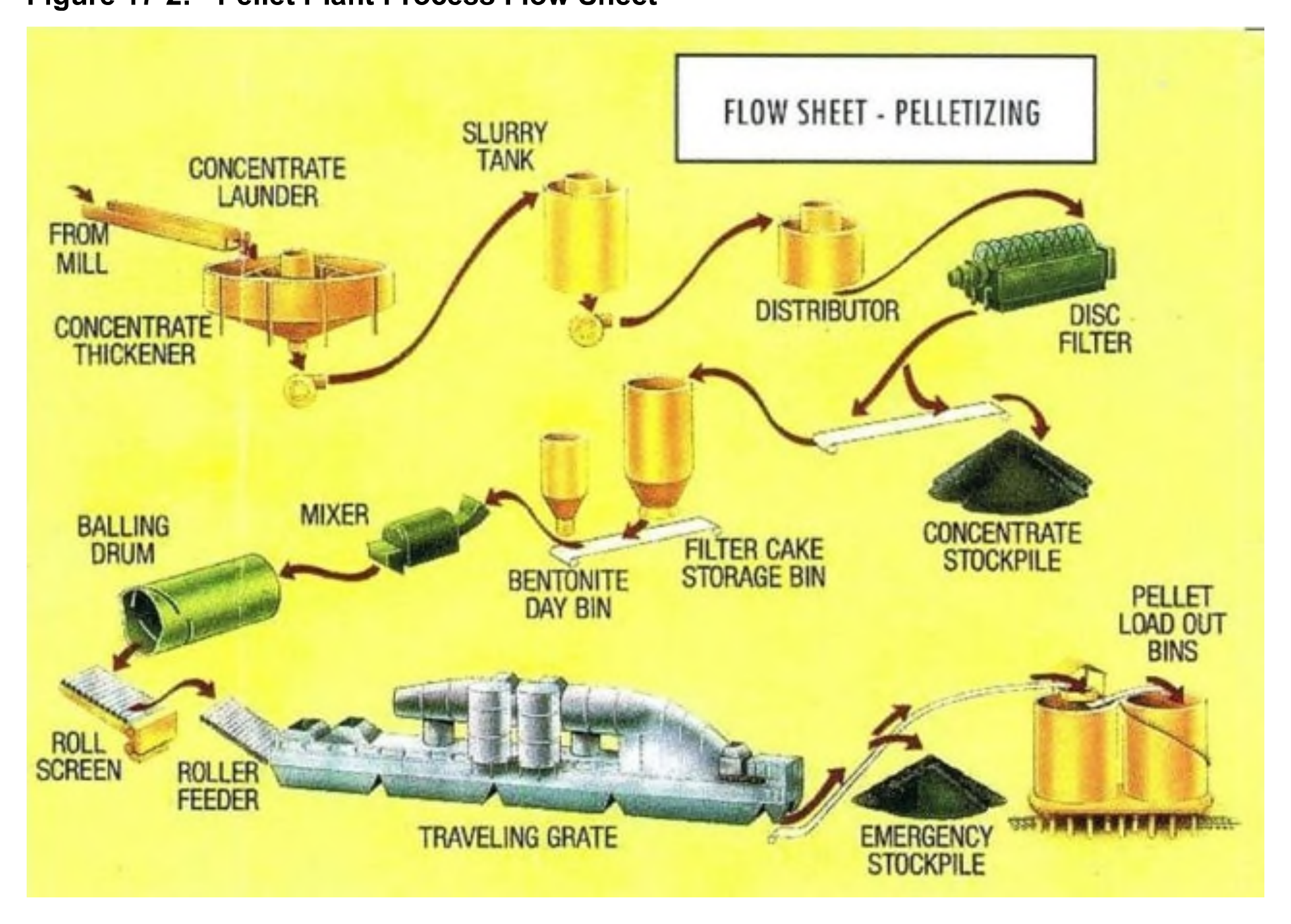
The concentrator uses a standard taconite flowsheet. Gyratory crushers feed a large stockpile, and autogenous mills grind the ore with no steel media. Rougher magnetic separators pull out the magnetite. The rougher concentrate is classified in cyclones, cleaned in finisher separators, screened, and the oversize is reground in Vertimills for a second finisher pass. Non-magnetic material goes to hydroseparators and on to the tailings basin. In the pellet plant the concentrate is thickened and filtered, mixed with bentonite and rolled into green balls, which are fired in traveling grate furnaces.
Three ore types are blended. The lean ore is thick bedded, with higher concentrate silica and harder liberation. The high-grade ore carries more magnetic iron and gives higher weight recovery, and it makes up more than 60% of the blend. The low-grade ore is thin bedded with fine laminations and lower magnetic iron. Each type has a limit in the daily blend.
Key Process Stages
Crushing and stockpiling
Two 60 inch by 109 inch Allis Chalmers gyratory crushers reduce run-of-mine ore to minus 10 inches. Conveyors carry it to the 450,000 ton crushed ore stockpile, which gives up to five days of surge capacity ahead of the concentrator.
Autogenous grinding and rougher separation
Nine 36 ft by 15 ft autogenous mills grind the reclaimed ore. Each mill discharges to five 48 inch by 10 ft single-drum rougher magnetic separators. The non-magnetic fraction goes to two hydroseparators, of 65 ft and 90 ft. The rougher concentrate from each line is classified in cyclones. Underflow returns to the AG mill, and overflow at 80% passing 44 µm goes to the finisher separators.
Finisher separation and regrind
Each grinding line has three triple-drum and two double-drum finisher magnetic separators. The finisher product goes to screens at 100 mesh, and the undersize goes to the pellet plant. Screen oversize from all lines is reground in two 1,250 hp Vertimills in closed circuit with cyclones to 90% passing 44 µm, then passes a second finisher stage before joining the pellet plant feed. Finisher tailings go to the main launders and the basin. The final concentrate carries about 66% magnetic iron and 4.1% silica.
Filtration and balling
The concentrate is thickened and held in agitated tanks, then filtered to about 9.25% moisture. Phase 1 filtration uses three 9 ft Eimco and five 10 ft North Star twelve-disc vacuum filters and feeds two pelletizing lines. Phase 2 uses four North Star filters for the third line. The filter cake is mixed at high speed with about 18.5 lb of bentonite per long ton, and limestone is added when high-compression pellets are needed. Each line has four 12 ft by 32 ft Sala balling drums with roll screens that size green balls closely, at 9.2% to 9.46% moisture. Oversize is shredded and returned to the drums with the undersize.
Induration
Roll feeders place the green balls on three Dravo traveling grate furnaces, each 13 ft wide and 243 ft long. Each furnace has 243 pallet cars moving through seven zones served by 38 windboxes and five process fans. Fired pellets go to the load-out bins, of 11,000 and 8,500 tons, or to an emergency stockpile.
Additional Interesting Data and Summary
Weight recovery to concentrate ran between 25.9% and 27.3% from 2015 to 2020, and magnetic iron recovery between 96.8% and 98.0%. Output dipped in 2020, when crusher feed fell to 20.1 million LT and pellet production to about 5.5 million LT. Standard pellets are specified at 66.15% iron and high-compression pellets at 66.00%, both at 4.50% silica. The report notes the effort the plant makes to hold silica to that specification.
Processing used about 105 to 113 kWh per long ton of pellets from 2018 to 2020, and the operation as a whole used about 160 to 171 kWh per long ton. Bentonite use ranged from 15.55 to 19.20 lb per long ton of pellets, and limestone from 5.86 to 7.73 lb.
Weightometers on furnace feed and returns track daily pellet production, which is adjusted monthly to train shipments. The monthly adjustments are typically 2,000 to 3,000 LT on about 700,000 LT, under 0.5%.
Key Processes
- Gyratory crushing to a five-day crushed ore stockpile
- Autogenous grinding in nine mills
- Rougher magnetic separation with hydroseparation of tailings
- Cyclone classification and finisher magnetic separation
- Screening and Vertimill regrinding with a second finisher stage
- Disc vacuum filtration of concentrate
- Bentonite mixing and drum balling of green pellets
- Traveling grate induration
Source: NI 43-101 Technical Report, Hibbing Taconite Property, Minnesota, USA, December 31, 2021.
Project website: Hibbing Taconite
