

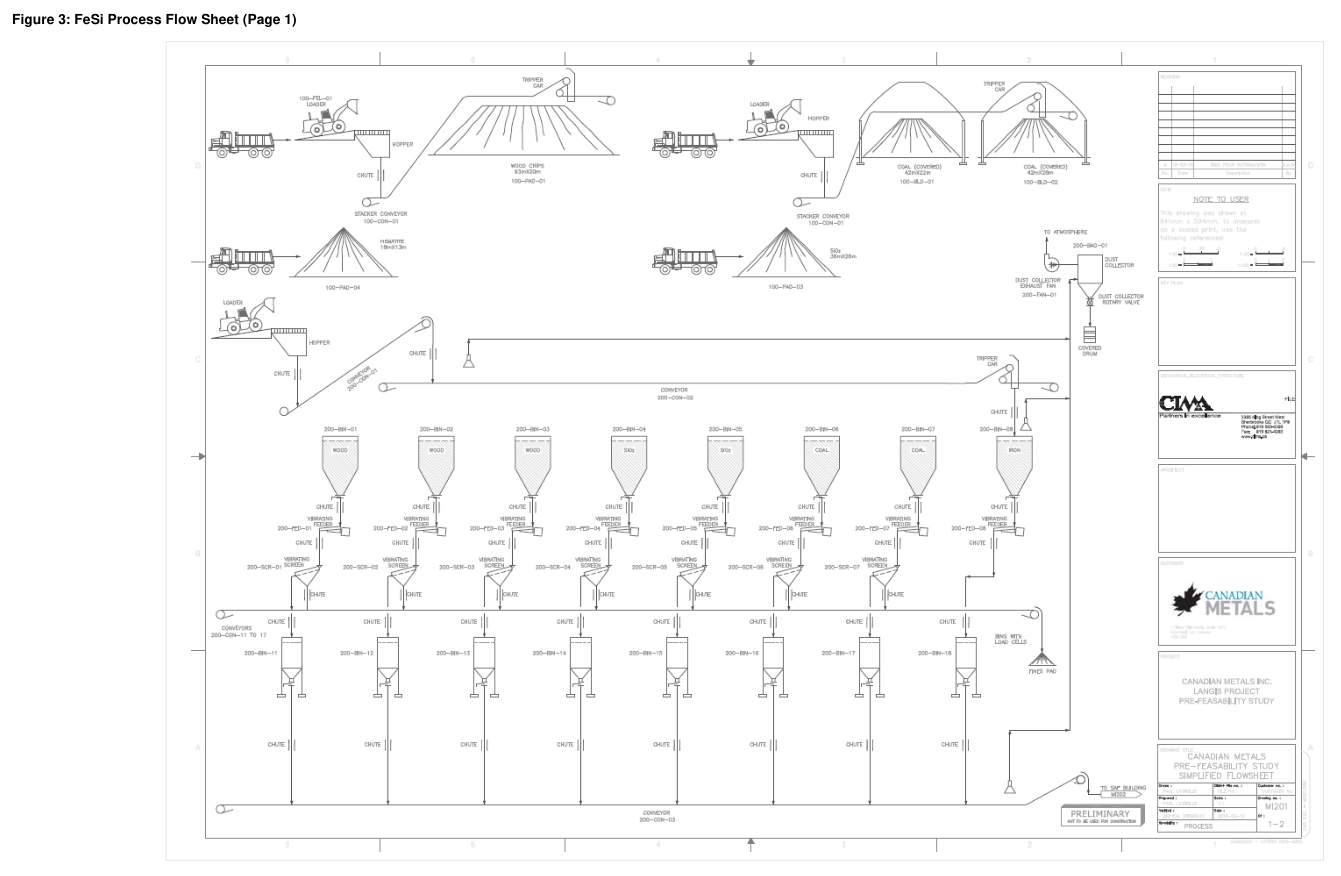
Canadian Metals' 2018 prefeasibility study for the Langis silica property near Saint-Vianney, Québec, crushes and screens quartzite at the quarry. The coarse fraction feeds two 35 MW submerged arc furnaces that produce ferrosilicon, microsilica and slag.
The NI 43-101 Technical Report on Pre-Feasibility Study for Langis Project was prepared by CIMA+ for Canadian Metals Inc. and is dated June 1, 2018. Its cautionary note states that metallurgical tests of the ferrosilicon (FeSi) process recovery were not performed for the PFS and will be part of the next stage. Earlier metallurgical programs did find that Langis silica has acceptable thermal degradation, explosive disintegration and reducibility to silicon for ferrosilicon smelting. Silica is quarried, crushed and screened at Langis, and the coarse fraction is trucked to a smelter at Baie-Comeau. Silica too fine for the smelter is sold to local industries. The smelter combines silica with coal, iron ore and wood chips in submerged arc furnaces (SAF) to make FeSi75. Microsilica (silica fume) and slag are sold as by-products.
Critical Data
| Parameter | Value | Unit | Notes |
|---|---|---|---|
| Report date | June 1, 2018 | Not applicable | CIMA+ for Canadian Metals Inc. |
| Quarry plant availability | 90 | % | Crushing and screening |
| Quarry mass recovery | 75 | % | To the smelter-size product |
| Silica fines | About 41,279 | t/a | Sold to local industries |
| Furnaces | Two 35 MW submerged arc furnaces | Not applicable | Hydro-Québec grid at Baie-Comeau |
| FeSi75 output | 72,051 (36,025 per furnace) | t/a | Primary product |
| Microsilica | 12,969 | t/a | Secondary product |
| Slag | 4,323 | t/a | For ballast, concrete and aggregate |
| Raw material ratios | Silica 1.80, coal 1.16, hematite 0.35, electrode paste 0.05 | t/t FeSi75 | Design criteria |
| Annual coal | 83,839 | t/a | Including fixed carbon from wood chips |
| Annual hematite | 25,218 | t/a | Iron supplement |
| Electrode paste | 3,603 | t/a | Søderberg paste |
| Energy | About 8 | MWh/t FeSi75 | Industry range 7 to 9 |
Overview
The Langis deposit is mined as an open-pit quarry. Blasted silica is crushed and screened to separate a coarse product for the smelter from fines for local sale. At Baie-Comeau, silica (quartzite), Colombian metallurgical coal, hematite and wood chips are fed through bins and water-cooled chutes into two SAFs. Each furnace has three electrodes, a smoke hood, water-cooled off-gas ducts, a stoking car and blow-down ducting. Molten ferrosilicon is tapped into ladles and poured into moulds as large multilayer castings. After cooling, the castings are crushed and classified to the sizes sold. Microsilica is collected from the off-gas, and slag is sold to the aggregate industry. Fines from crushing are reused as the casting bed.
Key Process Stages
Quarry crushing and screening. Quarried silica is crushed and screened to a smelter product sized between 20 and 120 mm (as given in the design criteria). About 75% of the mass reports to that product, and the rest is sold as fines.
Raw material selection. Colombian coal was chosen as reductant for its record in similar operations. Petroleum coke reacts less well, and charcoal would be too costly unless cheap locally. Hematite was chosen over magnetite and wüstite (FeO) as the iron source on thermodynamics, kinetics, grade, contaminants, availability, price and logistics. Softwood chips, available near the smelter, increase charge porosity so that SiO gas can pass through and react, and they add some reactive carbon. Søderberg paste was selected for the electrodes.
Smelting. The furnaces reduce silica with carbon at about 2,000°C (SiO2 + 2C → Si + 2CO). Iron oxide is reduced in the upper, cooler zone, mainly by CO and volatiles from the lower furnace. Carbon-saturated iron droplets take up silicon through reaction with SiO gas. Vibrating feeders in the chutes let operators shut off and charge each furnace, and the chutes are sectioned so they can be unblocked.
Casting and product handling. Ferrosilicon is tapped into ladles, cast in moulds, cooled, broken, crushed and screened to the specified size fractions.
Additional Interesting Data and Summary
The report notes that the choice of iron source, including magnetite or tailings iron, raises commercial, logistics and technical questions to revisit in the feasibility study. It also notes that the physical requirements for silica, such as thermostability, size distribution, and aluminium, titanium, calcium and phosphorus contents, strongly affect SAF performance.
In summary, the 2018 Langis PFS is not a mineral processing concentrator. It is a quartzite quarry that crushes and screens silica and supplies a two-furnace, 70 MW ferrosilicon smelter at Baie-Comeau, which produces about 72,000 t a year of FeSi75 with microsilica and slag by-products.
Key Processes
- Open-pit quarrying, crushing and screening of silica
- Sale of silica fines to local industry
- Submerged arc furnace smelting of silica, coal, hematite and wood chips
- Ladle tapping and mould casting of ferrosilicon
- Crushing and classification of FeSi75
- Microsilica recovery from furnace off-gas
- Slag sale for aggregate use
Source: Canadian Metals Inc., NI 43-101 Technical Report on Pre-Feasibility Study for Langis Project, prepared by CIMA+, June 1, 2018.
Consolidated report summaries
The following former standalone pages about this operation were consolidated here on October 25, 2026. They are retained for source traceability; dates and figures reflect each report’s own effective date and may be superseded by the current information above.
Langis Property — 2017 Resource Estimation Update
This report is a Mineral Resource Estimation Update and does not discuss recovery methods.
Report context
This technical report is dated 2017 and presents a Resource Estimation Update for the Langis Property. The report was prepared by GoldMinds Geoservices Inc. Because the document is limited to resource estimation, several standard technical sections are not included.
Processing route
Recovery methods
Since this report is a Mineral Resource Estimation Update, this section is not discussed in the present document.
Project infrastructure
Since this report is a Mineral Resource Estimation Update, this section is not discussed in the present document.
Capital and operating costs
Since this report is a Mineral Resource Estimation Update, this section is not discussed in the present document.
Economic analysis
Since this report is a Mineral Resource Estimation Update, this section is not discussed in the present document.
Key reported parameters
| Parameter | Value | Basis |
|---|---|---|
| Quarry price for FeroSilicon plant, filler, aggregates and additives | $44/t CAD | Assumed fair quarry price used to meet reasonable prospect of economic extraction |
Technical qualifications
The report is a Mineral Resource Estimation Update and does not include sections on recovery methods, project infrastructure, capital and operating costs, or economic analysis. The author is aware that CME has started the process of market studies and contracts negotiations but, due to a confidentiality agreement with CME, cannot disclose any information at this time. That information will be disclosed in due time at the PFS and FS stage of this project.
Source: GoldMinds Geoservices Inc., Resource Estimation Update 2017 – Langis Property, pages 93-94.
Langis Ferrosilicon Project – 2018 PFS Technical Report
Langis Ferrosilicon Project – 2018 PFS Technical Report
Company: Canadian Metals Inc.
Date: June 1st, 2018
Executive Summary
This report details the Pre-Feasibility Study (PFS) for the Langis Ferrosilicon project, focusing on the metallurgical processes for producing Ferrosilicon75 (FeSi75) from Langis silica. The project involves quarrying silica at the Langis site and transporting it to a downstream ferrosilicon smelter in Baie-Comeau, Quebec. The process utilizes a pyrometallurgical method in a Submerged Arc Furnace (SAF), combining silica with a carbon source, iron ore, and wood chips. The final products will be FeSi75, microsilica (silica fumes), and slag. This report outlines the process design criteria, raw material requirements, detailed process descriptions for smelting, tapping, casting, crushing, and sizing, as well as logistics and manpower needs. Metallurgical testing for process recovery details is noted as a next step in project development.
The Langis silica deposit is confirmed as suitable for FeSi production, with acceptable thermal degradation, explosive disintegration, and reduction to silicon. The chosen smelting process involves a Submerged Arc Furnace (SAF) operating at high temperatures, requiring significant energy input. The process flow includes raw material reception and storage, reclaim, weighing, dosing, smelting in SAFs, off-gas treatment, tapping and casting of molten ferrosilicon, and subsequent crushing and sizing of the solidified product. By-products like microsilica and slag are also valuable commodities. The report also addresses transportation and logistics for both raw materials and final products, as well as the projected manpower requirements for a year-round smelter operation. The preliminary layout of the Baie-Comeau smelter is presented, designed to optimize material flow and minimize costs.
Commodities: Ferrosilicon, Microsilica, Slag
Region: Quebec, Canada
Year: 2018
Mine/Project Name: Langis
Company: Canadian Metals Inc.
Website: https://www.globenewswire.com/news-release/2018/07/11/1536222/0/en/Canadian-Metals-Inc-announces-filing-of-the-Amended-Langis-project-Prefeasibility-Study.html
Report Date:
Region:
Project Status:
Commodity:
Throughput:
Mine Life:
Mine Type:
Ore type:
Langis Project — 2018 Technical Report (PFS)
Langis Project — 2018 Technical Report (PFS)
Company: Canadian Metals Inc.
Date: 2018
Executive Summary
This report details the Preliminary Feasibility Study (PFS) for the Langis silica deposit, focusing on its potential as a feedstock for a ferrosilicon smelter in Baie-Comeau, Quebec. The Langis silica deposit is planned to be quarried using open-pit methods. Extracted silica will be transported by truck to the smelter for processing into Ferrosilicon75 (FeSi75), microsilica (silica fumes), and slag. These products are intended for sale to various industrial markets, including the aggregate and refractory industries.
The ferrosilicon production process is pyrometallurgical, involving the smelting of Langis silica with a carbon source (coal), iron ore, and wood chips in a Submerged Arc Furnace (SAF). The molten ferrosilicon will be tapped, cast, cooled, crushed, and classified to meet market specifications. By-products such as microsilica will be captured from off-gases, and slag will also be a saleable product. The report outlines the process design criteria, raw material requirements, process flow, and operational details for the smelter. Manpower requirements and a preliminary layout for the Baie-Comeau smelter are also provided.
Website: https://www.globenewswire.com/news-release/2018/06/01/1515753/0/en/Canadian-Metals-publishes-a-Pre-feasibility-Study-Technical-Report-Concerning-its-Langis-project.html
Report Date:
Region:
Project Status:
Commodity:
Throughput:
Mine Life:
Mine Type:
Ore type:
