

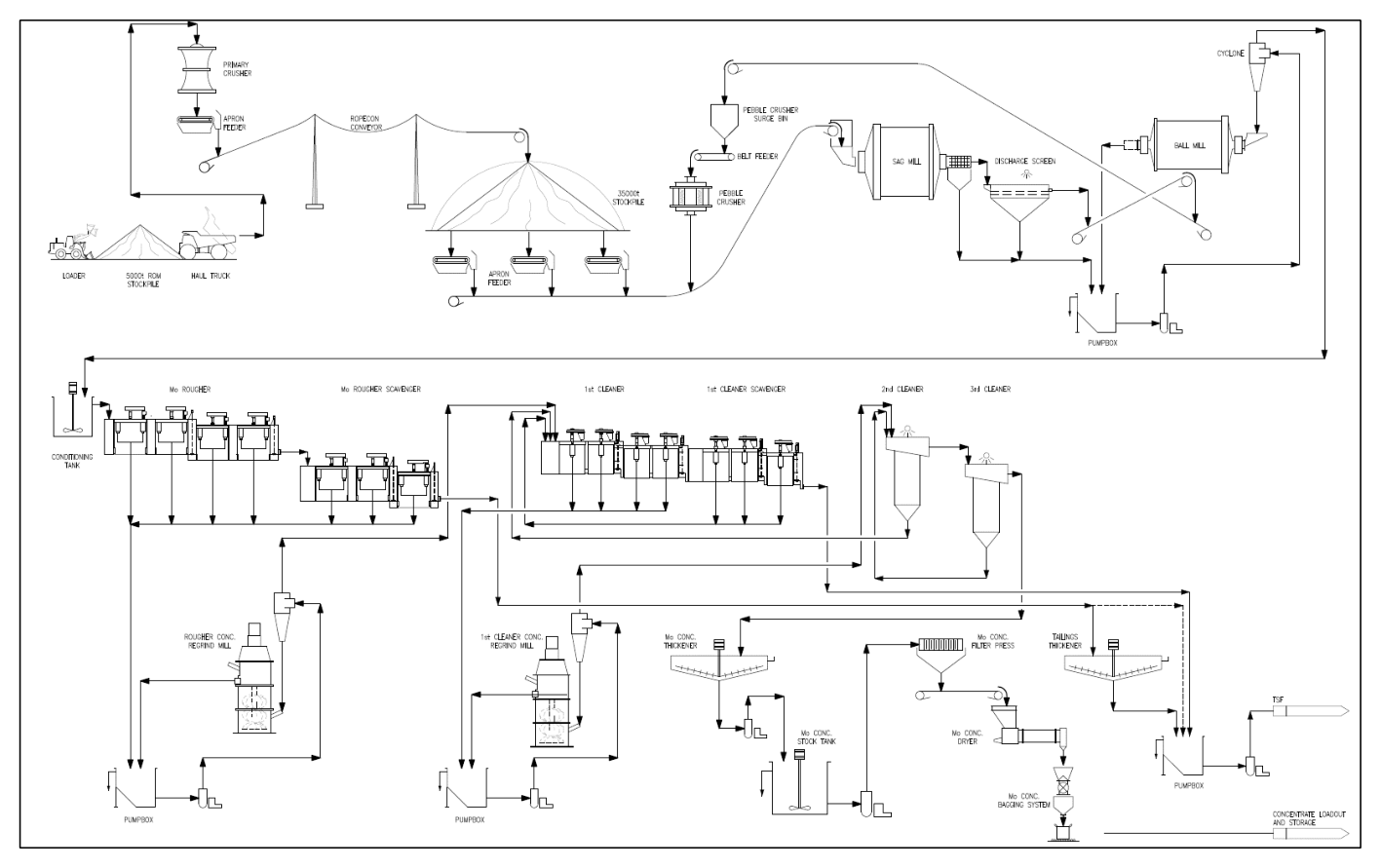
The April 2022 feasibility study for Greenland Resources' Malmbjerg project describes a 35,000 t/d plant with a gyratory crusher, twin SABC grinding lines on a process barge, rougher and three-stage cleaner flotation and a 54% Mo concentrate.
Malmbjerg is a molybdenum deposit in East Greenland, near the Scoresby Sund fjord system and the settlement of Ittoqqortoormiit. Greenland Resources Inc. is the issuer of the Malmbjerg Molybdenum Deposit Feasibility Study, an NI 43-101 technical report with an effective date of 23 February 2022 and an issue date of 11 April 2022, prepared by Hassan Ghaffari, Sue Bird and others. The mineral resource is molybdenite (MoS2), associated with a granitic intrusion into overlying sediments, with quartz and feldspar as the dominant gangue and pyrite the main sulphide gangue. The deposit would be mined by conventional truck-shovel open pit methods and processed in a conventional grinding and flotation plant to make a molybdenum concentrate, with tailings deposited in a tailings management facility (TMF). The processing plant is designed for a nominal 35,000 t/d, with a life-of-mine average mill feed grade of 0.11% Mo and an average recovery of 84.6%.
Critical Data
| Parameter | Value | Unit | Notes |
|---|---|---|---|
| Nominal throughput | 35,000 | t/d | 12.8 Mt/y |
| Mill feed grade | 0.11 | % Mo | Life-of-mine average |
| Molybdenum recovery | 84.6 | % | Life-of-mine average |
| Concentrate output | About 20,290 | t/y | 54% Mo |
| Crushing rate | 2,244 | t/h | 65% availability |
| Grinding and flotation rate | 1,585 | t/h | 92% availability |
| Crusher product | 125 | mm K80 | 1.372 m x 1.905 m gyratory, 600 kW |
| RopeCon conveyor | 21.7 | km | Four sections, mine to port site |
| Crushed ore stockpile | 35,000 | t live | Covered |
| SAG mills | 2 | 10.36 m x 5.21 m EGL | 8 MW each |
| Ball mills | 2 | 6.1 m x 9.1 m EGL | 4.2 MW each |
| Flotation feed size | 180 | µm K80 | Cyclone overflow at 42.5% solids |
| Rougher regrind | 60 | µm K80 | 500 kW tower mill |
| Cleaner regrind | 25 | µm K80 | 150 kW tower mill |
| Rougher cells | 4 + 3 | x 300 m3 | Rougher plus rougher scavenger |
| Concentrate moisture | 2 | % w/w | After drying |
| Bond ball mill work index | 12.7 | kWh/t | Abrasion index 0.76 g |
Overview
A conventional comminution and flotation process will be used. The mill flowsheet design is based on comminution and flotation test work programs carried out in 2005, 2006, 2007 and 2021. A single gyratory crusher operating as the primary crushing unit reduces the ROM ore to about 80% passing 125 mm. A 21.7 km RopeCon conveyor transfers the crushed ore from the primary crusher to a 35,000 t live crushed ore stockpile at the port site. Ore is reclaimed in two parallel lines to two SABC grinding circuits inside the grinding process barge, which reduce it to about 80% passing 180 µm.
Key Process Stages
Primary crushing and conveying
240 t haul trucks bring ROM ore to a static grizzly with a 1,000 mm aperture, with a hydraulic rock breaker for oversize. The gyratory crusher feeds a 2.1 m by 8.0 m apron feeder and a sacrificial belt conveyor with a belt scale, metal detector and magnet/metal separator protecting the RopeCon, which crosses rough terrain in four sections. Dust collectors cover crushing and conveying.
Stockpile and grinding
The covered stockpile is reclaimed in two parallel lines, each feeding one grinding line on the barge, so the plant can run at 50% capacity when one train is down. Each line has three 396 t/h apron feeders, two operating and one standby. SAG mills have 76 mm pebble ports, trommels and double deck vibrating screens with 25 mm and 12.5 mm apertures, and oversize goes to a 400 t pebble surge bin and two 370 kW pebble cone crushers that crush to 80% passing 12.5 mm. Two ball mills in reverse closed circuit with cyclone clusters of six 710 mm cyclones, five operating and one standby, bring the product to 180 µm, monitored by a particle size analyzer.
Rougher flotation and regrinding
Cyclone overflow goes to a 300 m3 conditioning tank where kerosene collector and W31 frother are added and the pulp is diluted to 38% solids. Four 300 m3 rougher cells and three 300 m3 rougher scavenger cells run at natural pH 7. Concentrate is reground in a 500 kW tower mill in reverse closed circuit with four 400 mm cyclones, three operating, to 80% passing 60 µm. Kerosene is added to the cyclone pump box, and lime raises the pH to 9.5 to depress pyrite.
Cleaner flotation and dewatering
The first cleaner uses four 30 m3 tank cells and a first cleaner scavenger of three 30 m3 cells, then a 150 kW tower mill regrind to 25 µm. A 2.75 m by 8.7 m column cell is the second cleaner, and a 1.75 m by 5.9 m column cell the third, giving a 54% Mo concentrate. Cleaner scavenger tailings go to the final tailings pump box. The final concentrate is thickened, pressure filtered and dried to 2% moisture, bagged and packed into shipping containers.
Tailings and water
Flotation and cleaner tailings are thickened on a tailings thickening process barge and pumped through an overland pipeline to the TMF at Noret, 17 km north of the concentrator. Thickener overflow is reused in grinding and flotation, and TMF supernatant is returned to the port site by an on-barge reclaim water pump station and overland pipeline.
Additional Interesting Data and Summary
Reagents are lime for pH control, diesel oil as the collector, W31 as frother and Magnafloc 351 as the concentrate and tailings flocculant. The sizing of the crushers and grinding mills is based on comminution test work and SABC circuit simulation by SGS, and the regrind mills were sized from the Bond work index and an estimated tower mill to ball mill efficiency factor. The laboratories will be placed and ventilated so that fugitive dust from the process plant does not contaminate samples.
Key Processes
- Gyratory crushing and 21.7 km RopeCon conveying
- Twin SAG and ball mill grinding lines on a process barge
- Pebble crushing and recycle
- Rougher and rougher scavenger flotation with tower mill regrinding
- Three-stage cleaner flotation with column cells
- Thickening, pressure filtration, drying and bagging of concentrate
- Barge-based tailings thickening and pipeline to the TMF
Source: Malmbjerg Molybdenum Deposit Feasibility Study, NI 43-101 Technical Report, April 11, 2022.
Project website: Malmbjerg Molybdenum Deposit
