

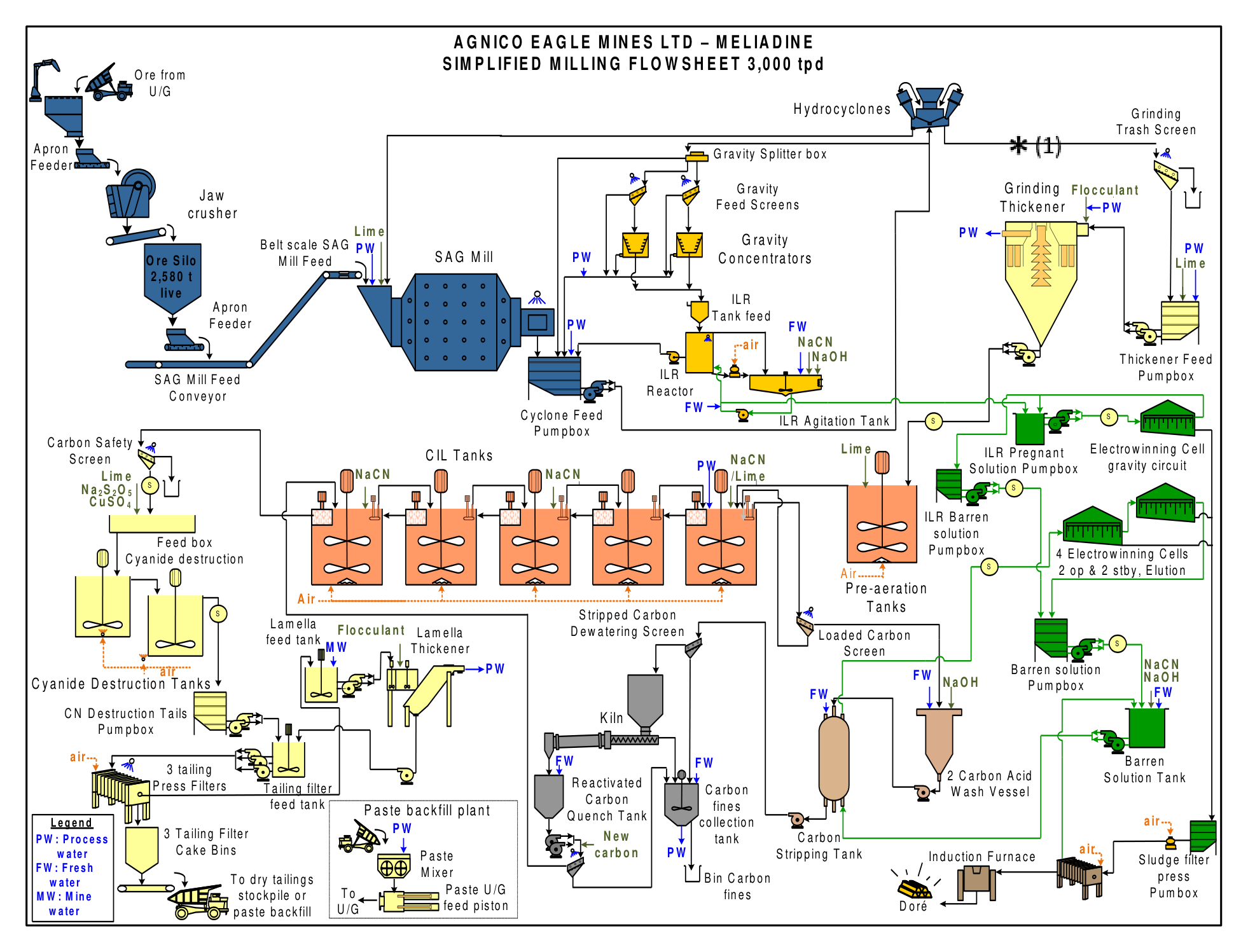
Agnico Eagle's February 2015 updated technical report on Meliadine describes a heated plant building with a 3,000 tpd start and a 5,000 tpd expansion in year 4, single-stage SAG milling, Zadra stripping and three filter presses.
Meliadine is a gold project in Nunavut, Canada, near Rankin Inlet, the nearest community and shipping port. Agnico Eagle Mines Limited commissioned the updated technical report on the Meliadine Gold Project, whose effective date is February 11, 2015. The proposed process plant would treat gold ore at a nominal 3,000 tpd from year 1 to year 3. A process plant expansion of 2,000 tpd would bring capacity to 5,000 tpd at year 4, when ore from the Tiriganiaq open pit is added. The Tiriganiaq deposit is the dominant source of plant feed in the early years. The report selects a combination of conventional gravity concentration and cyanidation.
Critical Data
| Parameter | Value | Unit | Notes |
|---|---|---|---|
| Nominal plant rate | 3,000 | tpd | Years 1 to 3 |
| Expanded plant rate | 5,000 | tpd | From year 4, with Tiriganiaq open pit ore |
| Ore bin | 2,500 | t | Adjacent to the plant; 2,580 t live on the flowsheet |
| SAG mill feed rate | 136 | t/h | Average |
| Gravity concentrators | 2 | Not applicable | Centrifugal batch units; space for a third |
| Gravity feed screen | 2 | mm | Oversize returns to grinding |
| Concentrate regrind | 38 | µm P80 | Before pre-aeration and leach |
| CIL tanks | 5 | Not applicable | Plus one pre-aeration tank |
| Expanded CIL circuit | 7 | Not applicable | Plus two pre-aeration tanks |
| Zadra desorption | 140 | °C | Maximum 380 kPa |
| Strip cycle | 12 to 16 | hours | Typical |
| Kiln reactivation | About 700 | °C | Organic removal |
| Cyanide destruction | 2 | tanks | SO2 and air |
| Tailings filter presses | 3 | Not applicable | Two operating, one standby |
| Filter cake moisture | Below 16 | % | Recessed plate presses |
| Paste cement bin | 200 | t | Backfill plant |
Overview
The process plant has three separate facilities: a crushing facility that can take underground or open pit ore, a main processing facility, and a paste backfill plant. The main facility holds a coarse ore surge bin with feed and reclaim systems, single-stage grinding, gravity concentration and an intensive leaching reactor, leach feed thickening, the CIL cyanide circuit, loaded carbon acid wash, elution and reactivation, gold electrowinning, smelting, cyanide destruction of the leach residue and filtration of final tailings. For operational and maintenance reasons, all process equipment, including the CIL tanks, thickeners, the paste plant and water tanks, is inside the insulated and heated process building.
Key Process Stages
Crushing and ore handling
Trucks bring ore from the underground mine to a surface crusher near the plant. They dump into a hopper with a static grizzly and a hydraulic rock breaker, and an apron feeder passes ore to a reciprocating grizzly feeder. Oversize goes to a jaw crusher, and the jaw product and grizzly undersize go by conveyor to a 2,500 t ore bin. An apron feeder reclaims it onto the SAG mill feed conveyor at an average 136 t/h. The crushing plant is designed to handle the step from 3,000 to 5,000 tpd.
Grinding
A single-stage SAG mill runs in closed circuit with a cyclone cluster. Underflow recirculates to the mill and overflow goes to the thickener, whose underflow feeds the CIL circuit and whose overflow goes to the process water tank. The discharge area layout allows a future vibrating screen and recycle conveyors if the circuit expands to two stages, in which case a discharge screen would be needed to keep oversize out of a Vertimill.
Gravity recovery
A portion of SAG mill discharge goes to two centrifugal batch concentrators in parallel, each preceded by a vibrating screen that returns plus 2 mm material to grinding. Tailings return to the cyclone feed pump box, and concentrates go to an intensive leaching reactor, whose pregnant solution is pumped to a dedicated electrowinning circuit. A continuous gravity system, added to the capital cost, operating cost and recovery model, treats cyclone overflow after the plus 2 mm material is removed. Its concentrate is reground to 80% passing 38 µm and then pre-aerated and leached.
Cyanidation and carbon adsorption
Thickener underflow goes to a pre-aeration tank sparged with process air to oxidize sulphides, with lime for pH. Five agitated CIL tanks follow in series, using sodium cyanide, lime and sparged air. Slurry moves through inter-stage pumping screens while loaded carbon is pumped counter-current. Space west of the circuit is reserved for three larger tanks, which would make two pre-aeration tanks and seven CIL tanks.
Gold recovery and cyanide destruction
Loaded carbon from CIL tank 1 is screened, acid washed with dilute hydrochloric acid, rinsed and stripped in a pressurized Zadra system at about 140 °C and a maximum 380 kPa. Pregnant solution goes to electrowinning cells where gold deposits on stainless steel cathodes, and a solution bleed controls impurity buildup. The kiln reactivates carbon at about 700 °C, and carbon fines are filtered and bagged for resale. Tails from the last CIL tank pass a carbon safety screen and two cyanide destruction tanks using SO2 and air, with copper sulphate, sodium metabisulphite and lime.
Tailings filtration and paste backfill
Three recessed plate filter presses, two in operation and one standby, bring tailings cake moisture below 16%. Filtrate and cloth wash go to a lamella clarifier. Trucks carry the cake to the tailings area or to the paste backfill plant, which sits in a separate building near underground portal 1. There a screw feeder, weigh scale conveyor and paste mixer add water and cement, and a piston pump sends the paste underground.
Additional Interesting Data and Summary
The report presents simplified milling flowsheets for both the 3,000 and 5,000 tpd cases. Layout and infrastructure for the site and for Rankin Inlet are described in the report's infrastructure section.
Water for the paste recipe can come from the underground mine or the process plant, and the process water tank supplies most plant uses. The filter cake conveyor extends outside the building to load trucks.
Key Processes
- Jaw crushing with a 2,500 t ore bin
- Single-stage SAG milling in closed circuit with cyclones
- Centrifugal gravity concentration with intensive leaching
- Pre-aeration and five-tank carbon in leach
- Acid washing, Zadra stripping, electrowinning and smelting
- SO2 and air cyanide destruction
- Filter press tailings dewatering and paste backfill
Source: Updated Technical Report on the Meliadine Gold Project, Nunavut, Canada, February 11, 2015.
Project website: Meliadine Gold Project
