

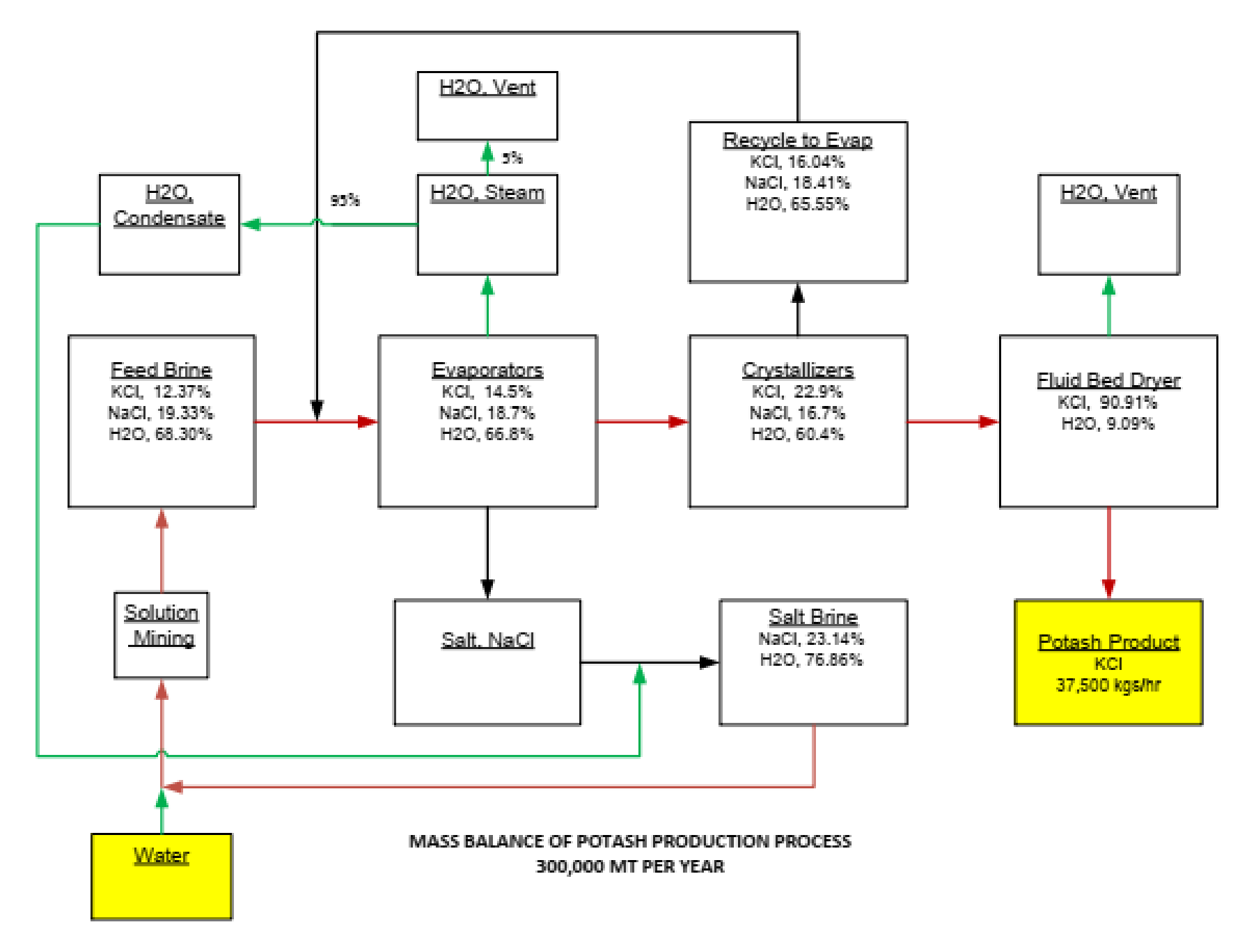
The November 2025 preliminary economic assessment for Sage Potash's Sage Plain property in San Juan County describes injection of 50 °C brine, eight evaporator trains, three draft tube crystallizers and a fluid bed dryer producing granular and white standard potash.
The Sage Plain Potash Property lies in San Juan County, Utah, and belongs to Sage Potash Corp. RESPEC and Patterson & Cooke prepared the NI 43-101 Preliminary Economic Assessment, report RSI-3679, with a report date of November 6, 2025 and an effective date of September 8, 2025. Potash is sold on chemical composition and size distribution, and recovering KCl from sylvinite ore (KCl and NaCl) is a well-established practice. The proposed potash plant is designed to produce up to 300,000 t of potash a year, based on the overall wellfield development, as crystal granular and white standard products. Mechanical evaporation is the recovery method that will be used to recover KCl. The plant is scheduled to run up to 8,000 hours a year.
Critical Data
| Parameter | Value | Unit | Notes |
|---|---|---|---|
| Annual KCl capacity | 300,000 | t/y | 331,000 short tons |
| Product grade | 98 | % KCl | Not applicable |
| Plant recovery | 95 | % | Availability 91% |
| Operating hours | 8,000 | h/y | Not applicable |
| Feed brine | 12.4% KCl | Not applicable | 19.4% NaCl, 68.2% water, 50 °C |
| Brine injection rate | Up to 250 | m3/h | NaCl-saturated, heated to 50 °C |
| Crystal granular product | 150,000 | t/y | Mean size 2.5 mm |
| White standard product | 150,000 | t/y | Mean size 0.5 mm |
| Evaporator units | 24 | units | Eight triple-effect trains |
| Water evaporation capacity | 203,600 | kg/h | Not applicable |
| Steam consumption | 85,540 | kg/h | 42 MMBtu/h boiler |
| Crystallizers | 3 | stages | 7.6 m x 7.9 m |
| Installed process power | 15,900 | kW | Site demand 24,000 kW |
Overview
The flowsheet is a conventional evaporation and crystallization design with fluid bed dryers for the final product. A NaCl-saturated brine is heated to 50 °C and injected into the wellfield. The brine, enriched in potassium, returns through a production well and is pumped to a triple-effect countercurrent evaporation system, where NaCl is selectively precipitated and used for barren brine pumped to the caverns. Concentrated brine then goes to three crystallizers and a fluid bed dryer.
Key Process Stages
Triple-effect evaporation
Fresh wellfield brine and recycled brine from the crystallizers feed eight triple-effect countercurrent trains, 24 units in all. Each evaporator is 3 m in diameter and 4.9 m high with a 550 m2 shell and tube heat exchanger. Brine passes a primary steam condensate preheater and then the third, second and first effects. At about 23% KCl and 17% NaCl, hot material goes to a thickener and an 8 t/h salt centrifuge that removes NaCl solids. The concentrated brine proceeds to cooling crystallization. A 1,000 hp, 42 MMBtu/h boiler makes steam for the eight circuits, and secondary steam from the third effect is condensed and mixed with salt solids to make brine returning to the wellfield.
Crystallization
Three crystallizer stages with external coolers are draft tube baffle units 7.6 m in diameter and 7.9 m high, each with two 600 m2 shell and tube heat exchangers. Controlling supersaturation lets coarse KCl crystals accumulate at the bottom, and two 28 t/h pusher centrifuges separate halite and muriate of potash (MOP) to 8% to 10% moisture. Brine leaving the crystallizers returns to the feed tank ahead of evaporation. Temperature and pressure control keep the NaCl and KCl separation pure.
Drying and sizing
KCl solids go by quantitative feeder to a fluidized bed dryer with internal dust removal, reaching a target 0.2% moisture, and then to a fluidized bed cooler. The product is screened and graded. Granular has a mean size of 2.5 mm with less than 0.5% passing 0.85 mm, and white standard has a mean of 0.5 mm. A fine fraction, 100% passing 0.3 mm, is recirculated and recompacted into either product.
Compaction and loadout
Fines are compacted into flakes with high-pressure rolls, then granulated, screened and polished into durable, dust-free granules for fertilizer and other uses. An anti-caking agent, a mixture of anti-cake and de-dusting oil, is added before storage, and material going directly to loadout is treated in loadout only. The product is stored in a building until it is loaded into railcars.
Additional Interesting Data and Summary
Thermal optimization has not been explored. Natural gas demand is estimated at 200 MBtu/h, with 40 MBtu/h for the boilers and 160 MBtu/h for the dryers. Steam evaporation and dryer venting are the main water losses, and streams are condensed and collected for reuse in the injection brine. Any fresh make-up water comes from deep wells on the property.
The process needs very few reagents, only those for product polishing such as anti-caking. The report also describes cavern growth modelling, solution mining design and a wellfield layout elsewhere in its mining chapter, and builds on a prior resource estimate and NI 43-101 report by Thorson in 2023.
The property is about 110 km south of the Intrepid Potash solution mining facility, which exploits Salt Cycle 5 and Salt Cycle 9 of the Paradox Formation. Sage Potash plans a small-scale production facility using solution mining with recovery by multiple-effect evaporation. It holds 2,646 ha of potash mineral leases under ML 53646 OBA, 2,991 ha of mineral salts and lithium leases and 4,845 ha of private saline mineral leases, plus 368 ha of Surface Use Agreements. The Johnson 1 Well sits about 24 km southeast of Monticello, Utah. Potash was first found in the Paradox Basin in 1922 during oil and gas exploration, and an earlier technical report was written for Sennen Potash Corporation, which relinquished its interest on January 31, 2017.
Key Processes
- Brine heating and wellfield injection
- Triple-effect countercurrent evaporation
- Salt separation by thickener and centrifuge
- Three-stage cooling crystallization
- Fluid bed drying and cooling
- Compaction and granulation of fines
- Anti-caking treatment and railcar loadout
Source: NI 43-101 Technical Report Preliminary Economic Assessment for the Sage Plain Potash Property, San Juan County, Utah, USA, November 6, 2025.
