

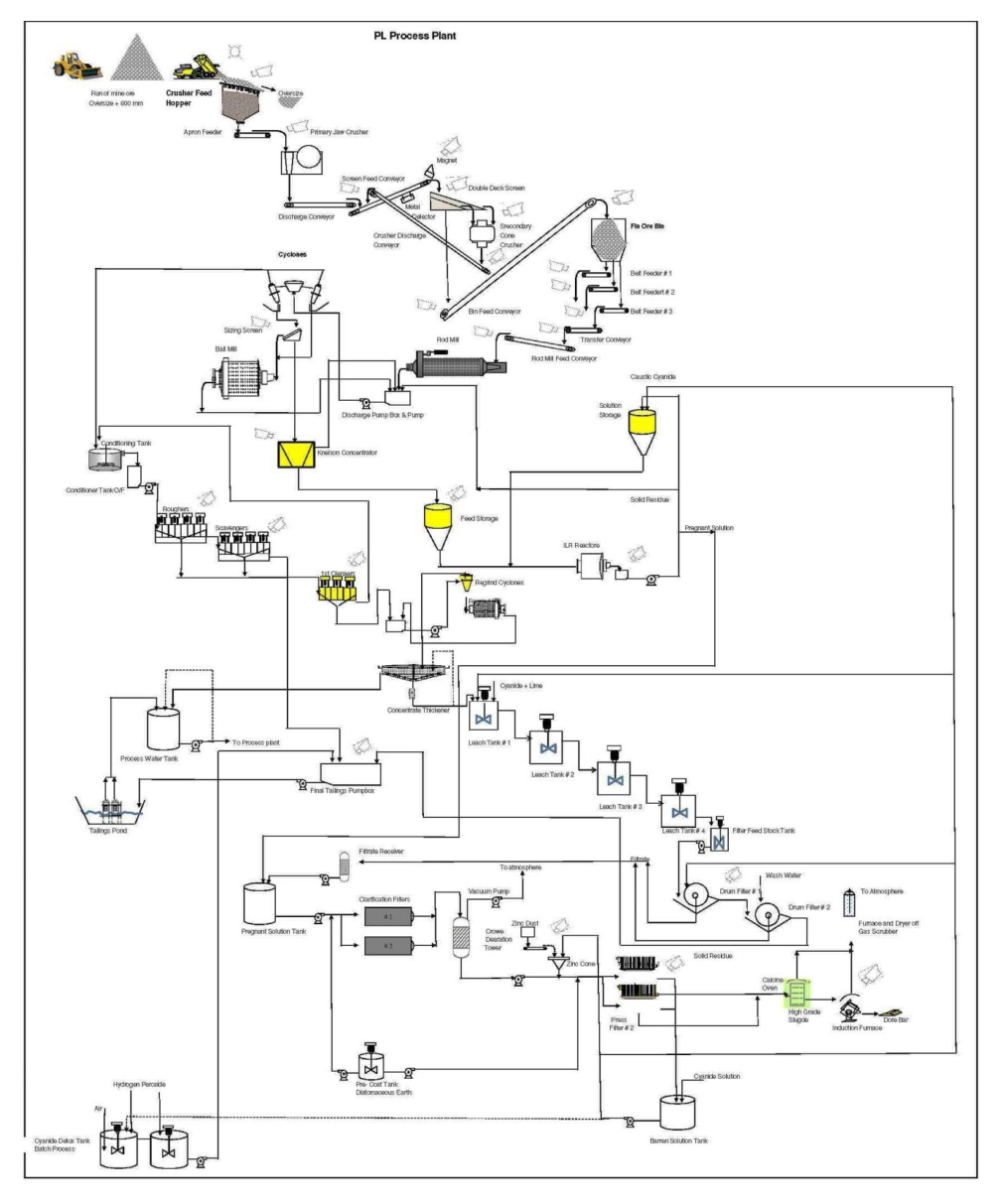
The April 2018 feasibility study for the PL Gold Project, the past-producing Puffy Lake mill, describes jaw and cone crushing, a Knelson and in-line leach reactor, bulk sulphide flotation, a 48 hour four-tank leach and an expected gold recovery of 90%.
The PL Gold Project is in Manitoba, Canada, around the former Puffy Lake mill and the Maverick area. The Feasibility Study, with an effective date of October 31, 2017 and a report date of April 23, 2018, was prepared by A-Z Mining Professionals with EHA Engineering, CSA Global and Blumetrics for Minnova Corp. The past-producing mine had a conventional processing plant comprising crushing, grinding, gravity concentration with a jig, flotation, Merrill-Crowe, leaching and refining for gold recovery to doré bars. The crushing circuit and processing plant buildings and most of the old equipment still exist, though the plant has been vandalized and most large cabling removed. A review of the process flowsheet found that the plant built in the 1980s differed from the design in the 1986 Kilborn Feasibility Study, and that the grinding mills effectively reduce plant capacity to about 750 to 800 tpd.
Critical Data
| Parameter | Value | Unit | Notes |
|---|---|---|---|
| Existing plant capacity | 750 to 800 | tpd | Limited by the grinding mills |
| Target rate for open pit mining | 1,000 | tpd | Needs an additional ball mill |
| Primary crusher product | 120 | mm nominal | Jaw crusher |
| Cone crusher setting | 10 | mm | Closed side setting |
| Crushed product | 13 | mm | Fine ore bin |
| Fine ore bin | 1,500 | t live | Three variable speed feeders |
| Dump hopper | 100 | t | Apron feeder |
| Grinding product | 100 | µm P80 | Rod mill then ball mill |
| Gravity | Knelson concentrator | Not applicable | Concentrate to an in-line leach reactor |
| Flotation product | Bulk sulphide concentrate | Not applicable | Rougher, scavenger and cleaner cells |
| Leach feed density | 50 to 55 | % solids | After thickening |
| Leach | 4 | tanks in series | About 48 hours residence time, oxygen added |
| Drum filters | 2 | in series | Wash the leached pulp |
| Expected gold recovery | 90 | % | Plant availability over 90% |
Overview
Ore from the underground mine goes to a crusher dump hopper, and a primary jaw crusher reduces it to a nominal 120 mm. A cone crusher in closed circuit with a double deck screen takes it to 13 mm for a 1,500 t live fine ore bin. A primary rod mill and secondary ball mill grind it to a P80 of 100 microns, with a Knelson concentrator in the circuit to recover coarse free gold, which is treated in an in-line leach reactor. Rod and ball mills operate in closed circuit with cyclones, and cyclone overflow feeds flotation, made up of rougher, scavenger and cleaner cells. The final flotation concentrate is reground in closed circuit with cyclones, thickened and cyanided in four leach tanks. Scavenger tailings are used as backfill or pumped to the tailing impoundment.
Key Process Stages
Crushing
Run-of-mine ore is dumped on a stationary grizzly with undersize feeding a 100 t dump hopper. A variable speed apron feeder feeds the primary jaw crusher, and crushed ore goes by conveyor to a double deck vibrating screen directly over the short head cone crusher. Bottom deck undersize falls onto the fine ore bin conveyor, and oversize from both decks feeds the cone crusher at a closed side setting of 10 mm, with its discharge combined with the jaw discharge to feed the screen.
Grinding and gravity
Three variable speed belt feeders draw from the fine ore bin onto a rod mill feed conveyor with a weigh scale and ratio-controlled water addition. Rod mill and ball mill discharge operates in closed circuit with a cyclopack of three operating cyclones and one standby. Two cyclone underflows feed the ball mill, and the third feeds a sizing screen for the Knelson concentrator. The Knelson runs for several hours and is then taken off line for several minutes to flush it. Gravity concentrate goes to a holding tank and an in-line leach reactor in batch mode, with leaching times of several hours. The leached solids are washed and returned to grinding, and the leachate goes to Merrill-Crowe.
Flotation and regrind
Cyclone overflow is pH adjusted with lime if required, conditioned with reagents and sent to rougher cells. Rougher and scavenger concentrate feeds the cleaner cells, and scavenger tailings are final tails to the tailings management facility (TMF). Cleaner concentrate goes to a regrind mill in closed circuit with cyclones, and cleaner tails return to the conditioning tank. The reground concentrate is thickened to an underflow density of 50% to 55% solids.
Cyanidation and Merrill-Crowe
Cyanide and lime are added to the first of four leach tanks with the thickened pulp, and oxygen is added to each tank to improve kinetics, for about 48 hours of total residence time. Two drum filters in series wash the discharge with recycled barren solution and then fresh water, and the filtrate goes to the pregnant solution tank. The filter cake is repulped and pumped with the flotation tailings to the TMF. A portion of the barren solution is treated with hydrogen peroxide to destroy residual cyanide and sent to the TMF, to limit buildup of deleterious elements that could slow leaching. Two pressure clarifiers with diatomaceous earth pre-coat clarify the pregnant solution, a Crowe vacuum tower removes air, and zinc dust is added by belt feeder. The precipitate is pressed, air dried, mixed with flux and refined in an induction furnace into doré bars.
Existing plant
AECOM inspected the plant buildings and equipment in late 2011 and estimated the rehabilitation work required. The crusher building and major equipment appear in reasonable condition, though the crusher motors, bearings and belt components need a complete maintenance inspection and the cone crusher lubrication system needs more significant repair. Sump and wet scrubber pumps appear seized, conveyor belting has been removed, and cables from the motor control center have been cut and removed, so rewiring is needed. Instrumentation and programmable logic controllers are to be replaced entirely with new technology in the restart plan.
Additional Interesting Data and Summary
The report notes that past problems with mill recovery and throughput, observed on the mill site assessment and reported in monthly reports, were partly caused by the two grinding mills being identical and adapted to different roles. The additional ball mill needed for 1,000 tpd could potentially be accommodated relatively simply in the existing plant.
Key Processes
- Jaw and cone crushing to 13 mm
- Rod and ball milling with cyclones
- Knelson gravity concentration and in-line leach reactor
- Bulk sulphide rougher, scavenger and cleaner flotation
- Concentrate regrinding and four-tank cyanidation
- Drum filtration and peroxide cyanide destruction
- Merrill-Crowe precipitation and induction furnace refining
Source: Feasibility Study, PL Gold Project, Manitoba, Canada, April 23, 2018.
