

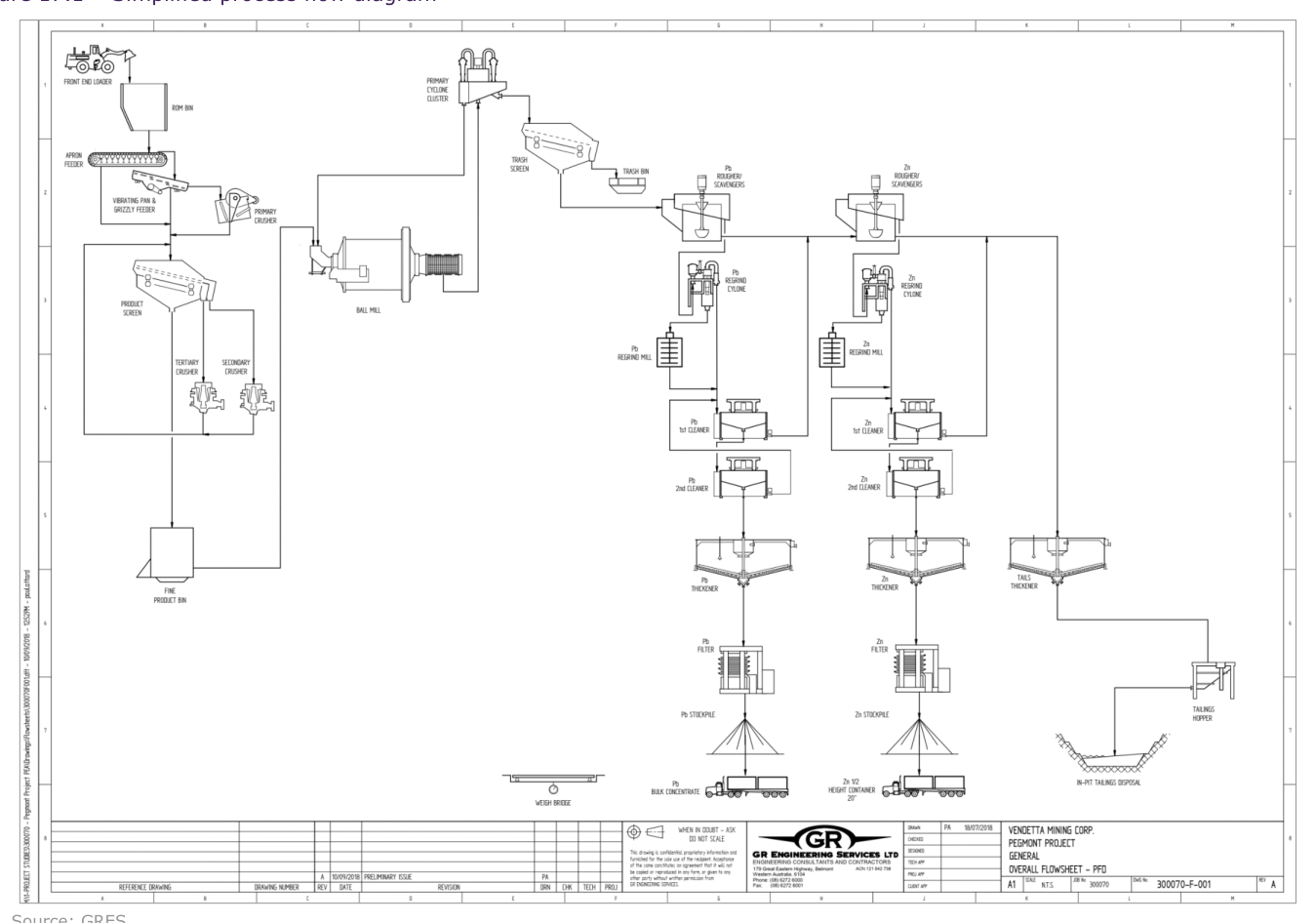
The January 2019 resource update and preliminary economic assessment for the Pegmont deposit describes a 1.1 Mtpa plant, lead concentrate at 69% Pb and zinc concentrate at 54% Zn, and in-pit tailings storage.
Pegmont is a lead-zinc deposit in Queensland, Australia. AMC Mining Consultants prepared the Technical Report on the Pegmont Mineral Resource Update and PEA for Vendetta Mining Corp, with an effective date of 21 January 2019. A conventional sequential flotation circuit was selected to recover the lead and zinc minerals. The process plant consists of conventional three-stage crushing and a single-stage ball mill grinding circuit, followed by differential flotation of lead and zinc to make separate saleable concentrates. The concentrates are thickened and filtered on site for road transport. The plant is designed to treat open pit material from the identified mineralized zones.
Critical Data
| Parameter | Value | Unit | Notes |
|---|---|---|---|
| Annual throughput | 1,100,000 | t/a dry | Design |
| Design feed grades | 8.3 / 3.0 / 10 | % Pb / % Zn / g/t Ag | Design |
| Ore specific gravity | 3.9 | t/m3 | Design |
| Crushing rate | 176 | t/h | 6,570 operating hours |
| Process plant rate | 138 | t/h | 8,059 operating hours |
| Bond rod mill work index | 22 | kWh/t | Benchmark |
| Bond ball mill work index | 20.3 | kWh/t | 85th percentile |
| Primary jaw crusher | 100 | mm CSS | F80 317 mm to P80 120 mm |
| Secondary / tertiary cone CSS | 32 / 14 | mm | Closed circuit with the product screen |
| Ball mill feed | About 10 | mm P80 | Crushed product |
| Ball mill | 5.23 x 6.67 | m diameter x EGL | 3,300 kW, 400 mm hydrocyclones |
| Primary grind | 106 | µm P80 | Up to 300% recirculating load |
| Concentrate regrind | 20 | µm P80 | Stirred media detritor, 355 kW |
| Lead concentrate | 69 / 91 / 70 | % Pb / % Pb recovery / % Ag recovery | Design |
| Zinc concentrate | 54 / 73 / 3 | % Zn / % Zn recovery / % Ag recovery | Design |
| Lead conditioning tank | 25 | m3 | Maximum 5 minutes residence |
| Lead rougher and scavenger cells | 5 | x 30 m3 | About 31 minutes residence |
Overview
Fresh open pit mineralization goes to a run-of-mine (ROM) pad and a three-stage crushing plant that makes a product suited to the single-stage ball mill. The ball mill runs in closed circuit with hydrocyclones to give a P80 of 106 µm. Differential flotation of lead and zinc follows, with rougher concentrate regrind stages in both circuits to make saleable grade concentrates. Tailings are thickened to recover process water and pumped to an in-pit tailings storage facility in a smaller starter pit, with mined-out sections of the main pit used later. The report recommends JKMRC drop weight or SMC comminution tests in the next phase to confirm the comminution approach.
Key Process Stages
Crushing
A front-end loader reclaims open pit material from the ROM stockpile into the ROM bin, and an apron feeder and vibratory grizzly pan feeder remove fines ahead of the primary jaw crusher, which reduces F80 317 mm to P80 120 mm at a closed side setting of 100 mm. A double deck product screen sends top deck oversize to the secondary cone crusher at 32 mm and lower deck material to the tertiary cone crusher at 14 mm, both in closed circuit with the screen. The bottom deck aperture controls the ball mill feed size at a P80 of about 10 mm, and the crushed material goes to a fine product bin.
Grinding
A single-stage ball mill of 5.23 m by 6.67 m EGL with a fixed speed 3,300 kW motor works with a cluster of 400 mm hydrocyclones at up to 300% recirculating load. Overflow goes to the lead flotation conditioning tank and underflow returns to the mill. Lime holds slurry pH at 8.5 to 9.0 before flotation, and sodium monophosphate limits pre-activation of sphalerite before lead flotation.
Lead flotation
Cyclone overflow passes a trash screen into a 25 m3 agitated rougher conditioning tank, and lead roughing and scavenging use two 30 m3 rougher cells and three 30 m3 scavenger cells in series for about 31 minutes of residence. Aerophine 3418A collector goes to the conditioning tank, the rougher and scavenger cells and the cleaners, frother to the rougher feed and cleaner heads, and lime to the conditioning tank and cleaners. Rougher and scavenger concentrate is classified by cyclones and reground to 20 µm in a 355 kW stirred media detritor mill, chosen because its inert media will not promote galvanic interactions with other sulphides. Cleaning uses five 16 m3 cells and recleaning four 4.3 m3 cells, and the recleaner concentrate is the final lead concentrate. Scavenger and cleaner tailings go to zinc flotation.
Zinc flotation
Tailings from lead flotation enter two 25 m3 agitated conditioning tanks, giving 4 minutes each and 8 minutes in total. Lime acts as pH modifier, and copper sulphate activator and SIBX collector are added to the second tank, with frother to the first rougher cell and cleaners. Zinc roughing and scavenging are followed by regrinding of rougher and scavenger concentrate and two stages of cleaning. The zinc concentrate goes to its thickener and final tailings to the tailings thickener.
Concentrate handling and tailings
Lead concentrate travels by road to Glencore's Mt Isa smelter. Zinc concentrate is loaded into sealed half-height containers and goes by road to the rail loading facility at Malbon, where it is stored and railed once a month to the Sun Metals refinery in Townsville, Queensland. Raw water is supplied from the artesian basin through a network of bore-field pumps, combined with water from tailings and concentrate thickeners and return water from the in-pit tailings facilities.
Additional Interesting Data and Summary
Five lead rougher and scavenger cells in series were selected to minimize losses by short circuiting, in an arrangement with pinch valves between groups of cells. The lead cleaner uses a two-bank arrangement of two plus three cells to the same end. Separate lead and zinc flotation water circuits were not considered in the initial design concept.
Flotation laboratory times used in the design were 11 minutes for lead and zinc rougher scavengers, 13 and 8.6 minutes for lead cleaners, and 7.7 and 4 minutes for zinc cleaners.
Key Processes
- Three-stage crushing with a closed circuit product screen
- Single-stage ball milling with hydrocyclones
- Lead rougher, scavenger and two-stage cleaner flotation
- Stirred mill regrinding to 20 µm
- Zinc activation, rougher, scavenger and cleaner flotation
- Thickening and filtration of concentrates
- In-pit tailings storage
Source: Technical Report, Pegmont Mineral Resource Update and PEA, Queensland, Australia, January 21, 2019.
