

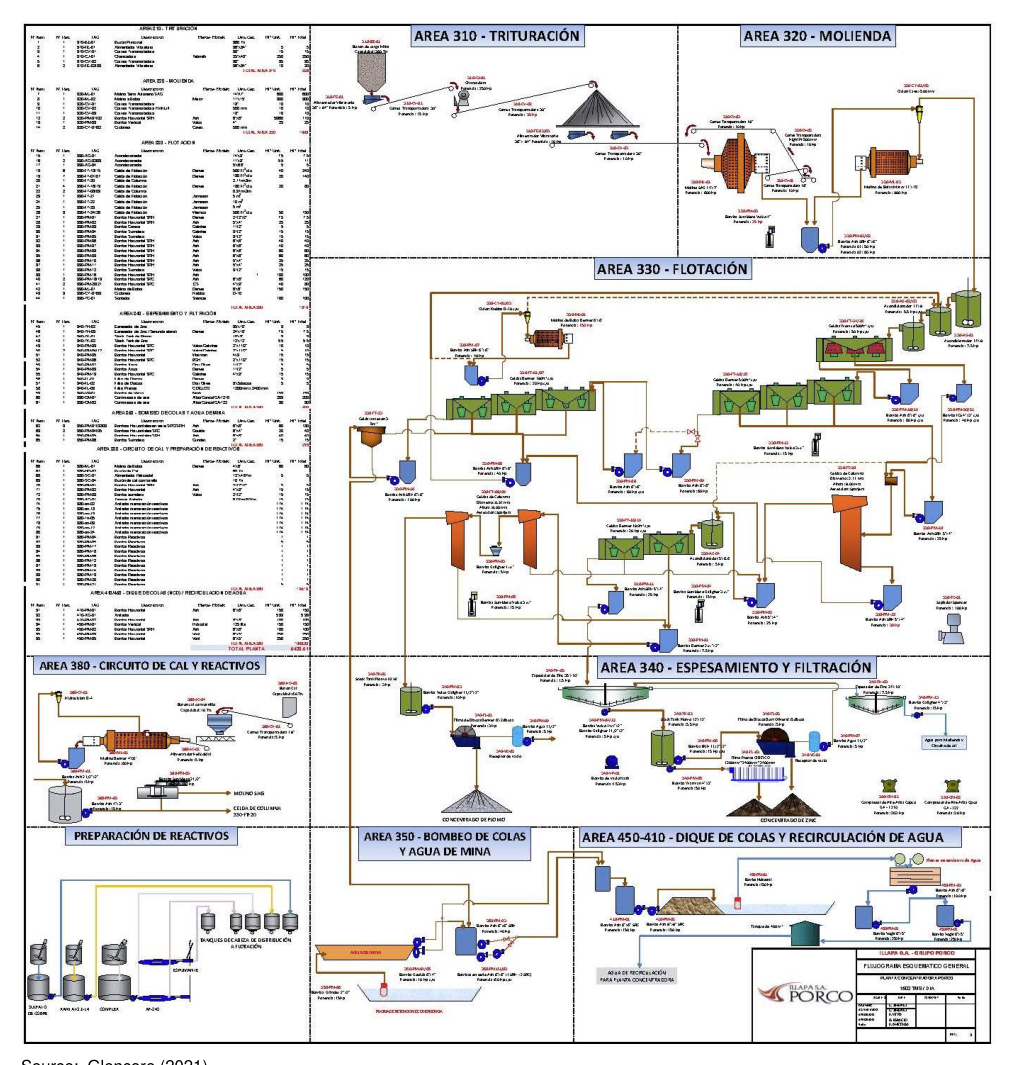
The August 2024 technical report on Santacruz's Porco mining operations describes a mill in production since 1992 that treats 1,200 t/d of company ore or 900 t/d of toll ore and makes bagged lead and bulk zinc concentrates for Glencore.
Porco is a silver-lead-zinc operation in Antonio Quijarro Province, Bolivia, operated by Santacruz Silver Mining Ltd. The NI 43-101 technical report, for what it calls an advanced project, has an effective date of January 1, 2024 and a report date of August 21, 2024. The Porco mill has two sources of feed, company feed and toll feed, and has been in production since 1992. It processes the two feeds separately, generally on different days, though on a few days both are processed with a shutdown in between to separate them. The mill uses a crushing, grinding and flotation flowsheet to recover a lead concentrate and a zinc concentrate. Both are sold to Glencore and shipped overseas through Antofagasta, Chile.
Critical Data
| Parameter | Value | Unit | Notes |
|---|---|---|---|
| Company feed capacity | 1,200 | t/d | Design |
| Toll feed capacity | 900 | t/d | Design |
| Jaw crusher | 25 x 40 | in | Telesmith |
| SAG mill | 14 ft x 7 ft EGL | Not applicable | With trommel |
| Ball mill | 11 ft x 15 ft EGL | Not applicable | CAVEX 500 mm cyclones |
| Flotation feed size | 100 | µm P80 | Cyclone overflow |
| Bulk rougher cells | 3 + 6 | x 500 ft3 | Wemco then Denver |
| Scavenger cells | 7 + 1 | 180 ft3 Denver + 5 m3 Jameson | Final tailings |
| Bulk cleaner | 1 | column, 2.11 m x 8 m | Single stage |
| Regrind mill | 6 ft x 6 ft EGL | Denver | Three Krebs D-10 cyclones |
| Differential cleaner columns | 2 | 0.91 m x 8 m | Plus four 180 ft3 first cleaner cells |
| Zinc thickener | 35 | ft diameter | Zinc concentrate |
| Tailings dams | 9 | Not applicable | One operating, eight decommissioned |
Overview
The plant flowsheet is a typical differential flotation circuit to produce lead and zinc concentrates. Ore is crushed, ground in a SAG and ball mill combination, and floated to a bulk lead-zinc concentrate. The bulk concentrate is cleaned and the lead is floated off while the zinc is depressed. Tailings from lead cleaning become the zinc concentrate. Both concentrates are filtered for shipping to the smelter. The lead concentrate is bagged, as required by Bolivian law, and the zinc concentrate is shipped in bulk in trucks.
Key Process Stages
Feed sampling
Feed grades for company feed are measured by sampling at the cyclone overflow and reconciling each month against concentrate produced and tailings samples. Toll ore comes in lots often of one to two tonnes and is weighed and sampled when received at San Lucas. It is combined on a toll feed stockpile, and follows the same sampling and reconciliation procedure.
Crushing and grinding
Haul trucks dump into the crushing feed bin, a vibrating grizzly feeder feeds a 25 inch by 40 inch Telesmith jaw crusher, and the discharge goes to the mill feed stockpile. An underground vibratory feeder reclaims the stockpile to a 14 ft by 7 ft EGL SAG mill whose trommel returns oversize. Fines are pumped to a cyclone pack of CAVEX 500 mm cyclones. The undersize goes to an 11 ft by 15 ft EGL ball mill, and cyclone overflow targets 100 µm P80 for flotation.
Bulk flotation
The grinding product goes to three conditioning tanks that receive frother, Aerophine 3418A, Aerofloat 242, copper sulphate and sodium isopropyl xanthate. Rougher flotation uses three 500 ft3 Wemco cells and six 500 ft3 Denver cells, with rougher tailings scavenged in seven 180 ft3 Denver cells and a single 5 m3 Jameson cell. Scavenger tailings go to the final tailings pumpbox, and scavenger concentrate returns to the bulk feed, optionally through a regrind circuit with a 6 ft Denver ball mill in closed circuit with three Krebs D-10 cyclones. A single column cleans the bulk rougher concentrate, its tails return to the second conditioning tank and its concentrate goes to differential flotation.
Differential flotation
A conditioning tank adds cyanide and zinc sulphate to depress zinc. Four 180 ft3 first cleaner Denver cells follow, whose tailings go to the zinc concentrate thickener. Concentrate from the first two cells goes to a second cleaner column, and concentrate from the other two returns to the conditioner. The second cleaner column concentrate goes to a third cleaner column, the final stage, whose concentrate is the final lead concentrate. Its tailings return to the second column feed.
Concentrate dewatering
Lead concentrate goes to a 10 ft by 8 ft filter stock tank and a 6 ft disc filter with two discs, and the filtered concentrate is bagged. Zinc concentrate goes to a 35 ft thickener and a 12 ft by 12 ft filter feed tank, and is filtered on either a pressure filter or an 8 ft disc filter with five discs. Trucks carry the products to a train loading facility about 10 km from the mine.
Tailings
Porco has nine tailings dams, eight of which are decommissioned. The operating dam received a capacity increase in January and was designed to hold production through the end of 2023. The dams are inspected and maintained to the Canadian Dam Association guidelines, under the supervision of engineers from Wood, with a recent external audit by Knight Piésold.
Additional Interesting Data and Summary
The infrastructure comprises both mine portals, the processing plant and support services such as offices, maintenance facilities, surface stockpiles, warehousing, a dining hall, a first aid station and fuel storage. The report states that this infrastructure is sufficient to meet the needs of the mine and processing plant.
The reagents are generally the same for toll and company ores, and the flotation columns are used to clean both bulk and differential concentrates.
Key Processes
- Jaw crushing and stockpiling
- SAG and ball milling with cyclone classification
- Bulk lead-zinc rougher and scavenger flotation with column cleaning
- Differential flotation with zinc depression
- Disc filtration of lead concentrate with bagging
- Thickening and filtration of zinc concentrate
- Tailings storage in an engineered dam
Source: NI 43-101 Technical Report for the Advanced Project, Porco Mining Operations, Antonio Quijarro Province, Bolivia, August 21, 2024.
Project website: Porco Mining Operations
