

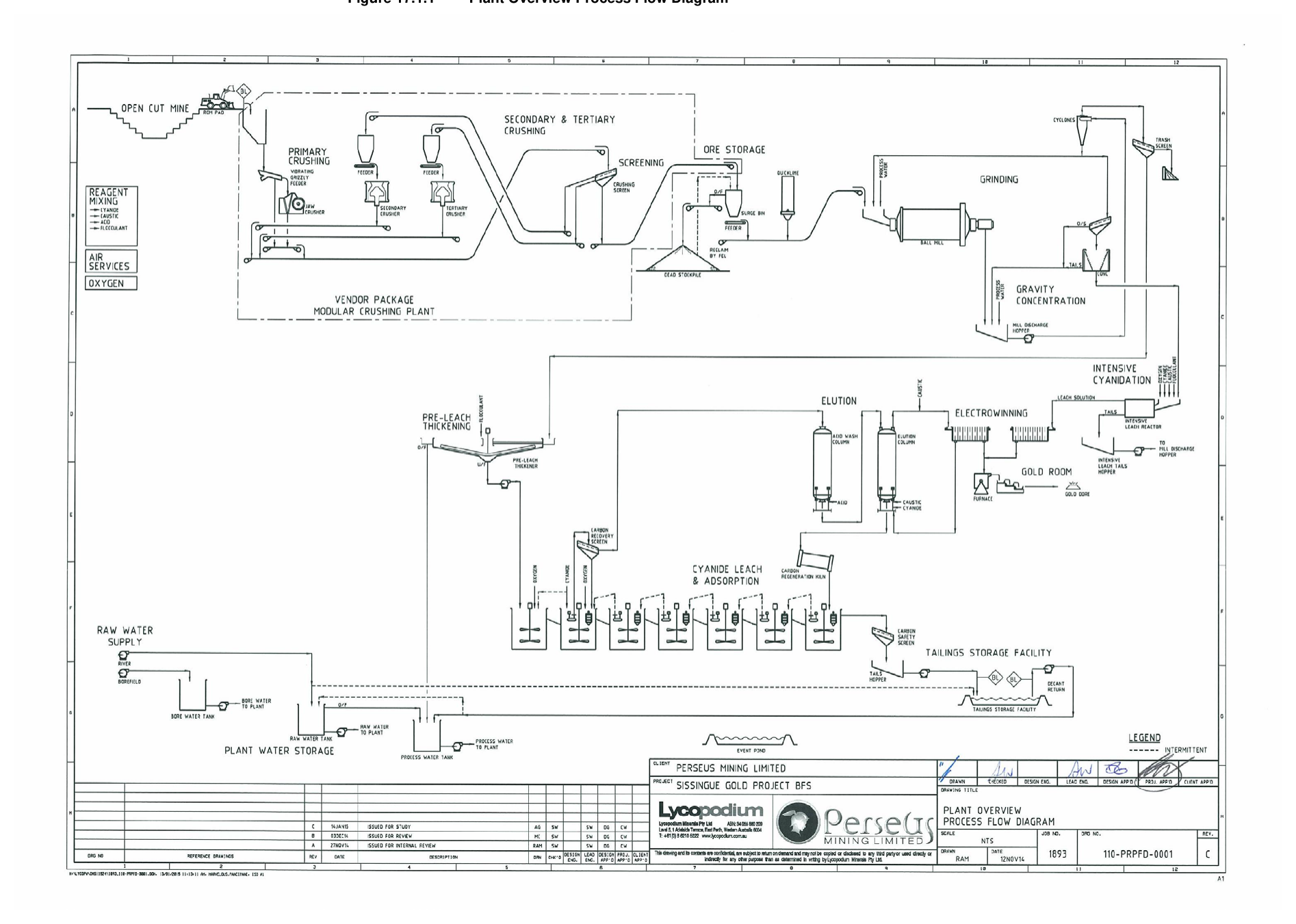
Perseus Mining's May 2015 NI 43-101 report on the Sissingué gold project describes a hybrid comminution circuit, gravity concentration with intensive cyanidation, pre-oxidation and six CIL tanks, and a four tonne Zadra elution circuit.
Sissingué is a gold project in northern Côte d'Ivoire, adjacent to the Mali border, with Korhogo, the principal regional centre, about 150 km to the south-east. Perseus Mining Limited commissioned the National Instrument 43-101 technical report, whose recovery methods chapter was prepared by Lycopodium Minerals and is dated May 2015. The proposed process plant design is based on a robust metallurgical flowsheet built from proven unit operations, with optimum recovery at minimum operating cost. The plant will process a range of ore types, namely oxide, transition and primary porphyry, granite and sediment ores. The primary ores are significantly more competent than the oxide ores and need a longer leach time to optimize gold recovery.
Critical Data
| Parameter | Value | Unit | Notes |
|---|---|---|---|
| Oxide ore rate | Up to 1.2 | Mt/y | Two-stage crushing, SAG mill |
| Primary ore rate | 1.0 | Mt/y | Three-stage crushing, SAG converted to ball mill |
| Primary blend design | 800,000 | t/y | 78% granite/porphyry, 22% sediment |
| Crushing availability | 70 | % | Mechanical |
| Plant availability | 91.3 | % | Remainder of the plant |
| Oxide crushing product | 50 | mm P100 | Open primary, closed secondary |
| Primary ore crushing product | 14 | mm P100 | Three stages |
| Surge bin | 100 | t | Nominal |
| Grind size | 106 | µm P80 | Both ore types |
| Selected mill power | 2,500 | kW | Grate discharge SAG, 4.80 m x 6.80 m EGL |
| Conversion mill | 4.8 x 7.10 | m EGL | Overflow ball mill |
| Sediment ore capability | 0.92 | Mt/y | At 2,500 kW |
| CIL tanks | 6 | Not applicable | Plus one leach or pre-oxidation tank |
| Elution | 4 | t pressure Zadra | Electrowinning and smelting |
Overview
The Sissingué mine schedule produces mostly oxide and transition ore in the first 12 months and again for five months in year 3, and the proportion of primary ore then rises quickly. The plant is therefore designed to be reconfigured. Oxide ore is crushed in two stages and ground in a single-stage SAG mill in closed circuit with hydrocyclones. Primary ore is crushed in three stages and ground in the same mill converted to a ball mill. Both circuits include gravity concentration with intensive cyanidation, a pre-leach thickener, leach and carbon-in-leach (CIL) tanks, elution, electrowinning and smelting, and tailings pumping to a tailings storage facility.
Key Process Stages
Selecting the comminution circuit
After considering three configurations, the report selected a hybrid circuit that can handle both the low competency, possibly wet and sticky oxide ores and the competent primary ores. Orway Mineral Consultants evaluated four options at a target grind of 106 µm. A 5.50 m by 9.15 m SAG mill with a 4,500 kW motor, already available to Perseus in storage, was judged unsuitable. On oxide ore it was too large and would overgrind, and on competent sediment ore it was too small in diameter to generate enough impact breakage. A SAG mill of 4.80 m by 6.80 m with a 2,500 kW motor suits oxide ore but would be less efficient on primary ore. A three-stage crushing and ball mill option suits primary ore but would be hard to operate on oxide ore, with handling problems and overgrinding. The fourth option, a two-stage crushing SAG circuit later converted to three-stage crushing with an overflow ball mill of 4.8 m by 7.10 m EGL, combines the operability on oxide with the energy savings on primary ore.
Crushing and stockpiles
A ROM pad buffers mine and plant, with a mobile rock breaker for oversize. Oxide ore is crushed in open circuit primary and closed circuit secondary stages to 50 mm P100. Primary ore adds a tertiary stage to give 14 mm P100. A 100 t surge bin overflow goes to a dead stockpile that a front-end loader reclaims when the crushing circuit is off-line.
Grinding, gravity and thickening
Both circuits grind to 106 µm P80 with hydrocyclones. The mill is oversized so grinding does not limit throughput on the most competent primary ores, and OMC recommended high capacity pulp lifters, a grate design with over 8% open area and a variable speed drive. The planned primary rate is faster than the 0.8 Mt/y design, with granite at about 1.0 Mt/y and sediment at 0.9 Mt/y, and leach feed density will be raised to compensate. A gravity circuit removes coarse gold from the recirculating load, and the concentrate is treated by intensive cyanidation and electrowinning to doré. A pre-leach thickener raises density to the CIL circuit to minimize tankage and reagent use.
Leach and CIL
For oxide ore, the initial circuit has one leach tank and six CIL tanks. For primary ore it becomes a pre-oxidation tank with oxygen addition to cut leach oxygen needs and cyanide consumption, followed by six CIL tanks. Cyanide can be added to the first tank if needed.
Elution and tailings
A four tonne pressure Zadra elution circuit, electrowinning and smelting recover gold from loaded carbon as doré. Tailings are pumped to the tailings storage facility.
Additional Interesting Data and Summary
The design document used metallurgical test work and comminution circuit modelling. The ore properties differ sharply: primary sediment ore has higher competency, resistance to impact breakage and grinding energy requirement than granite and porphyry ore. A simple primary crushing and SAG circuit is unlikely to suit sediment ore, and some pre-crushing will be required.
Equipment is selected for suitability for duty and for the initial short mine life, without compromising reliability or ease of maintenance. The layout gives easy access to equipment while keeping a compact footprint to reduce construction cost.
Key Processes
- Two-stage crushing of oxide ore and three-stage crushing of primary ore
- SAG milling reconfigured as ball milling
- Hydrocyclone classification at 106 µm P80
- Gravity concentration with intensive cyanidation
- Pre-leach thickening and six-tank carbon in leach
- Pre-oxidation with oxygen for primary ore
- Pressure Zadra elution, electrowinning and smelting
Source: Sissingué Gold Project, Côte d'Ivoire, National Instrument 43-101 Technical Report, May 2015.
Project website: Sissingué Gold Project
