

This technical report summarizes the processing testwork and design basis for the Hopes Advance iron ore project.
Report context
The Preliminary Economic Assessment (PEA) for the Re-scoped Hopes Advance Property, dated January 2020, was prepared for Oceanic Iron Ore Corporation in accordance with NI 43-101 standards. The report describes recovery methods, process design, and testwork results for the proposed concentrator.
Processing route
Comminution circuit
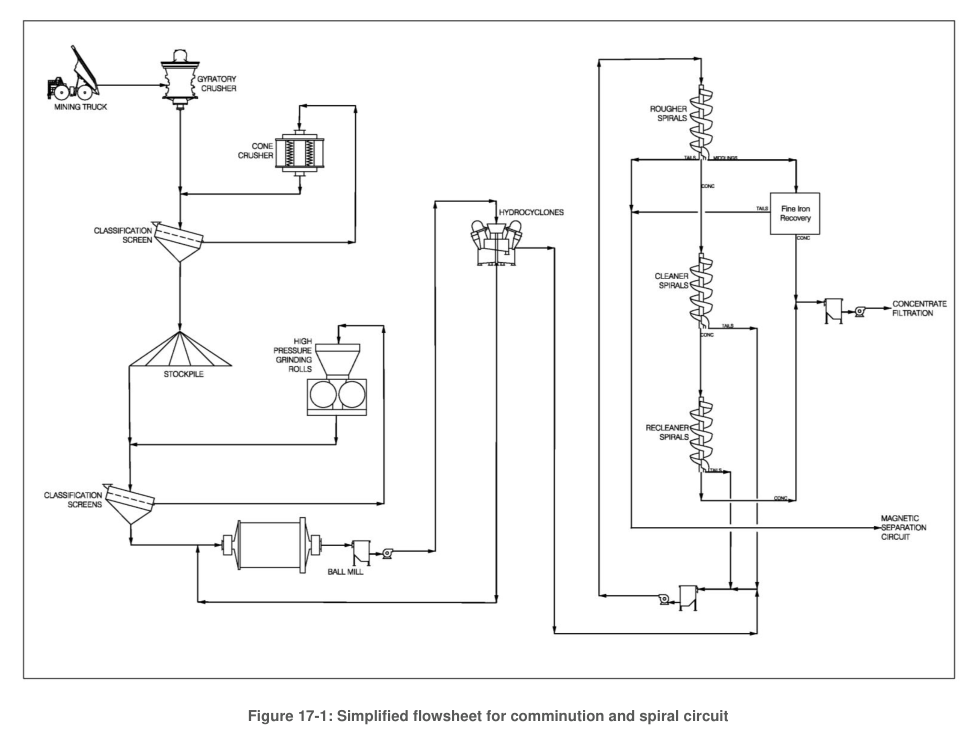
The current PEA is based on primary and secondary crushing with screening, stockpiling, HPGR crushing with screening, and ball milling to mill a constant ROM throughput. This uses the installed capacity of the comminution circuit to produce varying annual amounts of concentrate based on the head grade and weight recovery from the mine plan.
Although there are some disadvantages to HPGR based comminution circuits, the report notes that with the scale of the project and the high cost for producing self-generated electric power, HPGR technology is worth considering. The testwork demonstrated that significant energy savings can be achieved on grinding (excluding added energy requirements for conveying and screening). During scale-up from bench-scale to industrial scale units, HPGR specific energy is reduced due to the roll edge effect having less of an impact.
One of the arguments against using HPGR technology was that the process would generate more fines, resulting in more hematite losses in the gravity circuit (negligible impact on magnetite losses as these would be recovered in the magnetic separation plant). To minimize excessive fines generation, proper equipment and circuit design will need to be incorporated in the next study phase. Also, technologies such as hindered settlers and Reflux Classifiers can be used to replace or complement spirals in the gravity circuit to improve fine iron recovery. In this study, the HPGR and ball mill circuits were designed as to minimize fines creation in order to mitigate potential hematite losses.
Concerning the notion of the high abrasive index of the mineral resulting in faster HPGR roll wear, the report states there would also be higher grinding media and liner consumption in the SAG mill circuit due to the high abrasiveness of the mineral. This may offset the higher costs in the HPGR circuit. The impact of higher wear on roller life has been taken into consideration by assuming a conservative roller life. Mill availability had been assumed to be 90% to account for any additional downtime for roller changes. The HPGR based circuit will require more material handling infrastructure and some added labour, which will be part of the overall project design.
Gravity and magnetic concentration
The testwork showed that a final concentrate grade of 66.6% Fe and 4.5% SiO2 could be achieved via milling, gravity recovery and magnetic recovery. To obtain the aforementioned grade, the ROM material needs to be ground to a P80 of at least 140 µm for hematite liberation and a P80 of 29 µm for magnetite liberation.
Based on the average life-of-mine (LOM) head grade of 32.3% Fe, the gravity concentration spiral circuit would have a weight recovery of 31.6% or 84% of total concentrate produced. The gravity concentration circuit tails were then fed to the Cobber Magnetic Separator circuit. The product from the Cobber circuit, which represents only 13.0% of mill feed, was ground to a P80 of approximately 29 µm. The material was then fed to the Low Intensity Magnetic Separation (LIMS) circuit to recover the liberated magnetite. The LIMS circuit produced a further 6.0% of weight recovery (in relation to plant feed) or 16% of total concentrate produced. In the pilot campaign, the total weight recovery to the final concentrate was 37.6% of mill feed.
Deposit lithologies and recovery equations
Chapter 10 and Chapter 11 of the report show that each deposit can contain up to four different lithologies of mineralized, iron oxide bearing materials. These are referred to as: 4m, 4mh, 4hm and 4h, where ‘m’ represents magnetite and ‘h’ represents hematite. Each has varying amounts of magnetite to hematite, 4m being the highest in magnetite content and the lowest in hematite while 4h is the highest in hematite content and the lowest in magnetite. Each deposit can have varying amounts, thicknesses or proportions of the above-mentioned lithologies. As a result, the mine plan will deliver these lithologies at different rates and proportions depending on the deposit and the area of the pit being mined.
From the testwork performed, recovery equations were developed for each deposit using results from the bench-scale tests. The resulting equations are as follows:
- Castle Mountain / Iron Valley: Dry wt Rec = (1.3383*Head Fe) – 4.3905 – 1.23
- All Bay Zones: Dry wt Rec = (1.2935*Head Fe) – 2.8375 – 1.23
These equations provide a general correlation between the dry concentrate weight recovery and the head grade based on testwork results. The average weight recovery of the concentrate from the bench tests has been reduced by 1.23% to represent the recovery to be expected when scaling from bench-scale tests to industrial scale processing.
Power generation and concentrate transport
The current PEA is based on a project with an initial phase having a capacity to produce a nominal 5 Mtpa followed by an expansion to 10 Mtpa of dry concentrate. Electric power for both phases will be self-generated using diesel power generation, thus optimizing energy efficiency, which is an important design consideration. Filtered concentrate from the concentrator will be trucked year-round to the port stockyard, therefore avoiding the need to regrind gravity concentrate and pump by pipeline to the port. Concentrate from the port stockpile will be loaded in ships and transported to clients only during the summer months, thus avoiding environmental impacts, marine infrastructure and costs for transhipment that would be associated with year-round shipping.
Key reported parameters
| Parameter | Value | Basis |
|---|---|---|
| Final concentrate grade | 66.6% Fe, 4.5% SiO2 | Testwork achieved |
| ROM grinding target (hematite liberation) | P80 of at least 140 µm | Design requirement |
| ROM grinding target (magnetite liberation) | P80 of 29 µm | Design requirement |
| Average LOM head grade | 32.3% Fe | Estimate |
| Gravity circuit weight recovery | 31.6% of mill feed (84% of total concentrate) | Estimated based on average head grade |
| Cobber circuit product weight | 13.0% of mill feed | Testwork result |
| LIMS circuit weight recovery | 6.0% of mill feed (16% of total concentrate) | Testwork result |
| Total weight recovery to final concentrate | 37.6% of mill feed | Pilot campaign result |
| Initial phase concentrate capacity | Nominal 5 Mtpa dry concentrate | Proposed design |
| Expanded phase concentrate capacity | 10 Mtpa dry concentrate | Proposed design |
| Mill availability | 90% | Assumption |
Project website: https://www.oceanicironore.com/
Technical qualifications
BBA’s experience with similar deposits in the Labrador Trough shows that the different lithologies, even between adjacent deposits, can vary in hardness (hence grindability), in weight recovery between gravity and magnetic separation, and at times in liberation size. For this reason, in the next study phases of the Hopes Advance project, it will be important to analyze the testwork, not only by deposit, but also by lithology. Weight recovery equations should be developed by deposit and lithology for each deposit. The equations should take into account the potential variability in recovery based not only on the total iron head grade but also in the recovery per unit of Satmagan in the magnetic circuit.
Furthermore, the geological interpretation clearly shows how the various lithologies manifest themselves within each deposit; however, the lithologies are not coded into the block model used for mine planning. This should also be done for the next study phase.
Design of the concentrator and concentrate stockpiling at the port will be based on operations at a level of detail consistent with a PEA; the report notes that the current study is preliminary in nature.
Source: NI 43-101 Technical Report, Preliminary Economic Assessment, Re-scoped Hopes Advance Property, Oceanic Iron Ore Corporation, January 2020. Relevant sections: Recovery Methods, Process Design Basis, and supporting chapters as referenced.
