

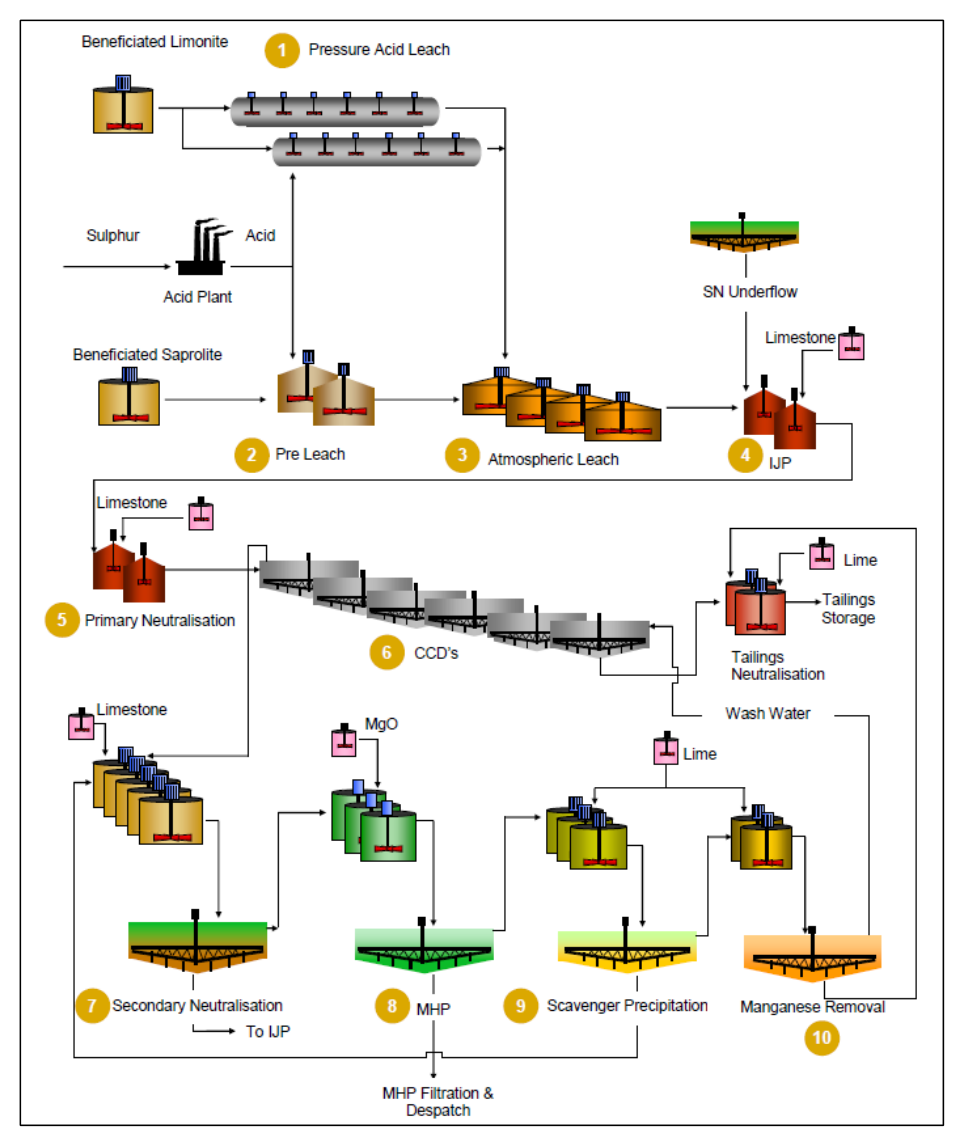
First Quantum's March 2022 technical report on Ravensthorpe in Western Australia describes scrubbing and screening, two titanium-lined autoclaves, jarosite and neutralisation steps, six-stage CCD and magnesia precipitation of a nickel-cobalt product.
Ravensthorpe Nickel Operations (RNO) is a nickel laterite operation in Western Australia, run by First Quantum Minerals Ltd (FQM). The NI 43-101 technical report, dated March 28, 2022, has an effective date of December 31, 2021 and updates the mineral resource and reserve estimates. FQM bought RNO in February 2010 as a decommissioned operation and restarted mining and processing in late 2011 after a refit costing about US$550 million. FQM placed the operation on care and maintenance in August 2017 because of low nickel prices, announced a restart in July 2019, restarted mining in February 2020 and the processing plant in April 2020. Processing at RNO involves four stages: beneficiation, hydrometallurgical extraction by high pressure acid leach (HPAL) and atmospheric leach (AL), impurity removal, and precipitation of nickel and cobalt as a mixed hydroxide product (MHP).
Critical Data
| Parameter | Value | Unit | Notes |
|---|---|---|---|
| ROM particle size | Under 1,000 | mm | Both ore streams |
| Crushed product | Nominal under 100 | mm | Jaw crusher and mineral sizers |
| Crushing plants | 3 | Not applicable | Two at Halleys/Hale-Bopp, one at Shoemaker-Levy |
| Overland conveyor | 10 | km | Shoemaker-Levy to the plant |
| Stockpile capacity | About 3 | days | Plus 7 days emergency feed |
| Beneficiation mass rejection | 60 to 70 | % | Nickel recovery 60 to 65% |
| Nickel grade increase | About 200 | % | Beneficiated product |
| Buffer ponds | About 2 | weeks | Beneficiated product storage |
| HPAL trains | 2 | Not applicable | Six-compartment titanium-lined autoclaves |
| Autoclave conditions | 250 / 4,500 | °C / kPa | Preheated to about 190 °C |
| Pre-leach temperature | About 95 | °C | Saprolite, atmospheric |
| AL reactors | 3 | Not applicable | Brick lined, 95 to 100 °C |
| Primary neutralisation pH | 2.0 to 2.5 | pH | 1.5 hours |
| CCD thickeners | 6 | x 42 m | Counter-current |
| Sulphur consumption | 1,500 | tpd | About 4,400 tpd of acid |
| Average nickel output | 30.0 / 28 | ktpa | First five years / thereafter |
Overview
Limonite and saprolite ores are identified in grade control and mined separately for processing in separate beneficiation plants. The beneficiated limonite goes to HPAL, and the beneficiated saprolite goes through a pre-leach and an atmospheric leach. The two streams are combined, impurities are removed in stages, and nickel and cobalt are precipitated with magnesium oxide as MHP, which is bagged in 1.1 t bulk bags and containerised for export.
Key Process Stages
Crushing and stockpiling
Each ROM stream is crushed by a jaw crusher and duplicate mineral sizers to a nominal minus 100 mm, then sent to its own reclaim stockpile. Rotary bucket wheel reclaimers recover ore from the stockpiles and act as blending tools by taking cuts from the full 360° circumference around the rill tower. A single 10 km overland conveyor links the Shoemaker-Levy mine to the plant.
Beneficiation
Beneficiation is designed to reject the barren siliceous coarse fractions. Each feed goes to a drum scrubber that breaks up agglomerates and scrubs mineralisation from siliceous gangue, then a combination of screening and hydraulic classification with cyclones and screw classifiers. Nickel and cobalt concentrate in the minus 100 micron fraction, and the plus 100 micron material is discarded to a reject stream trucked to a dump. Surplus product goes to two buffer ponds, reclaimed by floating dredges and rethickened before the leach circuits.
Leaching
Thickened beneficiated limonite is leached in two parallel HPAL trains. Each is a continuous six-compartment, titanium-lined horizontal autoclave at 250 °C and 4,500 kPa. Slurry is preheated to about 190 °C in three stages of counter-current heating using heat from the pressure let-down system, and sulphuric acid is injected into the first two compartments. Saprolite slurry is mixed with sulphuric acid and leached at atmospheric pressure at about 95 °C in a pre-leach stage. HPAL and pre-leach streams combine in the AL stage, three brick-lined reactors at 95 to 100 °C. Below 30 g/L H2SO4, iron precipitates as sodium jarosite, which releases acid and keeps leaching.
Impurity removal
Induced jarosite precipitation removes excess ferric iron under hot, mildly acidic conditions using recycled alkaline residue and ground limestone slurry, holding acid at 5 to 10 g/L and the temperature above 95 °C. Primary neutralisation raises the pH to 2.0 to 2.5 with limestone slurry to precipitate most remaining iron plus some aluminium and chromium. Six 42 m CCD thickeners then separate leach liquor from barren residues, with manganese removal overflow as wash liquor. Secondary neutralisation oxidises ferrous iron with air and precipitates it with limestone.
Mixed hydroxide precipitation and manganese removal
Magnesium oxide powder precipitates most of the nickel and cobalt as MHP in three reactors. About 5% of nickel and cobalt stay in the thickener overflow, which is deliberate for impurity control, mainly manganese, and is treated in scavenger precipitation with slaked lime. Manganese is then precipitated using slaked lime and air in two tanks. MHP is washed on a horizontal belt filter, repulped and filtered on a pressure filter with a clean water wash.
Additional Interesting Data and Summary
Sulphur is imported by bulk ship, stored in a 100,000 t shed at Esperance and trucked to site by road train, where it is melted. About 6 days of molten sulphur and acid storage is held. Limestone comes from the Tamarine quarry and is crushed in a jaw and cone circuit and ground in two ball mills. Magnesia arrives as bulk powder from a third party supplier in Eastern Australia. The tailings go to a tailings storage facility by two pipelines.
Key Processes
- Jaw crushing and mineral sizing of limonite and saprolite
- Drum scrubbing, screening and cyclone beneficiation
- High pressure acid leach of limonite in titanium-lined autoclaves
- Atmospheric acid leach of saprolite
- Jarosite precipitation and limestone neutralisation
- Six-stage counter-current decantation
- Magnesia precipitation of mixed nickel-cobalt hydroxide
- Scavenger precipitation and manganese removal
Source: Ravensthorpe Nickel Operations, Western Australia, NI 43-101 Technical Report, March 28, 2022.
Project website: Ravensthorpe Nickel Operations
